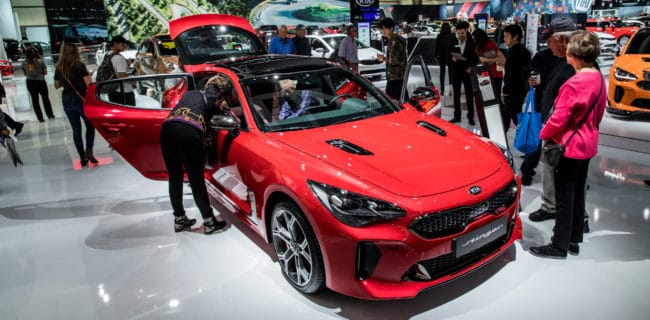
The LA Auto Show kicks off the auto season in North America. The show is filled with glitz, glamour, and nearly 60 world and North American vehicle debuts. It’s the show to watch for the latest trends in the auto industry — everything from the greenest cars to the most innovative connectivity features to the latest autonomous driving technology coming to the market.
Going green was a major theme at this year’s auto show. As part of BMW’s commitment to roll out 25 electric and hybrid-electric vehicles by 2025, the German automaker unveiled several green vehicles in LA including the 2019 BMW i8 Roadster, a two-seater plug-in hybrid convertible.
The soft-top roadster has a gas engine driving the rear wheels and an electric motor powering the front wheels. You can drive solely on the electric power for about 30 kms before it switches over to the gas engine — a feature designed to reduce range anxiety over a pure electric vehicle.
There’s no need to sacrifice performance either — the roadster can hit 0 to 100 km/hr in 4.4 seconds, yet it’s still environmentally friendly.
But it’s not only luxury automakers jumping on the green bandwagon — more affordable nameplates like Kia are getting in on the action. The South Korean automaker showed off its 2019 Niro plug-in hybrid (PHEV) — Kia’s third plug-in model. The Niro PHEV is part of Kia’s strategy to triple its lineup of alternative fuel vehicles by 2020. The new model has a range of more than 900 kms with the electric motor and gas engine combined — about 41 kms on the electric power alone. The charging time has improved, too. The battery can be fully charged in 2.5 hours using a 240V (Level 2) charger or under nine hours via a 120V (Level 1) charger.
With SUVs outselling passenger cars, who can blame manufacturers for bringing more money-making SUVs to the market. Many CUVs and SUVs debuted in LA including a funky little compact crossover from Nissan called the Kicks.
Positioned below the new Nissan Qashqai in size and price, Kicks is targeted to urban dwellers, particularly singles and young couples who are looking for affordable wheels with a bit of attitude. “The Nissan Kicks is the newest addition to our family. We now have 6 crossovers in our lineup starting with the Kicks, Qashqai, Rogue, Murano, Pathfinder, and Armada,” boasts Joni Paiva, president of Nissan Canada Inc., after the North American debut of the Kicks.
Expect to see more automated driving technology as well as fuel-efficient green cars coming to the major auto shows across North America
in 2018.
On the opposite side of the spectrum were SUVs with three rows of seats — a hot trend at the show. Subaru’s largest family member is the all-new Ascent midsize SUV.
Geared to growing, active families, it seats up to seven passengers in three rows. It will be built on Subaru’s global platform and American-made at its plant in LaFayette, Indiana.
From Toyota’s luxury arm came the new, longer Lexus RX “L” models, which include the 2018 RX 350L and the RX 450hL hybrid. With seven-passenger seating, it has numerous standard features including power folding third-row seats, AWD and a hands-free tailgate for easy access to the cargo area.
And the North America debut of the refreshed 2019 Kia Sorento 3-rowed SUV adds a number of cool connectivity features — another big trend in LA.
The Sorento gets Kia’s new UVO Intelligence embedded telematics system, which makes it easier to connect your SUV — the navigation, diagnostics, entertainment, and convenience features — to your Smartphone with a handy, little app. “You can use your phone to start the vehicle from inside your house so in the wintertime you can warm up the car or if it’s the summertime you can cool it down. You can control the climate along with starting and stopping your vehicle, and unlocking or locking the doors,” said Steve Carter, Director of Marketing at Kia Canada Inc.
On the road to autonomous driving, Audi’s flagship A8 sedan featured its new Traffic Jam Pilot system, specifically developed for Level 3 automated driving.
The AI system takes control of driving in traffic jams while traveling at speeds less than 60 km/hr. A slew of hardware — including 12 ultrasonic sensors, four mid-radar sensors, a long-range radar sensor, and four 360 degree cameras — all work together to pilot the vehicle, freeing the driver to do other tasks. When it’s time to take control of the wheel, the system alerts the driver. This is the future of driving.
Expect to see more automated driving technology as well as fuel-efficient green cars coming to the major auto shows across North America in 2018.