Employment across Canada’s automotive sector weakened in early 2026, according to new industry data released by DesRosiers Automotive Consultants.
Total automotive-related employment reached 578,900 workers in February, down 0.8 per cent from the same month last year. The sector had already shown signs of softening at the end of 2025, with December employment slightly below year-earlier levels. Results varied across industries.
“Employment figures saw growth in 2023 and 2024 but have begun to see some pullback as we move through 2026,” said Andrew King, Managing Partner at DAC, in a statement.
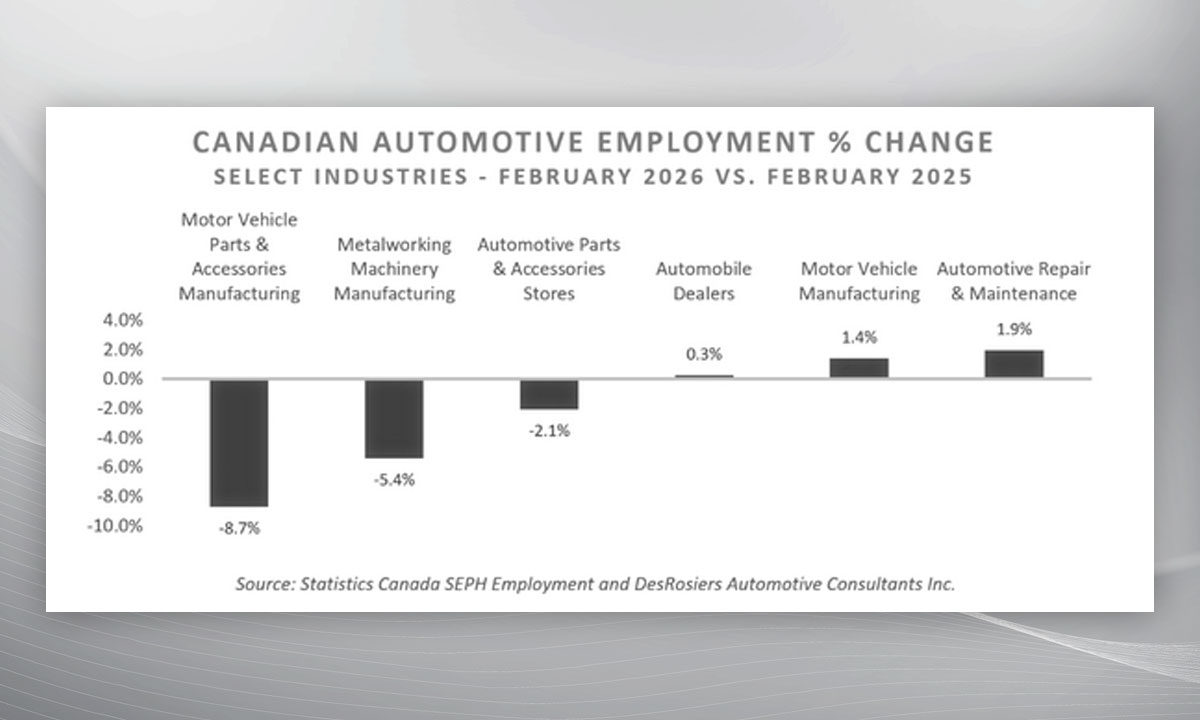
Motor vehicle parts and accessories manufacturing recorded the sharpest decline, with employment falling 8.7 per cent year-over-year in February, representing a loss of 6,200 jobs. At the same time, automotive repair and maintenance employment rose 1.9 per cent to 123,100 employees, while motor vehicle manufacturing employment increased 1.4 per cent despite remaining below pre-pandemic levels.
Automobile dealers, the largest employment category in the sector, remained relatively stable. Dealer employment totalled 158,200 workers in February, up 0.3 per cent from February 2025.
“The sector has proven its resilience so far, but the ongoing political and international turmoil does carry clear consequences for Canadians, and a positive path forward on trade is needed to solidify this crucial employment base,” said King.
The figures reflect growing uncertainty across North America’s automotive industry as manufacturers, suppliers and retailers continue to navigate supply chain pressures, shifting consumer demand and ongoing trade concerns.
Relatively stable employment levels may suggest continued resilience in retail automotive operations despite broader industry softness. However, weakness in parts manufacturing and wider economic uncertainty could eventually affect vehicle supply, pricing and consumer confidence if conditions persist.