As has long been expected, Canadian auto sales for the 2018 calendar year were the second-best in history, even with a dramatic drop in December sales that extended the period of gradual decline to 10 consecutive months.
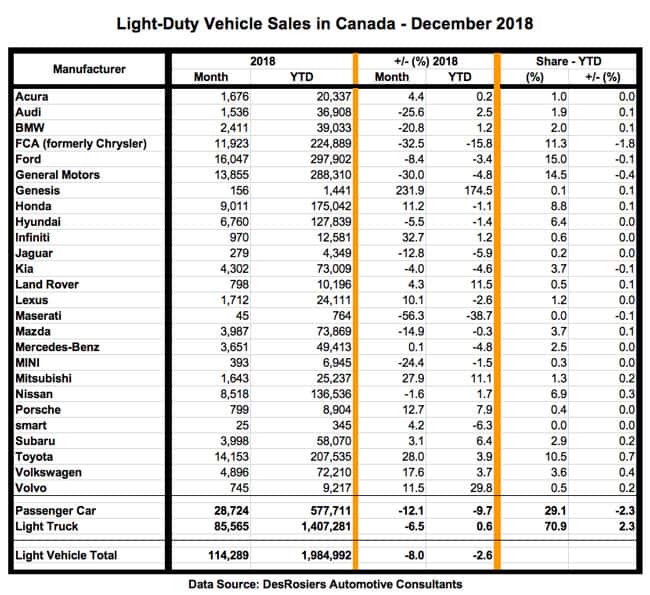
December sales of 114,289 units, down 8.0% from those of the same month last year, helped drag the annual sales figure down by 2.6%, to 1,984,992 vehicles sold, according to DesRosiers Automotive Consultants (DAC) figures – thus also falling short of the mythic 2-million sales hurdle.
(NOTE: Other sources, which include estimates of unreported Tesla and other specialty manufacturer sales, do put the total just over 2-million; the DAC figures are based on actual reported sales and are directly comparable to prior-year figures.)
“Given all of the political and economic turbulence — combined with interest rate increases — it is difficult to classify 2018 as disappointing from a sales perspective,” said David Adams, president of Global Automakers of Canada. “We’ve had a decade of record sales each year and at some point, things are going to slow down — that’s the nature of the business,” he added.
While 2018’s overall sales figures and second-best status are definitely laudatory, the continuing trend of monthly declines does tend to cast a pall over any celebration, for it suggests a tougher year ahead in 2019.
As Dennis DesRosiers observed, “the industry gradually lost steam during the second half of the year ending with the first year-over-year decline since 2009.”
December’s sales, in particular, send a sobering message as their substantial 8.0% decline is from an already relatively low comparable in 2017. In addition, December’s SAAR (Seasonally Adjusted Annualized Sales Rate) was below 1.7-million, according to DAC – the lowest level since December 2012.
In addition, while we have become used to steady declines in passenger-car sales, those have been substantially offset by increased sales of light trucks, including SUVs. Not so in December. True to form, passenger-car sales were down by 12.1 %, but light truck sales also declined by 6.5%.
For the full year, car sales were down were down 9.7% but cumulative truck sales were up by only 0.6%. In terms of market share, trucks claimed 70.9% to passenger-cars’ 29.1%, a 2.3% shift in favour of trucks from last year.
Ford on top again
As has been the case for nine of the past 10 years, Ford was the best-selling automaker in Canada for 2018. A mid-year surge by General Motors that suggested a close race to the finish, lost its momentum in the final quarter.
However, an 8.4% decline in Ford’s December sales limited its yearly total to 297,902 units, a 3.4% decline from 2017, leading to a 0.1% loss in market share to 15.0%.
General Motors’ suffered even more in December with sales down 30.0% from a year go. Full-year sales of 288,310 vehicles were down by 4.8%, dropping GM’s market share by 0.4% to 14.5%.
Fiat Chrysler Automobiles (FCA) hung onto third place in annual sales, despite a 32.5% decline in December, when it was surpassed by Toyota for the fifth month in a row. Over the full year, FCA’s 224,889 sales were down 15.8% from 2017 and the company’s market share fell by 1.8% — the greatest share decline in the industry.
Toyota has consistently claimed third place in monthly sales since August and did so again in December, with a 28.0% increase, the greatest of any major manufacturer. But the Japanese brand ranked fourth for the year with 207,535 total sales, up 3.9% from a year ago. That increase drove a 0.7% jump in market share, to 10.5%, the biggest share gain in the industry.
With an 11.2% sales increase in December, Honda remained unchallenged in fifth place for both the month and the year. Total 2018 sales of 175,042 vehicles were down 1.1% from last year but, given the overall market decline, Honda’s market share increased 0.1% to 8.8%.
Close races in the mid-field
The fight for sixth place was the tightest in the industry at times during the year but Nissan claimed it decisively over Hyundai at year-end.
With Nissan’s December’s sales off just 1.6% in December and up 1.7% for the year, to 136,536 units, the Japanese brand gained 0.3% in market share, to 6.9%. That’s the third-best share improvement in the industry and the second year in a row with a similar improvement.
In seventh place for both the month and the year, Hyundai’s sales fell by 5.5% in December and its annual total of 127,839 vehicles was down by 1.4%, holding the Korean brand’s market share steady at 6.4% for the year.
Volkswagen took firm control of eighth place in monthly sales, beginning in October, but it had a lot of ground to make up to catch Mazda and Kia, which were also contending for that position for the full year.
The decision went to Mazda in the end, but not by much. Despite a 14.9% decline in December that left total annual sales of 73,869 units down down 0.3%, Mazda’s market share increased by 0.1% to 3.7%.
Kia ranked ninth for the month, with sales down, 4.0%, as well as for the year. Its annual total of 73,009 sales was just 860 units short of eighth place, although it lost 0.1% of market share to 3.7%.
In spite of claiming eighth place for December, with a 17.6% sales gain, Volkswagen ranked 10th for the full year. That said, the German icon’s second-half surge resulted in a 3.7% gain to 72,210 sales for the year — fewer than 1,500 behind eighth-place Mazda and enough to bump its market share by 0.4% to 3.6% — the second-biggest improvement in the business.
Subaru solidified its position in 11th place during the year and a 3.1% sales increase in December helped push annual sales up 6.4% to 58,070 vehicles sold. As a result, Subaru’s market share improved by 0.2% to 2.9%.
Despite a 4.7 % sales decline for the year, Mercedes-Benz maintained 12th-place overall and leadership among premium brands. BMW held off an earlier threat from Audi to retain second place in that elite group.
Winners and losers
On a percentage basis, the biggest winners in 2018 were Genesis (+174.5%), Volvo (+29.8%), Land Rover (+11.5%), Mitsubishi )+11.1%) and Porsche (+7.9%).
The biggest losers, in percentage terms, were Maserati (-37.1%), FCA (-15.8%, Smart (-6.3%), Jaguar (-5.9%) and Mercedes-Benz (-4.8%).