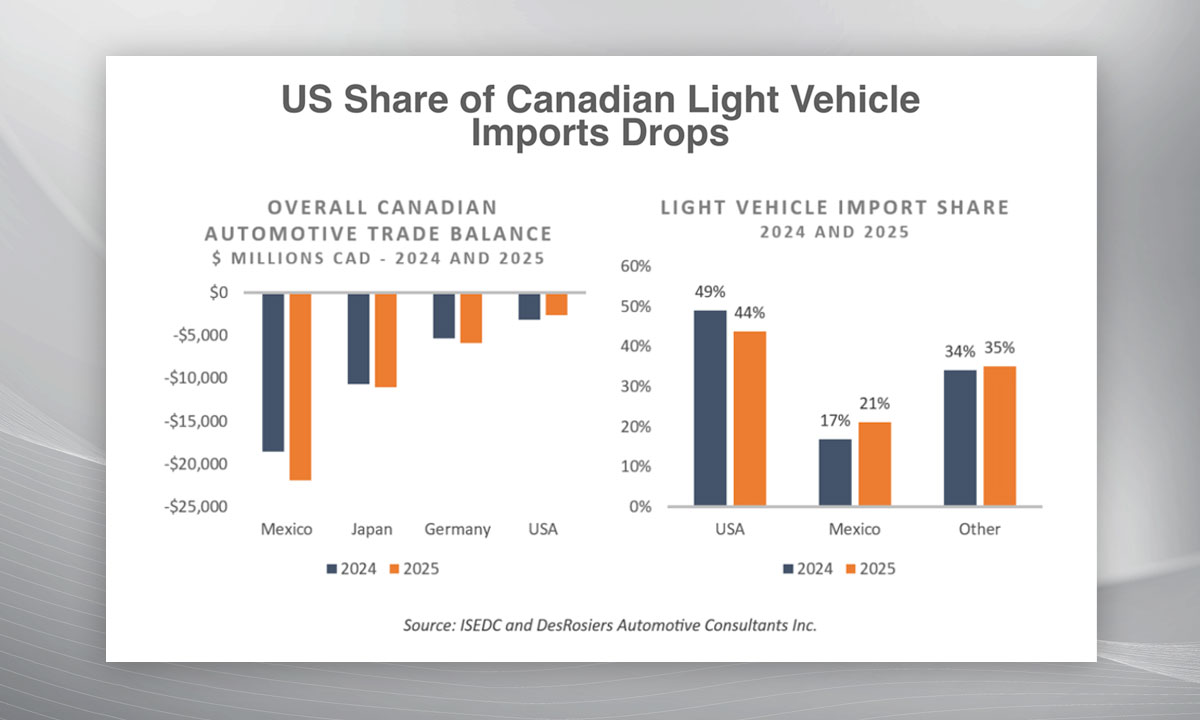
Canada’s share of light vehicle imports sourced from the United States declined over the past year as automakers adjusted to ongoing trade tensions and tariff measures between the two countries.
According to data released by DesRosiers Automotive Consultants (DAC), the proportion of Canadian light vehicle imports coming from the U.S. dropped to 43.7 per cent on a dollar basis, down from 49.1 per cent a year earlier. The report said automakers shifted sourcing to assembly plants in other countries to avoid Canadian counter-tariffs applied to U.S.-built vehicles.
The figures come roughly one year after the U.S. administration expanded trade actions affecting multiple industries, including the automotive sector.
Despite the shift in vehicle sourcing, Canada’s broader automotive trade relationship with the U.S. remains dominant. DAC said Canada exported $78.6 billion in automotive products globally in 2025 while importing $143.1 billion worth of vehicles, parts, trailers and machinery. Nearly 95 per cent of Canada’s automotive exports were destined for the U.S. market in 2025, underscoring the continued integration of the North American automotive industry.
“The interconnected nature of the trade relationship between Canada and the U.S. is readily apparent in the automotive sector and it is here where practical geographic and historical ties have thus far continued to override political upheaval,” said Andrew King, Managing Partner at DAC, in a statement.
King said ongoing U.S. trade policies continue to create challenges across the industry.
“The US administration’s policies continue to punish the industry, workers, and consumers in both countries. We can but hope 2026 brings some reasonableness to the American approach and a successful renewal of CUSMA.”
The shift in sourcing could influence future vehicle availability, pricing and inventory strategies as OEMs continue adjusting production and import patterns in response to trade policy changes.