NON-VERBAL COMMUNICATION IS HUGELY IMPORTANT WHEN IT COMES TO GETTING YOUR MESSAGE ACROSS AND DELIVERING POSITIVE OUTCOMES WITH OTHERS
 Effective communication is the fundamental principle in providing great customer service. It’s a two-way process of reaching a mutual understanding in which you do not only convey and exchange information with your customers, but also create and share meaning.
Communication skills can be categorized in two ways: Emotional and Logical. Emotional includes your body language (listening, reflecting, and non-verbal communication), whereas logical includes questioning, writing, reading, explaining, comprehending, processing, and transferring the information to your customers.
Non-verbal communication is a process of communication without using words or sounds. It regulates relationships between messages and meaning, and may support or replace verbal communication.
It can provide accuracy, clarity, and contradiction for ambiguous messages. It uses gestures, body language, eye contact, facial expressions, impressions, appearance and every part of the body to communicate with the customer to portray a feeling — be it a happy, sad or angry one. Even the way you dress signals a kind of message to the one who sees you.
Your actions and expressions speak for you when you personally interact face-to-face with customers, and nonverbal communication makes up a large portion of your communication skills and abilities.
 A MAJOR COMPONENT
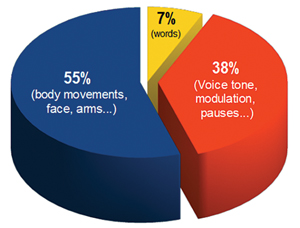
Research by Albert Mehrabian, Professor Emeritus of Psychology at UCLA, found that “nonverbal communication not only has a direct effect on the message that is received, it actually plays a more major role in messages than the words said or the tone of the voice used.”
Beyond words and tone of voice, there is another major factor that influences the message that you communicate. It is your body language, which is 55 per cent of the total message that you exhibit during conversation. The tone of voice used conveys 38 per cent of that message. Thus actual words spoken account for only 7 per cent of total communication.
UNDERSTANDING BODY LANGUAGE
The difference between the words a customer speaks and your understanding of what they are saying comes from non-verbal communication, otherwise known as “body language.”
By developing your awareness of the signs and signals of body language, you can more easily understand customers, and more effectively communicate with them.
Facial expressions are among the most important parts of body-to-body communication, as they can communicate a tremendous amount of information about your customer’s emotions and responses to information and events around them.
THE RIGHT WAY
Facial or hand gestures contribute to effective communication. Let the whole body talk with appropriate actions. Soft gestures should be exhibited for individuals and small groups; more prominent ones should be used for a larger audience.
Effective communication is a must for everyone who hopes to climb the ladder of success. It is not something that you can leave to destiny. You have to work really hard to improve your communication skills and get your point across to your customers.
Finally, communication is a fuel for human interaction; its effectiveness can play a major role in maintaining relationships with your customers, resulting in less friction and effort to gain their trust, confidence, satisfaction and ultimately, repeat business.