WHY UNDERSTANDING HOW CUSTOMERS WANT TO ENGAGE IS CRITICAL TO BUILDING RELATIONSHIPS AND GROWING YOUR BUSINESS
 It’s generally accepted these days that consumers, young and old, are gravitating towards screens to keep in touch with what’s going on, not only in their lives but also the world around them.
This is happening at a rate that was probably not projected even five years ago and is now accelerating rapidly. This column takes a look at some of the implications for dealerships and how to stay current with your customers.
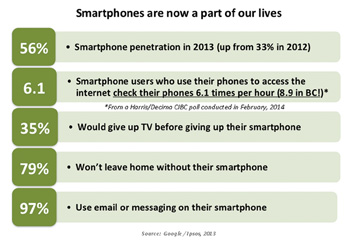
First, some hard facts about the device that is facilitating and driving this change — the smartphone. In studies conducted for Google by Ipsos in the USA (2012) and in Canada (2013), the tremendous growth in use of and our growing dependency on smartphones is clearly apparent. Here are some key numbers on smartphones from the Canadian study conducted in 2013.
Smartphones are clearly a way of life now, not just for younger consumers (your future customers), but also for those who are still the backbone of auto sales in Canada, namely the Baby Boomers.
CENTRE OF THE INFORMATION WORLD
The Google/Ipsos studies in the U.S. and Canada clearly paint a picture of a society that is increasingly connected to some type of screen most of the time. And that screen is most likely to be a smartphone. Even when they’re watching TV, many consumers have their smartphone with them and use it to further investigate subject matter they find interesting on TV. We are becoming a “multi-screen” society but at the epicentre of social interaction and information is the smartphone.
We also use multiple screens simultaneously or sequentially, so it becomes more important for retailers and marketers to make sure that consumers are able to pick up where they left off on any device. It sounds complicated, but it doesn’t have to be if you start out by keeping it simple and building from there, rather than trying to do everything at once.
 SPENDING WISELY
The way we consume media and interact with companies, products or brands has changed dramatically. To quote the the Google / Ipsos study:
“The vast majority of media interactions are screen-based, and so marketing strategies should no longer be viewed as “digital” or “traditional.” Businesses should understand all of the ways that people consume media, particularly digital, and tailor strategies to each channel.”
Open any newspaper and you’re likely to find pages and pages of retail auto ads, focused largely on pricing and incentives to lure customers into the showroom. Do you know if these ads provide a return on investment (whether by your dealership or through your association)? If you increased expenditure, would you see an increase in showroom traffic: if you reduced expenditure, would showroom traffic fall as a result?
The question then for dealerships is not just how to allocate budget and resources, but how to ensure that you’re getting the best return on your marketing dollars. While print and radio still play a role, you need to ask: “am I spending those dollars as effectively as I can, given that I now have other options to tailor communications to customers and prospects so that the messages are more relevant to the target audience, how well I know them and what result I would like to achieve with my efforts?”
SEEKING NEW OPPORTUNITIES
The growth in the use of smartphones and the growing comfort among consumers to adopt the smartphone screen as their window to the world provides many opportunities for dealerships. Smartphones can carry verbal and visual messages.
In the service context, a technician can communicate with a customer using video and audio to explain clearly, through visual demonstration, exactly what work needs to be performed on the vehicle. Not all customers will be interested in that, but for expensive service or repairs, it brings a new level of transparency. In the sales context, appealing features of a new vehicle can also be sent to a prospect or a customer with whom a dialogue has been initiated. Instead of using paper coupons, promotional offers can be forwarded to customers digitally.
There’s no question that some barriers to engaging with customers and prospects via a smartphone screen still exist. Processes need to be in place to provide security and to protect privacy. Standards also need to be put in place to maintain the level of quality and consistency in communication. But when done well, what better way to connect with your customers than using a medium that’s consistent with their way of communication?
By taking this approach, dealerships are able to maintain strong and engaging prospect/customer relationships that can serve to both increase predisposition and foster a sense of customer loyalty towards their stores.