There are a host of programs to encourage loyalty. But are they effective in the long-run?
 Customer satisfaction will always be a fundamental part of running any successful business, but satisfaction is not the end goal. The end goal should be to develop a customer base that’s not just satisfied, but customers who come back to you because they truly want to do business with you.
In many cases, businesses have shifted their focus from satisfaction to loyalty because they realize that even a satisfied customer will often just take their business elsewhere. This new focus works best when the business has developed a strong culture of satisfaction and loyalty initiatives are based on a supportive customer experience. It doesn’t work when loyalty programs have no positive customer experience foundation to justify loyalty in the customer’s mind.
Here’s where the difference becomes very apparent to customers and where investments in loyalty programs and initiatives actually cost more than the returns they bring in.
 Are loyalty programs worthwhile?
The business case for loyalty programs is being called into question. In a whitepaper published earlier this year global professional services company, Accenture, refers to “the loyalty illusion” and suggests that businesses need to “invest more wisely” when it comes to spending on loyalty programs.
“This focus on loyalty is costing more than most business leaders realize. Businesses spend billions each year for non-cash loyalty incentives. Even more, and potentially greater, costs are hidden in the ‘loyalty’ line item within programs that simmer in the background, consuming investments at a steady pace, year after year. Once activated, they are difficult and time-consuming to shut down. So they rarely are.” (Accenture, 2017)
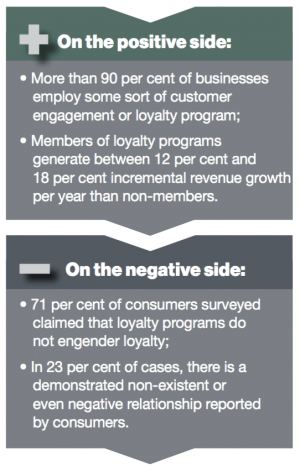
The whitepaper references among others, Accenture’s Global Consumer Pulse Survey (done in 2016 among more than 25,000 consumers in 33 countries) and their Digital Survey, also done in 2016. Here are some highlights.
On the surface, these numbers suggest a positive business case for loyalty programs. But there’s a very clear signal from consumers that they don’t feel that loyalty programs engender loyalty and that some may even feel they have the opposite effect.
Why do we have this apparent contradiction, when members of loyalty programs do actually contribute more revenue than non-members? It comes back to the type of loyalty we’re talking about.
Two kinds of loyalty: true loyalty and manufactured or “fake” loyalty
Fake news is on everybody’s mind these days. I believe there’s also something called “fake loyalty.” A more polite and scientific term is “spurious” loyalty, but fake says it all for me.
The difference between fake loyalty and what I call “true” loyalty is in the underlying foundation of each.
This is not to say that some of the things that are often part of fake loyalty cannot be part of true loyalty.
Every business needs to compete by offering promotions and good deals. But generating true loyalty from the outset will only enhance any type of customer engagement, promotions or loyalty initiatives.
If all you have engendered in a customer is “fake” loyalty (through special offers for instance) the chances are you won’t make much profit on their business and they may not be around for long, especially if someone else comes up with a better offer. You’ve trained them to come to you only when you have a special offer.
What can you do to drive and prosper from customer loyalty?
Create shared value by using “sharebacks” — sharing information with customers about how their feedback is helping you and them

There are two interesting perspectives on what to do to engender true loyalty. The first comes again from the Accenture whitepaper:
- Justify investments (in loyalty) with an eye towards margin growth;
- Double down on new customer acquisition through loyal customers (they are much more likely to recommend you);
- Learn how to engender loyalty with millennials. They are more open to switching and moving on. They prefer a more customized approach;
- View loyalty as a “team sport” – everybody in the dealership owns customer loyalty and plays a role.
Another perspective comes from a Vision Critical summary of the thoughts of influential customer loyalty executives in global companies such as Stanley Black & Decker, Unilever, Heineken, Google and Twitter. Their priorities are:
- Focus on building long-term customer relationships;
- Create shared value by using “sharebacks” — sharing information with customers about how their feedback is helping you and them;
- Lead the conversation about the ROI of customer loyalty within your organization;
- Embrace agility — look at non-survey alternatives that can provide more timely and accurate feedback that you can quickly adapt to (new developments in AI models based on social media content are gaining ground rapidly); and
- Get rid of data silos in the organization.
So, does it matter?
Take a closer look at your “loyal” customers. What drives their loyalty — is it just your price promotions and special offers, or are there customers who keep coming back, spend more and drive more profits?
I believe it does matter and that differentiating between true and fake loyalty can help you focus more on true customer loyalty. The evidence is strong that this is a better, more profitable path for any business.