By Huw Evans and Todd Phillips
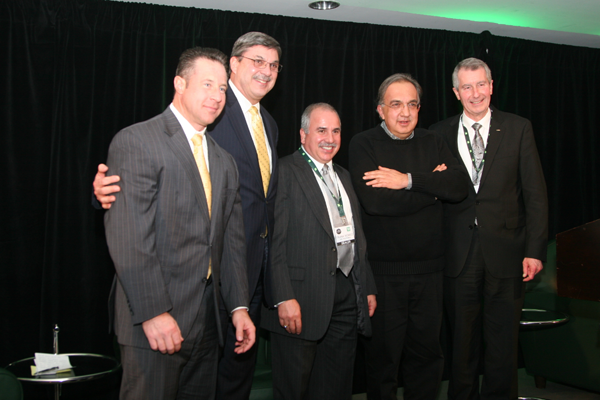
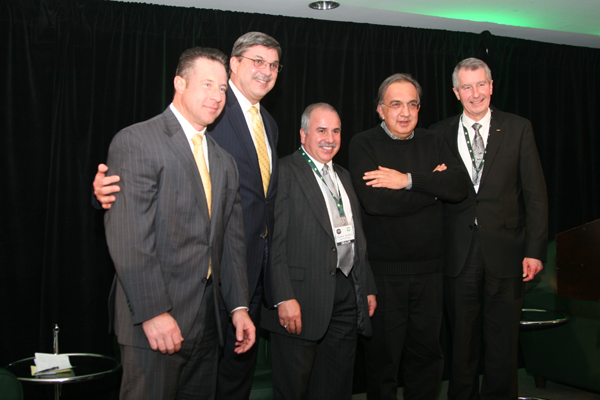
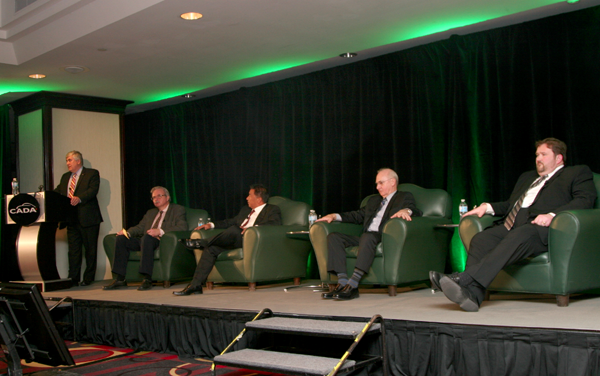
(Left to right, Reid Bigland, CEO, Dodge, Ram and Chrysler Canada, Rick Gauthier, President and CEO, CADA, Frank Romeo, CADA Director (Ontario), Sergio Marchionne, CEO Fiat Chrysler Automobiles, Ron Loveys, CADA Chairman
When you set such high standards during an inaugural event, it can seem a challenge to up the ante the second time around. Yet based on feedback from attendees, yesterday’s 2014 CADA Summit raised the bar even higher. “Superb,” “incredible insight,” and “truly worthwhile” were just some of the comments we heard from dealers in attendance.
Superstar keynote speakers and rich content ensured it was an event where the audience was riveted from beginning to end. Starting off with a welcome address from CADA Chairman Ron Loveys, the day quickly unfolded with a retail update from Peter Hatges, Canadian Automobile Lead Partner for consulting firm KPMG.
Hatges talked about the rapidly changing landscape and the shift towards more of the vehicle buying process occurring online. “People are buying things differently than they used to,” said Hatges. “That trend is only going to accelerate and it will impact your business.”
Hatges said there is a risk of retailers becoming irrelevant if they aren’t careful. He used an example of the music industry and how today services such as iTunes have completely changed the business model, from buying a physical product (such as records or CDs in stores) to downloading songs from the Internet.
WAY OF THE FUTURE?
Peter Hatges
Hatges cited GM’s recent, Shop, Click and Drive program as one way how the auto retailing process is becoming ever more digital. Although at an early stage, it indicates that we could witness changes in auto retailing similar to what has happened in the music business.
Hatges also said it was important for dealers to focus on their used car business and service operations to drive growth. “Ignoring used cars and focusing on new vehicle sales is perilous,” he said. “I suspect with awareness, margins on new cars will converge to market, which is low margin. But that is where it is going to be.”
He said that OEMs have seen what happened in the Great Recession in 2008-09 and want to protect residual values. “Residual values that are high, lower the leasing cost on the vehicle.” He said that in North America, a lot of people buy cars on credit so the residual value is hugely important.”
Michael McGhee
ONE-STOP SHOPPING
Michael McGhee, Senior Vice-President and Business Head with TD Auto Finance, talked about the feedback his team has received related to auto retail financing.
McGhee said that in talking with dealers across the country in the last few months, the most consistent message has been that finance partners need to provide a one-stop-shop service, whether it concerns prime, non prime, floorplan, or wholesale lending. McGhee also said that feedback has also indicated that lenders need to invest in the tools to serve dealer clients as effectively as possible and provide a service that is fast, easy and consistent. “We believe if we invest in the best people and resources, it frees you to tackle the challenges of running your business every day, not to mention managing any regulatory pressures.”
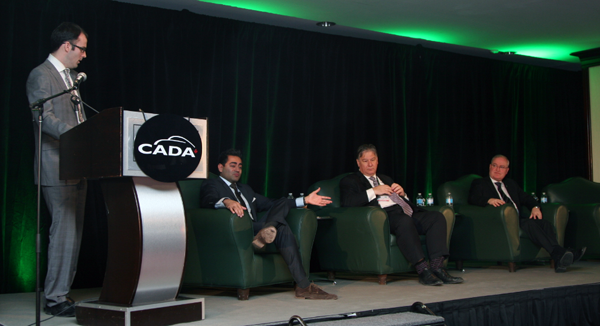
Economic panel
This year’s economic panel, moderated by CADA Chief Economist Michael Hatch and featuring Craig Alexander, Senior Vice-President and Chief Economist, TD Bank Group, Preet Banerjee, Personal Finance Columnist for the Globe & Mail and Peter Hatges, delivered a fairly bullish outlook on 2014.
“The vast majority of Canadian consumers are doing well,” said Banerjee. “I think it bodes very well for car sales in Canada.”
Alexander said growth in the U.S. economy will also be good news for Canada. “I think the U.S. economy is poised for growth. “Credit is flowing again.”
Alexander said he expects the U.S. economy to grow through 2014-2015. “Consumers are going to have their wallets open,” he says.
As the U.S. economy grows, that leads to more growth for Canada’s export sector, also fueled in part by a lower Canadian dollar that he expects to fall to about 85 cents versus the U.S. dollar.
For his part, Peter Hatges said that an aging vehicle fleet and access to inexpensive capital will continue to fuel strong growth for auto dealers for at least two to three years. “I will tell you that it’s happy days ahead for the auto industry — for sure,” says Hatges. He also predicted that North American OEMs will make a big strategic push to gain market share.
Banerjee noted that uncertainty remains about whether interest rates will increase or possibly even go down.
Hatges meanwhile said that Canadian business benefit greatly from the low cost of money. “It’s accustomed to operating in a low interest rate environment,” he remarked.
The economists discussed overall economic trends, the rising levels of consumer debts, the overvaluation of the Canadian real estate market, the impact of the falling Canadian dollar on the economy as a whole, and the impact of more free trade agreements on Canadian businesses.
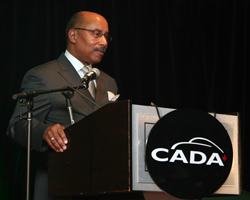
Ed Welburn
CHANGING TASTES
A much anticipated speaker was General Motors Vice-President of Design, Ed Welburn. Only the sixth person to ever hold this prestigious position at the automaker, Welburn said that as we move forward, any technology advantage automakers have will diminish, meaning that differentiation in the marketplace will be driven by other factors and that vehicle design will play a key role. “I feel so lucky to work at a car company that focuses on design,” he said. Welburn said he is often asked where he finds inspiration. “We are inspired by trends in fashion, technology and diverse cultures of the world.”
He noted that shopping patterns are changing with men shopping like women and women shopping like men. “Men are purchasing high fashion shoes, handbags and jewellery and women are purchasing high powered sports cars.” Welburn remarked that in China today, more than 30 per cent of all Ferrari sales are to female customers.
He said that although design inspiration can come from anywhere, one thing is certain. “Great design is and will continue to be, the ultimate differentiator between our brands in the marketplace.”
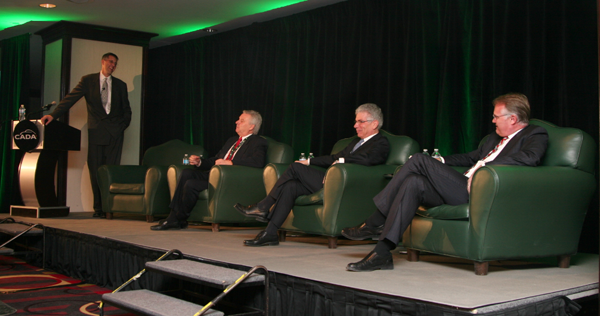
Manufacturer panel
TALKING SERVICE
The second panel discussion of the day switched the focus from economics to the OEM side, or more specifically the OEMs and their dealers. Moderated by Canadian auto dealer Publisher Niel Hiscox and consisting of Don Durst, Senior Vice-President, Sales and Marketing with Subaru Canada, Jerry Chenkin, President and CEO, Honda Canada, and Tim A. Reuss, President and CEO, Mercedes-Benz Canada, the panel generated lively discussion and some interesting viewpoints.
A key theme was that of shared responsibility — manufacturers and dealers working together to achieve the best result. Jerry Chenkin said that it was testament to the resilience of Honda’s dealer network that the automaker was able to recover so quickly from the supply difficulties it faced in 2011.
Tim Reuss, who has a somewhat unique position in that Mercedes-Benz Canada is both an OEM and also a retailer with a number of corporate stores, said that moving forward, the emphasis needs to be on the balance of information between the customer and the automaker and also between the dealer and the OEM.
A big emphasis on the panel discussion concerned the back end of dealer operations and why aftermarket companies continue to take a huge bite out of dealers’ service business.
Chenkin said one issue was greater convenience, while Reuss noted that customers have to be handled differently. “There has been an emphasis on warranty work and not focusing on the service customer,” Reuss said. “We need to change that. Customers in different vehicle age segments need to be handled differently with different labour rates and services. Those are some of the things we need to look at, otherwise we are going to strengthen the aftermarket.”
Don Durst added that dealers also need to focus on personal service to win customers. “It’s that value piece that is so important,” he said.
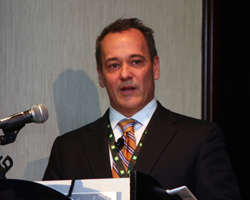
Robert Kurnick Jr
BIG BUSINESS, BIG RESULTS
Robert Kurnick Jr.’s session on dealer consolidation was one of the most anticipated of the day and featured an attentive audience from start to finish. Kurnick, President and CEO of Penske Auto Group, showed some of the strategies that has helped the group become one of the largest and most successful, both in the U.S. and overseas markets such as the U.K. and Germany.
Penske currently has 320 dealerships, over 40 brands and last year retailed more than 60,000 vehicles and wrote more than 3.4 million work orders.
Kurnick said that a key part in being successful is looking for opportunities and then learning to implement them on a large scale. He cited the firm’s expansion in the UK market where it radically changed the very concept of a dealership, introducing the idea of a luxury showroom and proper service drive. “The service drive was an unknown concept a few years ago, now it is standard practice,” he said.
Kurnick notes that a big advantage large dealer groups have is the ability to consolidate and streamline certain parts of their business, such as accounting, DMS and CRM. “We have one exclusive DMS throughout our organization, a common CRM program and even with 320 stores we know how many cars were sold and where are strengths and weaknesses are.” Common email templates and integrated used vehicle evaluation tools are also some of the features that have helped maximize efficiencies within the Penske Group while maintaining a good reputation and CSI scores.
THE MORE THINGS CHANGE
Independent consultant Glenn Mercer provided some interesting anecdotes and observations on the auto industry’s past, present and possible future. He said that over the last century, the auto business, certainly in the U.S. has shown remarkable resilience to “threats” whether they be shrinking networks, the introduction of massive, publicly run super auto stores, or the push into the retail space by Internet third party sites and OEMs.
Mercer said that despite these threats and predictions ranging from “build to order” vehicles to automaker consolidation, with single outlets serving multiple brands, many simply haven’t come to pass and auto retailing today, is still very similar to what it has been over the last 100 years, despite advances in technology and higher customer expectations.
“Dealerships are regulated more than most businesses,” said Mercer, “which limits their ability to rapidly evolve.” He noted that productivity growth in the industry has remained largely constant and that based on statistics from the U.S. Department of Labor, the average salesperson still sells approximately 10 vehicles per month.
Retail panel
LAUREATES TAKE THEIR TURN
The automotive retail panel saw Mercer join CADA’s most recent CADA Laureates, Al MacPhee, MacPhee Ford, Joe Medina, Crosstown Auto Centre and Sean O’Regan, of O’Regan’s Automotive Group. Chuck Seguin, of Seguin Advisory Services, served as moderator. Seguin kicked things off by drawing attention to a special 8-part fictional series in Canadian auto dealer that looks at the future of the automotive retail industry. “The pieces that Canadian auto dealer is doing is really helping us with that thinking,” says Seguin, encouraging readers to read the articles and join the debate.
Seguin talked about the huge differences to the processes that dealers are facing with their customers. “The back end of the business is critical,” he said.
Seguin asked the Laureate panelists about the biggest changes in their retail operations. “We have a much bigger focus on F&I,” says O’Regan. “It’s more important to find gross where you can find it. F&I is a big one. It tends to happen after there’s a commitment to buy.”
O’Regan says the margin on F&I today is much better than on new cars. He says selling used cars is also more of a focus now for his group.“If I’m priced $1,000 too high on a used car, everyone in North America can see that,” says O’Regan.
For his part, Al MacPhee said retailers have to change their approach. “You have to merchandise entirely differently,” says MacPhee. “I can’t even imagine what it will be like in the next 10 years.”
“When I look at the changes from five years ago to now, the number one thing is process,” said Joe Medina. “Having consistent processes is so important. We have to care so much more about the customer experience. We tend in our dealership, to really focus on that experience and make sure it’s memorable. We have to really respect that customer’s time because it’s so valuable.”
Medina said that a few years ago customers shopped on average at 4.1 dealerships before making a purchase. Now, that’s down to 2.1 dealerships. It’s critical for dealers to make that short list.
Seguin asked the panelists what they needed to do to keep service customers and what do they need to do to get them back?
“You have to give them the best experience possible,” said MacPhee. “They can get the service done most anywhere.”
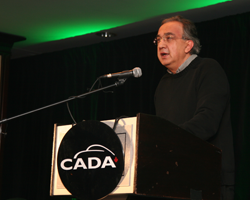
Sergio Marchionne
GRAND FINALE
Following a cocktail reception and dinner, CADA Summit attendees got a chance to hear an living industry legend deliver his keynote speech — Fiat and Chrysler CEO Sergio Marchionne.
Sporting his trademark black sweater and slacks, Marchionne’s address was riveting, providing some fascinating insight into the workings of what is now the world’s seventh largest automaker and how Fiat Chrysler Automobiles has overcome seemingly insurmountable odds to enjoy the success it has today.
Marchionne, who was born in Italy but raised in Canada started off with the story of the “Lucky Loonie,” a Canadian dollar that lies buried in the floor of Chrysler’s Jefferson North assembly complex in Detroit, which builds the Jeep Grand Cherokee. He said that back when Chrysler was still on the ropes and about to launch its new Grand Cherokee in 2010, then head of manufacturing Mauro Pino (a Canadian), took a Loonie and placed it on the floor. “The Grand Cherokee proved to be a hit,” said Marchionne “and we can’t build enough of them.”
As a Canadian citizen, Marchionne said he was proud of his ties to this country and also how Canada is part of the fabric of Chrysler. “Last year, Chrysler made 570,000 vehicles in Canada and built 23 per cent of all vehicles in this country.”
Marchionne said that while Canada has shown an incredible number of attributes related to vehicle manufacturing, current global competition for production is fierce.
He said that the auto industry is capital intensive and that economies of scale have to be large enough to continue new investment. He said the decision to invest in Canada must match economic alternatives and the reason to improve facilities or build new ones has to be structural.
“Canada has many appealing aspects to offer, highly skilled workers and a fundamental quality of life I miss almost daily. The future is full of promises, as long as all involved parties recognize the realities of competition go beyond natural boundaries.”