REVAMPING STORES REQUIRES MAJOR INVESTMENT AND DEALERS WANT TO UNDERSTAND WHY IT’S NECESSARY.
Visit any Apple store today and not only is the product showcased in a clean, modern and pleasant environment but no matter which part of the country you go to, the experience and service is designed to be consistent.
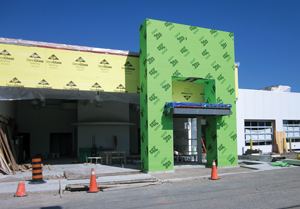
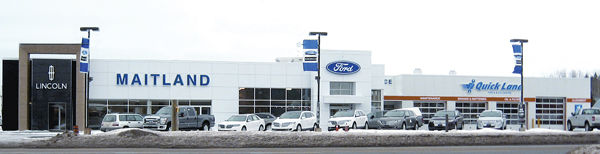
Maitland Ford Lincoln Sales today (above) and under renovation seen here.
And the same theme can be found with other successful retailers, from restaurant chains like Tim Hortons to clothing retailers such as Roots — all are designed to deliver a specific level of customer expectation in terms of product, place and service.
Given the nature of vehicle purchases, things have tended to be a little different for auto retailers. Although most dealer networks operate on the premise of the independent franchise model, traditionally — whether dictated by geographical location, store volume or other factors, from a customer standpoint, the actual experience of buying a car and having it serviced is often very different between locations.
Within the last two decades we’ve seen a shift in the car business, more towards a standard “branding” with stores (even though they often remain independent franchises).
The result is that from coast to coast, retail facilities tend not only to look more alike but are more in keeping with the OEM’s perceived image of their vehicle brand. And in order to keep up with OEM brand makeovers, plus changing consumer expectations; dealers are often required to invest in substantial remodeling of their facilities.
Renovating or rebuilding a dealership is no small task, often requiring millions of dollars, yet the rate at which brand re-imaging has been accelerating in recent years has been cause for concern for dealers, both here in Canada and other parts of the world.
SHOW ME THE MONEY
Throw in an economic downturn like the Great Recession and with slumping sales and falling revenues; asking a dealer to spend X number of dollars on their store, without having solid statistics to show the potential return on investment, becomes a highly contentious issue. So much so, that following the Great Recession in 2008-09, dealers were miffed enough about factory imaging pressure that the dealer associations got involved, taking a long hard look at some of the key issues and suggesting improvements.
This has involved consultation with industry experts, OEM representatives, dealers, architects and other key people in the business, as well as the commissioning (to date) of two research projects.

Glenn Mercer
The first report, assembled by auto industry consultant Glenn Mercer on behalf of NADA was presented at the association’s annual convention in Las Vegas in February 2012. The phase two report, featuring more Canadian data, was released at this year’s NADA Convention, in Orlando, Fla.
Glenn Mercer, says that among the three key aspects regarding factory imaging programs — expansion, modernization and standardization, the former was seen as the least contentious. “Reasonable business people could come to an agreement with an OEM on more service bays,” he says. “You could figure out what a technician would cost and how much money you could make from filling that bay but when its modernization and the OEM wants you to replace the floor tile you put in three years ago and use their supplier the return on investment becomes very unclear.”
Chuck Seguin, president of Seguin Advisory Services (and Canadian auto dealer columnist), who was involved with the phase two report, says the nature of the dealer network structure in Canada made access to data more straightforward in many cases. “In the U.S. there are very few single brand stores, which makes it harder to break out the numbers. In Canada it’s a little easier.” In terms of actual information that was gleaned, such as the cost for bringing facilities up to standard, Seguin says the results were “good, bad and ugly for everybody.”
He notes that for dealer groups that operate multiple stores, when it came to factory imaging they often go above and beyond the OEM requirements. “If the OEM says you need a 23,000 sq.ft. facility, they would build 35,000 sq.ft. This was done out of their own desire.” He says that in a lot of cases the store renovations were done at the behest of the dealer, not necessarily the OEM.
Seguin says that a big issue has been the increase in rent and building costs. “Rents really spiked in 2009 and [when sales dropped] dealers found themselves with lower volume and higher fixed costs.” He says that despite sales having increased since then, rent factors still remain a huge concern for dealers, especially since today, new vehicle profit margins tend to be lower. The problem is exacerbated when factory imaging requirements change within a relatively short timeframe and that in Canada, there is little in terms of financial support from OEMs to support extensive store renovations.
That’s an issue that Rick Gauthier, President and CEO of the Canadian Automobile Dealers Association, says is a prime concern for retailers in this country. He says regardless of the volume, the financial impact for dealers in Canada is still the same as the U.S. “We are going to be taking a long hard look at this. We have seen disparities of what OEMs are willing to do to encourage dealers.”
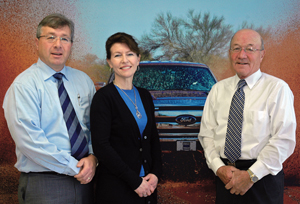
(Left to right), Brent Lewis, general manager,
Judith Kovala, dealer operations and Young Drivers Manager and Maitland Lewis, president, Maitland Ford Lincoln Sales
INCREASED VISIBILITY
As for dealers themselves, they see both pros and cons to factory imaging. Brent Lewis, general manager of Maitland Ford Lincoln Sales in Sault Ste. Marie, Ont, said that it “wasn’t easy to make the decision to renovate” and “it was something we gave a lot of thought to as a stand alone store,” though he believes the results have been worth the effort. “It sends a good signal to the public that you are investing in your dealership, your product and your community,” he says.
Sault Ste. Marie, due to its geographical location is what Lewis describes as “an economic island,” a sizeable city that’s surrounded for miles by small rural communities, so in many respects, Maitland Ford Lincoln arguably has a much higher profile in the community than a comparable store located in or close to a major urban conurbation such as Toronto, Montreal, or Vancouver. With rival retailers also having built new or refreshed existing stores Lewis says it is “important [for dealers to] fit with the local competition.”
A big change at Maitland, since renovations were completed in 2011, has been the inclusion of a separate Lincoln showroom and a Quick Lane light maintenance and repair franchise. He says the latter has proved “very positive for our customers. It has created a comfortable atmosphere and they are more relaxed because the waiting area is pleasant and they can actually see their vehicle being worked on.”

Hugh Sisley, president Sisley Motors Ltd.
In Thornhill, Ont, Hugh Sisley, president of Sisley Motors Ltd, which owns Honda and Hyundai stores in the Greater Toronto Area says that every dealer, wants to build a good facility. “We are retailers and we want to create a good environment with comfortable chairs but when the manufacturer gets to specifying what chair it actually needs to be and typically from a mid to high line supplier, its hard to get ROI from that.”
He says another issue concerns OEMs asking dealers to build more capacity than they actually need. “When we were building our Honda store on Steeles Avenue, the OEM said we needed X amount of service bays based on volume.” He says however that a manufacturer can change its fixed ops strategy, meaning that dealers are left with excess capacity and the associated costs. “Extended maintenance means that cars don’t come in as often and we don’t need as much shop as we have. That is a cost, a real cost the dealer has to absorb and you can’t just close up part of the building.”
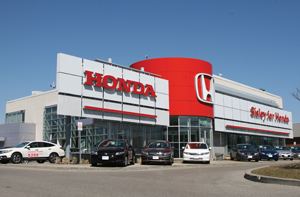
Sisley Motors Ltd, which operates one of the largest and most popular Honda stores in Canada
Sisley says that a big problem is the discrepancy between dealers and OEMs. “Dealers are in it for the long haul,” he says, “people making the decisions at the OEM and design level often aren’t.”
SMALLER FUTURE?
In the phase two facilities imaging report, besides looking at fewer, but more depth “bottom-up” case studies of individual dealerships than the original report did, the study also looked at conclusions and recommendations for the dealership of the future.
Glenn Mercer, notes that past predictions of the future of automotive retailing haven’t tended to be very accurate.
The consensus from the phase two report was that, due to a number of factors, ranging from franchise laws, to the complexity and cost of the product which dealers sell, the current retailing model is unlikely to disappear. That said, it is expected that stores of the future won’t be giant “Garage Mahals,” despite OEM pressure to build bigger facilities. “It will be easier to just have a few demonstrators on hand,” Mercer says, “so there will be no need for a gigantic showroom — our argument is Apple — their stores are always packed so we really don’t know why OEMs have to have these big echo chambers to sell cars.”
An interesting observation on the subject of the dealership of the future however, is fixed operations. As Canada continues to grow in terms of population and if the dealer count remains roughly the same, the aftermarket will only increase its lead in the service business. Mercer says that savvy dealers can take initiative in the service area, promoting convenience via personal pickup and drop off service, extended opening hours, or satellite service. He also says that a future where non critical service functions are moved off site or service facilities are actually shared between different brand stores could become common.
On the OEM side of the equation, service is also seen as the big opportunity for growth moving forward. John Capella, director, Network Development for Porsche Cars Canada Ltd, says that retailers will need a certain number of bays to service vehicles, even though the showroom itself might become more of a virtual experience “I think there are some opportunities to look at the buying process differently, using technology to display the products” he says, “but when it comes to service, quite frankly, you need the capacity.”
He says that Canada as a market presents some unique challenges for dealers in terms of facilities, due to its seasonal nature and that some months are significantly busier than others at many stores. “In spring, business tends to ramp up as people bring their cars in for service and change their winter tires.” Capella says that besides vehicles actually coming in, tire storage for customers will mean significant capacity will be needed at dealerships and Canadian retailers will need to bear this in mind when planning future facility upgrades or new stores.” That is going to require innovative thinking,” he says.