Looking at artificial intelligence through the eyes of the consumer.

Artificial intelligence is supercharging CRM.
Years ago, CRM systems were the domain of larger, sophisticated companies with large customer bases and big budgets.
Thanks to the rapid development of technology leading to better, more versatile and more cost-effective products, even the smallest companies can now benefit from a well-designed and well-executed CRM system.
Now we’re well into the next level of development of CRM solutions. It’s been at least five years since CRM providers have been offering artificial intelligence (AI) capabilities to enhance their product offerings and these are widely available.
A December 2018 article on “How Artificial Intelligence Technologies Are Changing the Face of CRM” from online publication Finances Online, describes how AI can greatly enhance CRM tools:
“The purpose of its (AI’s) use for customer care is not to dehumanize the process, but perhaps find better and faster solutions by reaching beyond the limitations of an actual employee. AI can only be considered useful when it’s mimicking or at least trying to simulate the human brain. This implies adaptation, learning, making decisions and applying them based on a set of rules and data. It’s from this point forward that technology has progressed to an extent when that crucial aspect might actually be possible. Many businesses are set to benefit greatly from it.”
There’s a lot buried in this statement, but the two key themes are right at the top — that AI does not necessarily “dehumanize” CRM and second, that an effective AI depends on its access to good data and being able to “learn” from the data.
Do customers always prefer to deal with a human being?
We encounter chatbots more and more in all of our interactions with organizations large and small. The essence of chatbots is that they are AI-based computer programs that simulate human conversations. It should come as no surprise that some chatbots are much better than others, enabling an interaction to go far beyond the basic menu of an interactive voice or text system towards a much more open-ended and intelligent conversation.
U.K. business-to-business (B2B) marketing agency Really B2B recently published some interesting perspectives on the use of chatbots in a B2B context. Some of their conclusions are based on their own work, and some are based on work from Forrester and from the Gartner group, both well-known global firms. The key observations are:
- By 2020 80 per cent of companies will be using chatbots for customer interaction;
- Forrester Research expects a 300 per cent increase in AI technologies like chatbots in the next two years;
- Gartner: more than 50 per cent of enterprises will spend more each year on bots and chatbot creation than on traditional mobile app development;
- Almost 2/3 of businesses implementing AI say that AI tools such as chatbots reduce their costs and:
- 59 per cent see better close rates
- 58 per cent see revenue increases
- 54 per cent see more traffic and engagement
- 52 per cent see higher conversion of leads; and
- Finally, 48 per cent of people would rather a chatbot resolve their issue than have “personality”.
This last point is a very important factor when looking at these new technologies through the customer’s eyes. Really B2B stresses that chatbots should focus strongly on utility. In my mind this means that the chatbot is developed in such a way that it can truly address a customer’s need and does so accurately, quickly and consistently.
Thanks to the rapid development of technology leading to better, more versatile and more cost-effective products, even the smallest companies can now benefit from a well-designed and well-executed CRM system.
I believe that today’s customers will lean more and more towards utility in all aspects of their interactions with companies. This does not mean that the human touch or politeness are irrelevant, but in the vast majority of situations or transactions, customers value a quick resolution more than a friendly chat.
The better chatbots become at listening and anticipating, the more they will enhance CX management, freeing CS staff to do more and providing rich and actionable information.
Is someone watching me?
Increasing use of AI and AI applications like chatbots rely heavily on access to good customer data — not just demographics, but also behaviour patterns, preferences and previous history with companies and brands. We’ve all experienced the way Google searches are intuitive and lead to information that’s targeted to us based on previous searches and on-line activity.
Mostly, this is not really worrisome and can actually be useful (which is the intent). But a good AI tool can amplify that to the point where customers become concerned about their privacy. Those concerns might prevent them from sharing more data with the company.
How do customers perceive the risk of sharing personal or behavioural data with companies that interact with them?
U.S. publication MarketingLand published an article in June 2018 written by Greg Sterling. In it, he quotes a survey by Acxiom, a U.S. database marketing firm that helps companies target advertising and marketing campaigns, and DMA, a U.K.-based marketing trade group.
While the original study was done in the U.K., this one was done recently in the U.S. I am not aware of any similar study done in Canada, but the data from the U.K. and the U.S. show similar patterns, so I believe Canada would not be very different.
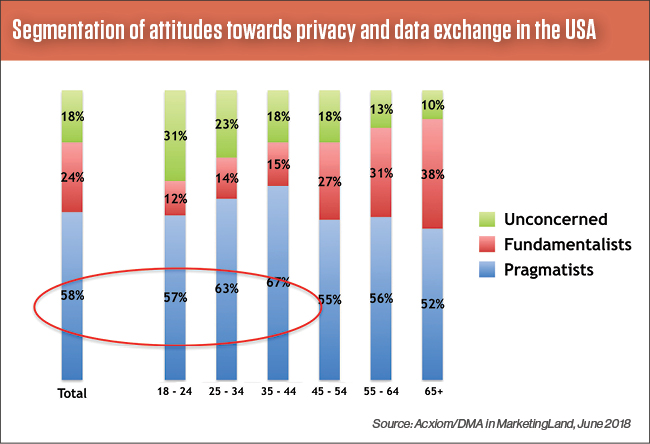
One key component is the segmentation of consumers based on attitudes towards privacy and data exchange. Acxiom/DMA identified three segments, based on these attitudes.
- Pragmatists: Will make trade-offs on a case-by-case basis as to whether the service or enhancement of service offered is worth the information requested;
- Fundamentalists: Unwilling to provide personal information even in return for service enhancement; and
- Unconcerned: Open to data exchange.
The chart below shows how the U.S. population breaks down by age group.
It’s not surprising to see how different younger consumers are, with almost one third being unconcerned about the privacy issue. But they will change as their lifestyles, family, and financial situations change. Most consumers will become pragmatists and will make trade-offs if there is a perceived benefit for them.
“The purpose of its (AI’s) use for customer care is not to dehumanize the process, but perhaps find better and faster solutions by reaching beyond the limitations of an actual employee.” — Finances Online, December 2018
Way back in the nineties, the buzz phrase for marketers was “show me that you know me”. That quaint phrase is still relevant, but we are light years ahead in terms of how much we know about our customers and how we can put that to use to drive business.
There’s a line that most customers don’t want us to cross in terms of using their personal and behavioural data and that may be different for different groups — not just across age groups, but also within age groups. The perfect AI will be able to take those differences into account.
It’s what goes in that counts
Over the past year, I have personally worked with AI solutions to help gain more insights than traditional data analytics can provide. The one thing I have learned is how critical it is to be very diligent about setting up an AI to make sure you get out of it what you want or need. The success or failure of any AI application — and especially chatbots — is entirely dependent on what goes in. And the best way to determine that is to be very specific about what you want to get out of your system.
The challenge is that there are many different companies offering different functionalities for an AI. Examples are:
- Lead generation
- Appointment setting
- Prospect engagement
- Sales call analysis
- Content management
- Forecast management, and more.
Balance the power of an AI with Trust and Integrity
There is no doubt that AI applications will become commonplace in most businesses over the next few years. The advantages are many.
In a December 2018 article by AI Business, Sal Visca, CTO of Elastic Path, identifies three key ways in which AI application can help optimize customer loyalty:
- It improves human-to-computer communications;
- It helps you identify what each customer cares about; and
- It enables you to be dynamic with your pricing.
The last point is an interesting one and perhaps more difficult in the dealership environment. But is it out of the realm of possibility? Probably not.
Deploying AI in dealerships requires a balance between functionality (what you want the AI to do), and customer concerns about how much you know about them and how you put that knowledge to work. The data suggest that more and more consumers will be comfortable with data sharing as long as they benefit in some way from that.
It will come down to two things: integrity (your ability to keep you word), and trust in your organization.