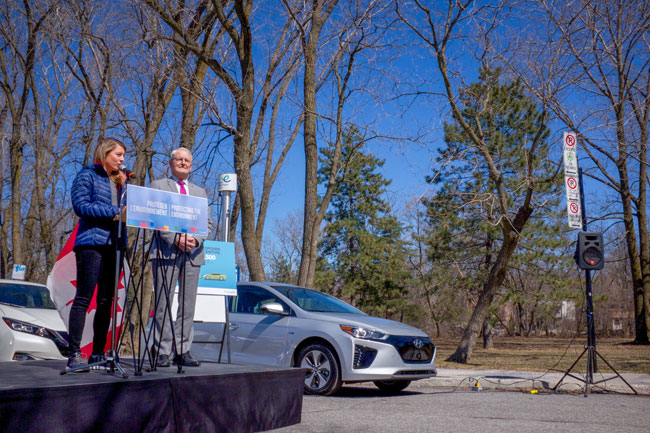
Mélanie Joly, Minister of Tourism, Official Languages and La Francophonie (left), and Canada’s Minister of Transport Marc Garneau (left) at a press conference on April 17 in Montreal, Quebec.
The Government of Canada’s recent announcement to launch its zero-emission vehicle (ZEV) incentive program on May 1 is a step in the right direction — but there is still work to be done, according to various industry groups. Canadian auto dealer captured feedback about the program details from industry leaders right after the government’s April 17 press conference in Montreal, Que.
It arrives on the heels of significant industry pressure to speed up the launch of the program and provide more details to both consumers and dealers. When the ZEV rebate plan was revealed with the federal budget in March, few details were offered and no timeline was mentioned. Since then, dealers have noticed that ZEV purchases have stalled as consumers wait for the incentives to take effect.
John White, CADA President and CEO said the announcement by Marc Garneau, Canada’s Transport Minister was “a positive first step” on the part of the government. CADA has been awaiting concrete details about the national ZEV strategy, and have been lobbying the government to roll out a program as quickly as possible.
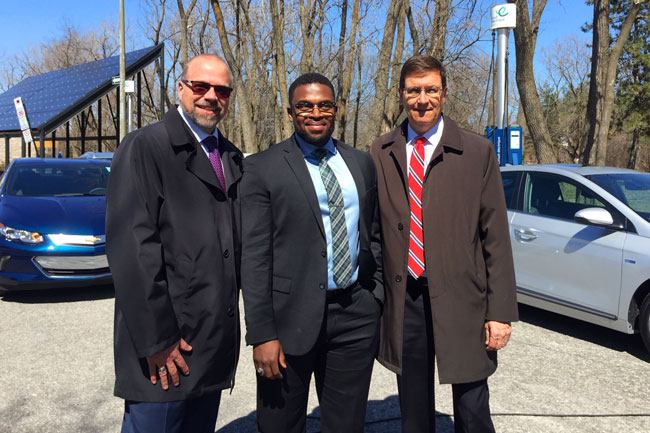
Denis Dessureault, Executive Vice-President of the Corporation of the Montreal Automobile Dealers CCAM (left), CADA Economist Oumar Dicko (centre), and John White, CADA President and CEO (right) offer their feedback on the ZEV press conference on April 17.
Behind the scenes, Transport Canada has also been talking with CADA to ensure it can introduce a program that will address the association’s concerns, and one that is seamless for consumers and dealers.
“We have a great example of how well such a program works in Quebec and B.C. The Ontario example was not good because dealers were sitting on tens, if not hundreds of thousands of dollars, waiting for the Ontario government to pay them at one point in time,” said White, in an interview. “Now that program has gone by the wayside, we’ve given that feedback to Transport Canada, they’ve provided us ahead of time with the Q&A that has gone out, and they have committed to working with us on the bulletin before it goes out at large.”
White said he is confident that all the details will be set up, but as to who will administer it all — that remains a question mark.
Denis Dessureault, Executive Vice-President of the Corporation of the Montreal Automobile Dealers (CCAM), said he was pleased with the details provided by Garneau.
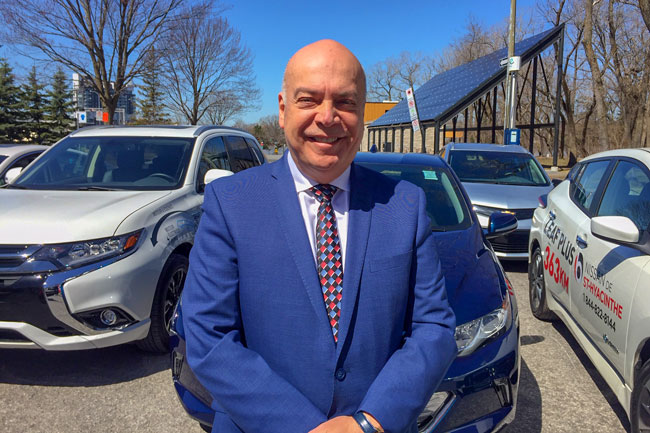
Robert Poëti, President and CEO of the Quebec Dealers Association (CCAQ) stands behind several vehicles eligible for the federal ZEV incentive plan.
In an interview with Canadian auto dealer, Dessureault said dealers were losing momentum selling these cars. “Especially in Quebec, there are plenty of these (types) of vehicles available, so you don’t have to wait three or six months to get one. But when they announced (the program) with the federal budget, it stopped everything. So now we know that it will restart.”
Similarly, Robert Poëti, who is the new President and CEO of the Quebec Dealers Association (CCAQ), said he is pleased that the announcement represents something concrete — as in, there is a date, and there are about twenty vehicles that consumers can choose from that are eligible for the rebate.
When asked whether he was worried that everything would be ready on time and that the remaining details (how to provide consumers with the incentives) would be available by May 1, Poëti said he was only concerned the first time the ZEV plan was announced — back in March.
“Today, I think we have enough details, and we have already applied a similar program in Quebec, so it’s already easier. Dealers already experienced at this. I am not worried about the application (of the program) in Quebec,” said Poëti in an interview.
As for Sidney Ribaux, Executive Director of Équiterre, he said the announcement was a step in the right direction, but acknowledged that more needed to be done. Équiterre is a Canadian non-profit environmental organization. They sat on a national zero-emissions vehicle advisory board created by the Government of Canada to discuss the type of policies that should be implemented to stimulate the sale of electric vehicles.
“There are many, many policy recommendations that came out of this committee. There were academic experts and environmental groups like ours, and the manufacturing industry, discussing what can be done to stimulate the sale of electric vehicles,” said Ribaux. “Having a rebate for consumers is one of those things. It’s one of them, and it’s an important one, but it’s certainly not everything the government should be doing. But it’s a step in the right direction, so at least we are moving.”

Sidney Ribaux, Executive Director of Équiterre, offers his impressions on the ZEV press conference in Montreal, Que., on April 17.
Ribaux said the government also needs to implement sales targets. “We really feel strongly that there needs to be regulation where you legislate targets for manufacturers and how many vehicles they need to sell.”
He sees this a key to get things moving — a way to push the OEMs to figure out the best way to sell electric vehicles. The market, he said, would do the rest of the work.
It’s not a suggestion that CADA is inclined to agree with, says John White.
“Équiterre sat with CADA on a national ZEV advisory group, and there were other things that we recommended that we came to a consensus with — one was that the government needed to invest in infrastructure across the country; the second is that they needed to invest in awareness, and also training,” said White. “Lastly, they needed to find a way to give dealers some sort of tax credit for all of the tools and equipment that they are going to be required to invest in these vehicles.”
He said one OEM has already asked their dealers to spend $300,000 to set up the necessary infrastructure to handle ZEVs.
The one thing that CADA does not want to see the government come out with is a ZEV mandate like they have in Quebec. “That is maybe one area where we disagree with Équiterre, but on the other elements we were aligned.”
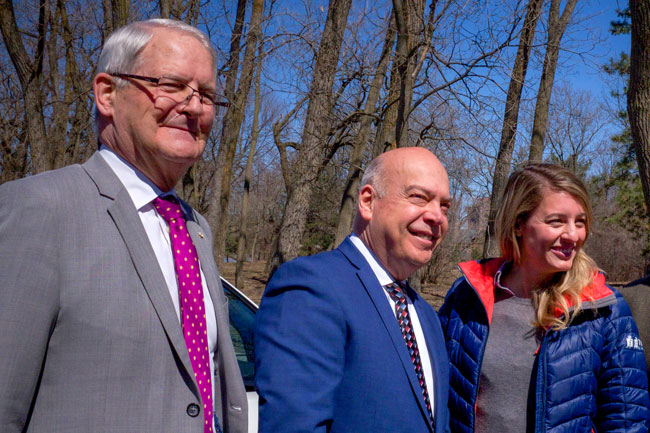
Canada’s Minister of Transport Marc Garneau (left), Robert Poëti, President and CEO of the Quebec Dealers Association CCAQ (centre), and Mélanie Joly, Minister of Tourism, Official Languages and La Francophonie (right).