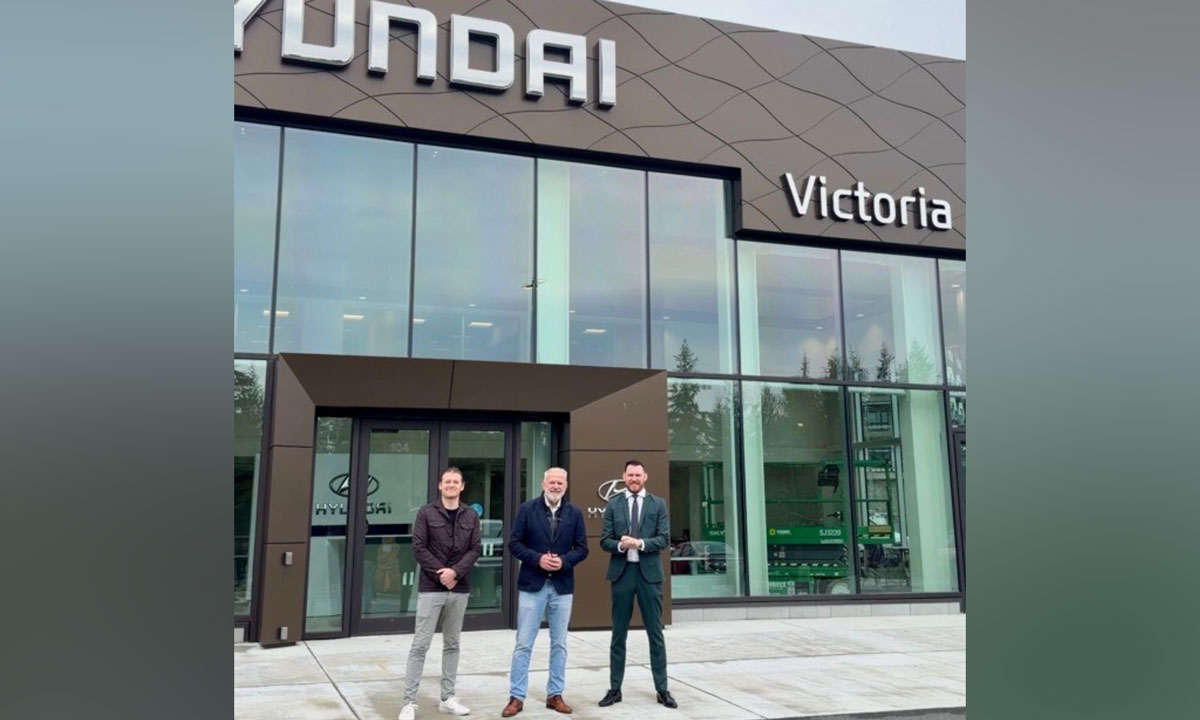
Keyloop’s Fusion event in Vaughan brought together dealers and industry stakeholders to examine a growing reality in automotive retail: the challenge is no longer adopting technology, but making it work together.
That theme ran through the day at the Paramount Event Space, where Keyloop executives from Canada and the U.K., dealer operators and outside speakers focused on what comes after years of digital adoption: simplification, integration and more practical use of AI.
Keyloop CEO Tom Kilroy opened the event by stepping back from product talk and looking at what has and has not changed over five decades in retail automotive.
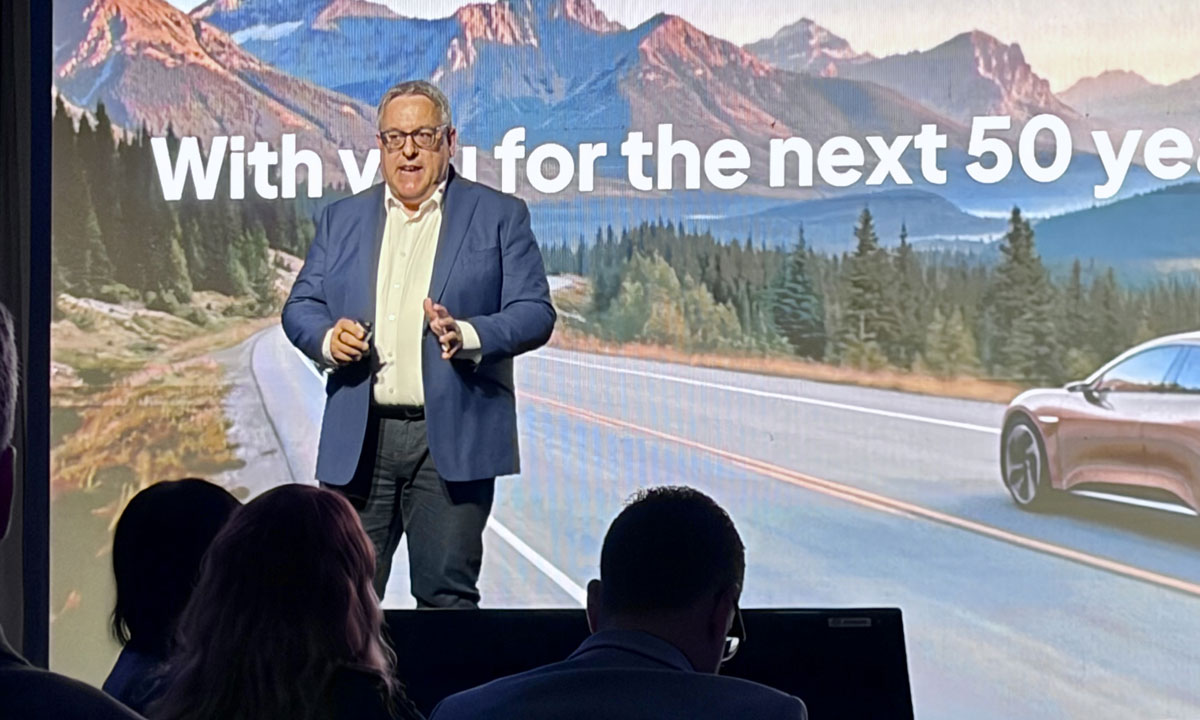
Tom Kilroy
“The thing that hasn’t changed is a desire to have freedom and mobility to be out on the open road,” said Kilroy. “People buy cars because they want the enjoyment of owning. That hasn’t changed even if technology has.”
He said the other constant is trust.
“People buy a car from somebody that they trust,” Kilroy said, arguing that the job of technology is to support that human relationship, not interrupt it. In today’s dealership, he added, customers arrive in “a much richer information state” than they once did, and the real test is whether the experience feels joined together from the first digital touchpoint onward.
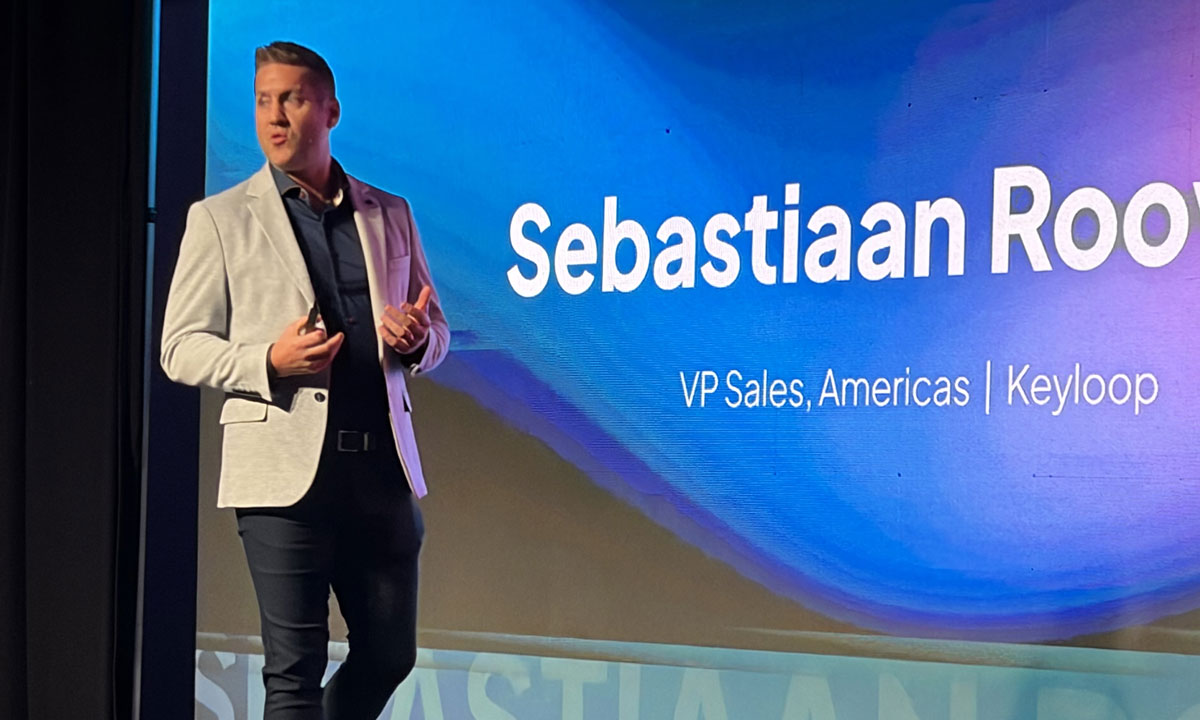
Tim Smith, Keyloop’s Chief Strategy Officer, picked up that thread by talking about how quickly the landscape is shifting.
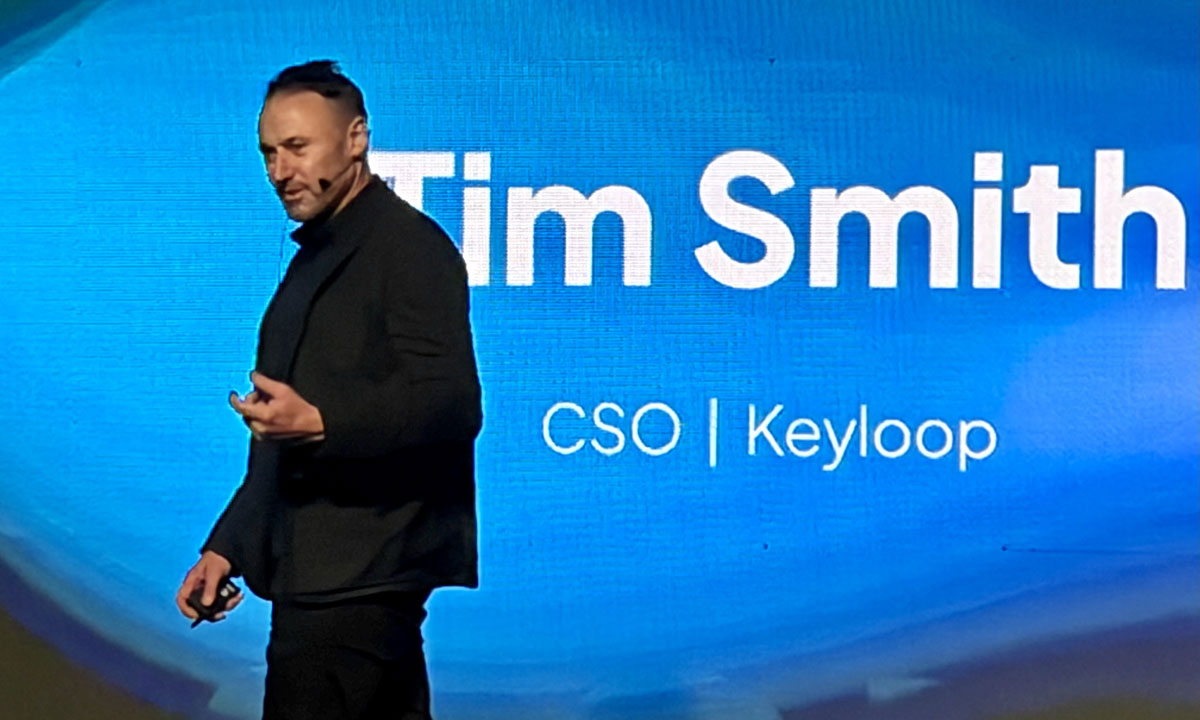
Tim Smith
“One of the big factors, and we have to be aware of this context, is the speed of change. We all feel it every single day,” said Smith. “At this precise moment in time, we are seeing the advent of AI and automation.”
Smith said automotive retail is still catching up to sectors that digitized earlier and more aggressively, but he argued the industry’s bigger problem now is not lack of technology. It is excess complexity.
“At some point, the machines got in the way,” he said. “I call this the layer cake.”
By that, Smith meant the buildup of point solutions over time: more systems, more logins, more friction, more human effort required to connect tasks that should already be connected. He cited research suggesting some dealerships are using about 18 pieces of technology in the sales process, with 30 to 60 per cent of sales executive and administrative time tied up in non-customer-facing, low-value-added work.
He also argued that the old retail funnel is gone.
“The car buying journey is no longer linear,” Smith said. “It is non-linear. It’s all individual.” And, in a line that captured much of the day’s subtext, he added: “It’s not just the technology that’s changing — it is the way that we sell.”
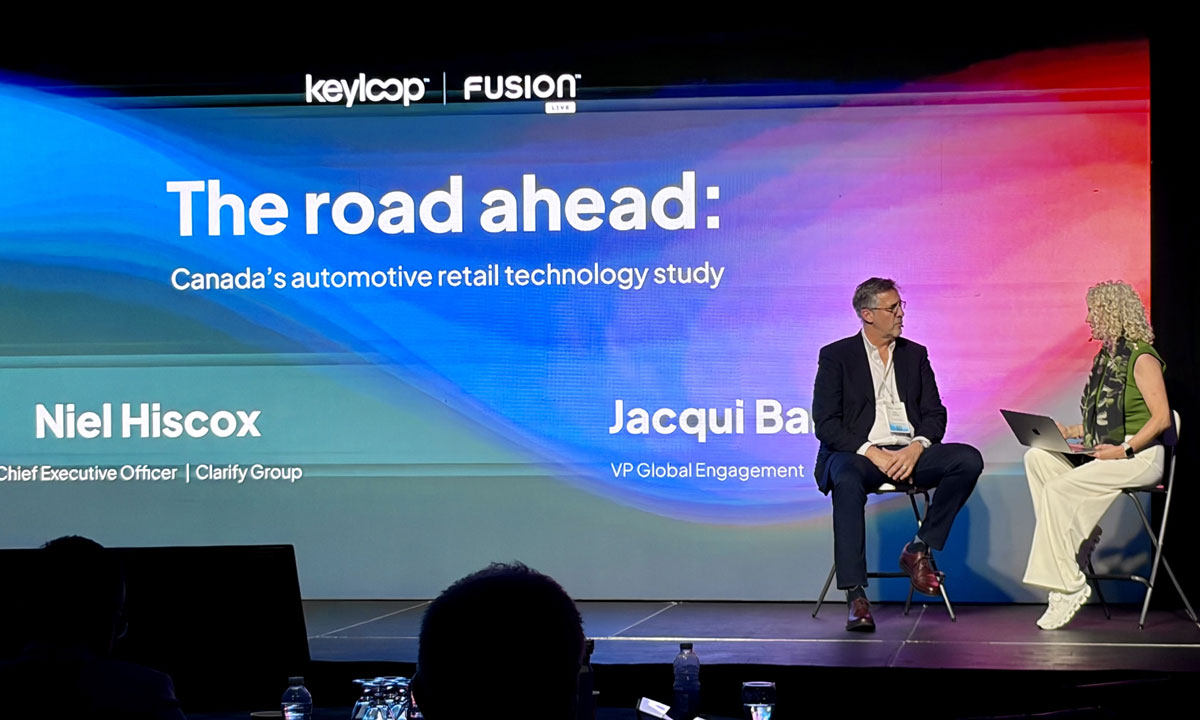
That set up an engaging fireside chat moderated by Jacqui Barker, VP Global Engagement at Keyloop, with Niel Hiscox, CEO of Clarify Group, on the findings of the Canadian Automotive Retail Technology Study (CARTS) prepared for the Canadian Automobile Dealers Association and sponsored by RBC Auto Finance.
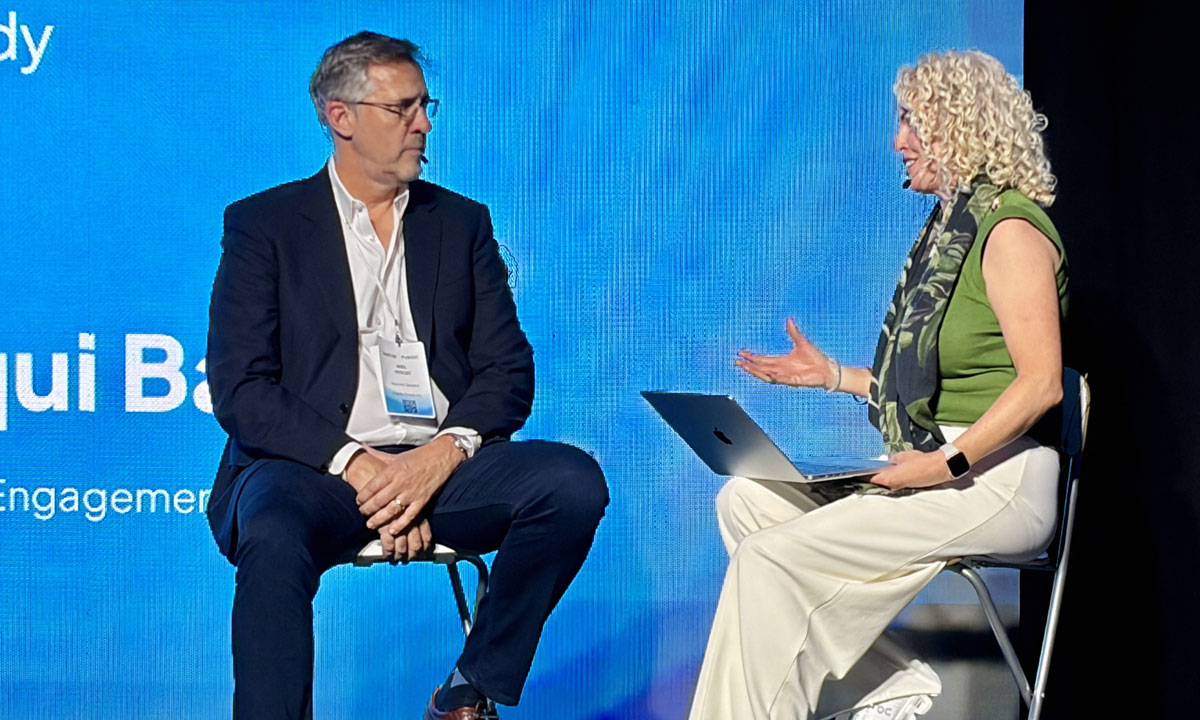
Niel Hiscox and Jacqui Barker
Barker framed the exchange in human terms, telling dealers that if they feel overwhelmed by the amount of technology coming at them, “you’re not on your own.” She said one of the striking lessons from the study is that even when the discussion centres on software and systems, “primarily it’s always about the human.”
Hiscox said the study began with a simple but important gap.“What we realized is there really wasn’t any Canadian data that provided some depth and specificity to what was going on with technology at the dealer level,” he said.
But once the research began, another issue surfaced. Dealers wanted the information, but even they struggled to describe their own tech environments clearly.
“Dealers had a tremendous appetite to get the information. They believed the study was important, they wanted to participate. They found it really hard to answer the questions,” said Hiscox. He said the lack of information at the highest levels signalled that the study was even more important to conduct.
That prompted a study redesign. As Barker put it, the study shifted toward asking, “What process are you doing in dealerships? How do you look after your customers?” rather than focusing on technology itself. Hiscox said that change got closer to the real issue: dealers are not looking to buy features, they are looking to solve business problems.
“The antidote to the hesitancy was really understanding the business case,” said Hiscox. “I don’t want to buy technology, I don’t want to buy features that your technology offers … I’m actually trying to solve the problem with my business.”
He said that is especially true at the front of the store, where OEM priorities, lead sources and customer expectations all converge.
“If you work in an OEM office, what you get rewarded for is vehicle sales. That focus pushes itself all the way down to the dealership,” said Hiscox. But dealers also see “tremendous inefficiency and waste and bad data at the front of the store.”
Considering the mix of leads coming from dealer websites, third parties and OEM channels, “there is redundancy, there is junk, there is time wasted there.” Chasing a bad lead, he said, is both a waste of staff time and “a bad experience for the customer.”
From there, Hiscox made the argument that the next step is not just more investment at the front end, but a better connected view of the customer across the whole business.
“One of the real pieces that we need to see improved from a business performance standpoint, certainly from a customer experience standpoint, is actually the ability to have common tools, common touch points, and looking at a common view of the customer throughout the store,” he said.
Barker pushed the conversation further by pointing to one of the study’s more revealing findings: dealerships often already have technology they are not fully using.
“There’s technology in the dealerships that just isn’t being used,” she said, likening it to how most people use only a fraction of Excel’s capabilities. Hiscox agreed, saying partial adoption breeds dissatisfaction because stores end up paying for tools they do not feel are delivering full value. That, in turn, creates an opening for better post-sale vendor relationships and more deliberate optimization.
His advice to dealers and vendors was blunt.
“From the dealer standpoint, you and your teams need to go into these sales discussions fully transparent in terms of talking about your business, what’s working, what you’re trying to address,” he said. “And from the vendor side … the key really is to sell by listening.”
Adrian Nash, Keyloop’s Chief Product Officer, and James King of Fusion’s newly-acquired firm motortech.ai took the stage next to explain how Keyloop is trying to respond to those same problems through Fusion and embedded AI.
Nash said the company is not positioning Fusion as just another DMS, but as “an automotive retail platform” designed to connect business processes end to end. “The whole point of Fusion is to connect those things together,” he said. “What we want to do is to deliver something that is end to end,” with “a solid line through any customer journey.” He also stressed that the company’s Sales Hub was built for Canada first: “It’s not a U.K. market solution that we’re bringing into Canada.”
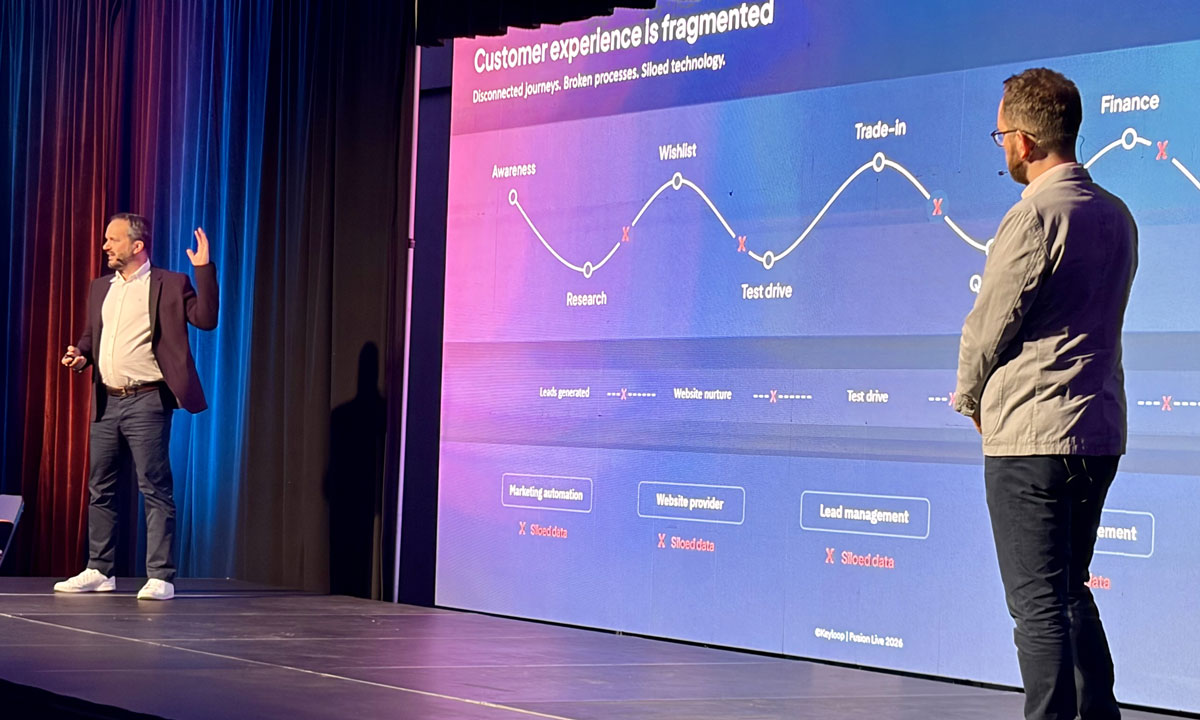
King reinforced the AI message in broader terms.
“AI isn’t a product, it isn’t a feature,” he said. “It’s actually more currency that runs through the whole of the ecosystem.” The goal, he suggested, is not to bolt AI on top of dealership workflows, but to embed it in a way that gives staff “superpowers” while preserving consistency, data integrity and the human touch.
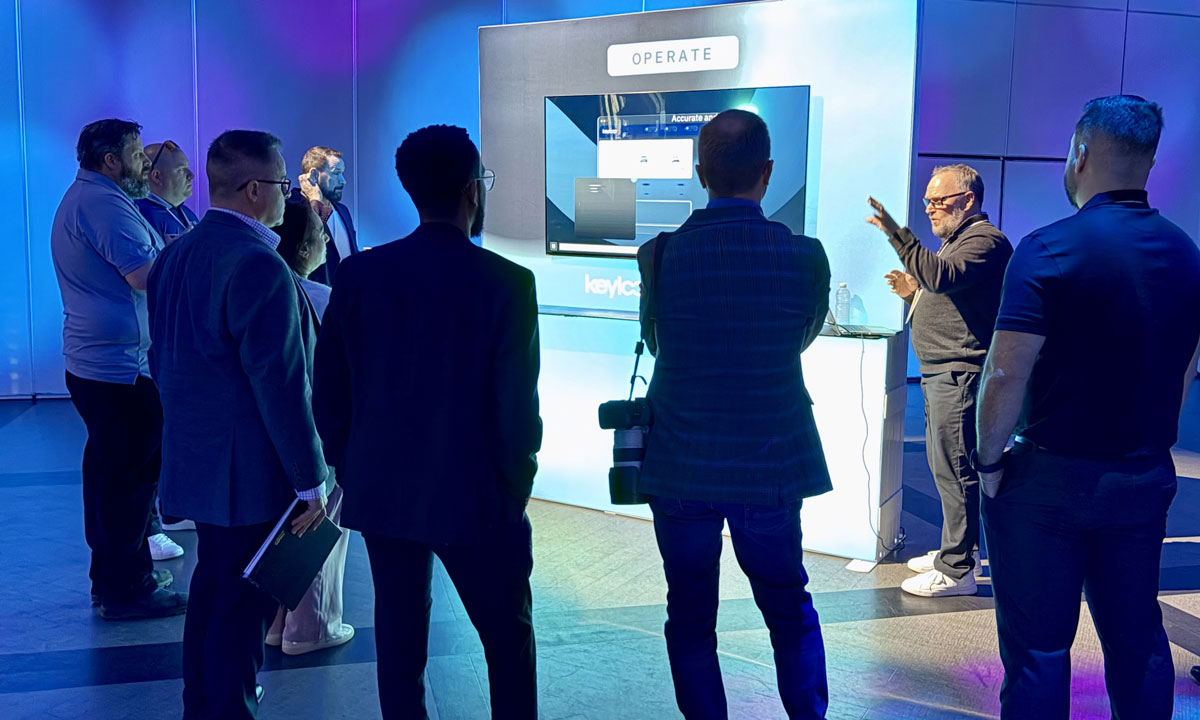
After the Nash-King session, dealers moved into a demo theatre, where they split into four smaller groups and rotated through four demo stations featuring large-format screens led by Keyloop product experts. Each station focused on one of the platform’s four domains — operate, ownership, supply and demand — giving attendees a closer look at how Fusion’s capabilities are meant to connect across the business rather than sit as standalone applications.
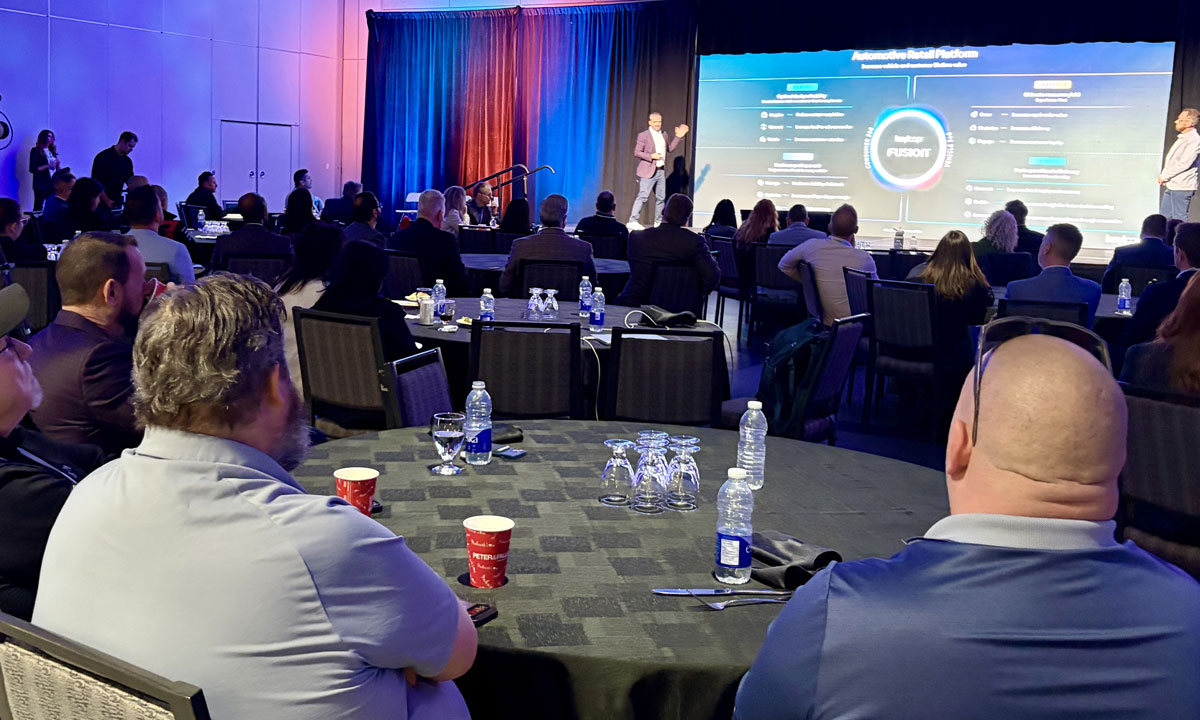
Dealers then returned for a panel discussion moderated by Barker, titled From Insight to Impact: Why Retailers Are Choosing Change — and What Happens Next. Panelists were Andy Caletti, Owner and General Manager of Erin Park Lexus, Erin Park Toyota and Belleville Toyota; Eric Van Spyker, Dealer Principal and Managing Partner at Trillium Ford; and Brent Wees, certified AI trainer and marketing strategist at idea.meet.plan.
Wees said he has seen dealer interest in AI accelerate quickly.
“They’re doing the research faster, they’re getting in front of us with their questions quicker,” he said. “I think the dealers are wholeheartedly trying to get their chops up because the learning curve is so fast.” He added that many people have a conversion moment early on: “The first time you ask a question of AI and you get War and Peace back and you don’t have to follow 12 links to find the answer, it blows your mind.”
Caletti said the payoff will not always show up neatly on a spreadsheet.
“There’s going to be huge efficiencies that you can’t necessarily quantify,” he said. He also praised Keyloop’s willingness to work with Canadian dealers to shape the product. “It might take a little longer than some of us anticipated,” he said, “mostly because there is so much being built into it to ensure and deliver those efficiencies that we’re looking for and to ensure at the end of the day when we launch the product … that it is going to be the best product it can be.”
Van Spyker framed the issue in practical operating terms.
“It’s not just about being efficient to make more money,” he said. “It’s an efficiency to gain more time back.” With labour costs so high, he said, the decision increasingly becomes whether to keep adding people or “look for technology tools to do what they’re supposed to do and derive that efficiency for you.”
Closing keynote speaker Rocky Ozaki, founder and CEO of NoW of Work Inc., widened the lens again, arguing that the real dividing line may be mindset more than capability. He said automotive retail has good reasons for moving cautiously: it has operated in a model that worked well for a long time. But that cannot be an excuse for standing still.
“If it works and it’s not broken, why fix it?” Ozaki said, before answering his own question: “What I’m going to compel you today is: now is the time to make the shift, even if it’s working.” He described AI as a force that will be “bigger than the Internet, the smartphone, any other type of technology ever before.”
The question for dealers is no longer whether change is coming, but how quickly they are prepared to adapt to it.