How women are climbing the ranks in the automotive industry
It’s the only conference of its kind in Canada — a great place for women to network, connect, and meet inspirational female leaders who are breaking barriers in the auto industry and beyond.
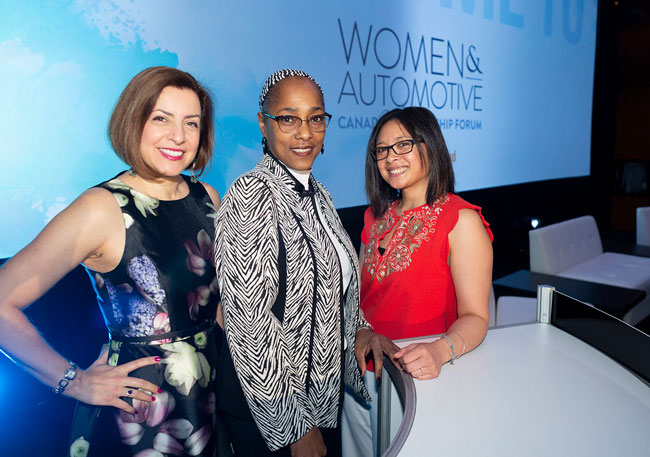
Nearly three hundred people gathered for the 4th annual Women & Automotive Canadian Leadership Forum in downtown Toronto, Ont., on March 21, 2019.
And even though the keynote speaker Rhiannon Rosalind wasn’t from automotive, her story was inspirational; it was the highlight of the forum.
At only 34, Rosalind is the President, CEO, and Owner of The Economic Club of Canada. But she faced many challenges to get there. Raised by a single mom, they faced financial problems and addiction issues.
“By 15, I was out of school — flunked out, kicked out — however you want to phrase it, I was out. I was trying to find my place in the world by hanging out with kids who felt broken like me. I started to dabble with drugs and alcohol quite heavily,” said Rosalind.
“Things changed the moment I caught my reflection of my own eyes in the mirror after a night of heavy drug use and people passed out around the apartment. I woke up and I took a longer glance at myself and there was a hollowness in me. There was a vacancy in my eyes. I knew deep in my heart this was not my calling. I ran out of the apartment sobbing. My life was a mess. I knew I was on the road to repeat a cycle.”
Rosalind went back to school, and became the only person in her family to graduate from university. She launched her career as a junior level event coordinator, and rose up the ranks to become the President and CEO of The Economic Club of Canada in 2008.
“People will accept you in positions where you look the part. I looked like an entry level event coordinator. I don’t look like the CEO. As an event coordinator people were fine with me. I found myself in very important rooms and I knew what my place was. It was changing from that place, literally against the wall of the room, to sitting at the table,” said Rosalind.
She spoke from the heart with honesty and authenticity. “I had all the confidence in the world when I was jumping the ranks in the organization. But when I became president I lost every single ounce of my confidence. I was shell shocked. All of a sudden I was responding to other people’s perceptions and bias towards me not being right for the role. I started seeing myself through their eyes and I started to absorb that. It rocked me very aggressively for the first couple of years.
“I tried my very best to play a role. I was acting because I didn’t believe in myself. It took time for me to change my own mind. When we find ourselves as women in places that traditionally we weren’t seen in, we have to change our minds about that,” said Rosalind. “I had to understand: this is progress at its finest. Walking into this room, being the only woman, and having to convince everybody in this room why I’m here is an honour and a privilege. And I accept the challenge.”
Another key message was women in the workforce improve productivity, according to panelist Sandra Kim, Director of Human Resources at TradeRev.
Companies with a diverse workforce and more than 30 per cent female employees increase productivity by 15-35 per cent. “You need to have the diversity and perspective that women bring to the table. If there are few women, you’re going to lose that perspective,” she said during a panel discussion on Advancing Women in Automotive.
Unfortunately many women still aren’t applying for jobs in automotive, said co-panelist Ruth McBride, Vice-President, Manufacturer Partnerships, Dealer Products & Programs at Scotiabank.
“It’s difficult to find women who apply, especially in automotive roles in wholesale or commercial automotive. It’s not typically where women go. We have to go outside the organization and tap people and tell them: ‘I think this will challenge you. I could see this as a development opportunity that will help you down the road,’” said McBride.
The opportunities are significant, especially for women in automotive. Currently, the General Motors Canadian Technical Centres in Oshawa and Markham employ nearly 700 engineers — though only one in four are women. But the goal is to increase the headcount to 1,000 and add more women to these typically male-dominated roles. The opportunities ahead and the future look bright for women in automotive.