IN OUR FINAL INSTALLMENT OF THIS HISTORICAL SERIES, WE EXPLORE THE CHANGES THAT ROCKED THE AUTOMOTIVE INDUSTRY IN THE 1990s
The 1980s had been a roller-coaster ride for the auto industry. The oil crisis a decade before had finally opened the doors to smaller import cars, ending the domestic automakers’ near-monopoly and sending them scrambling to downsize their vehicles.
To keep their foothold, Japanese automakers first built factories in the U.S., and then added luxury brands to their portfolios.
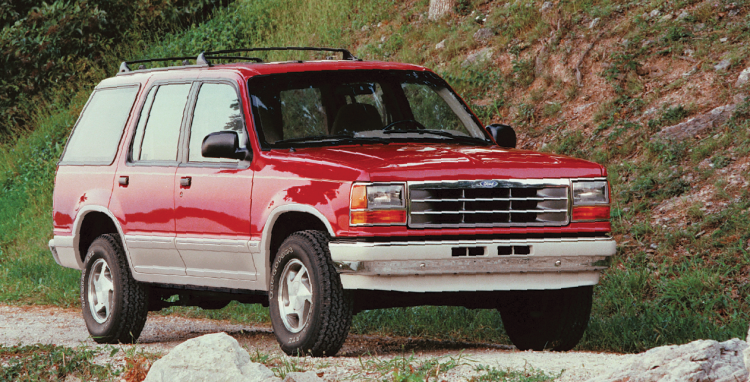
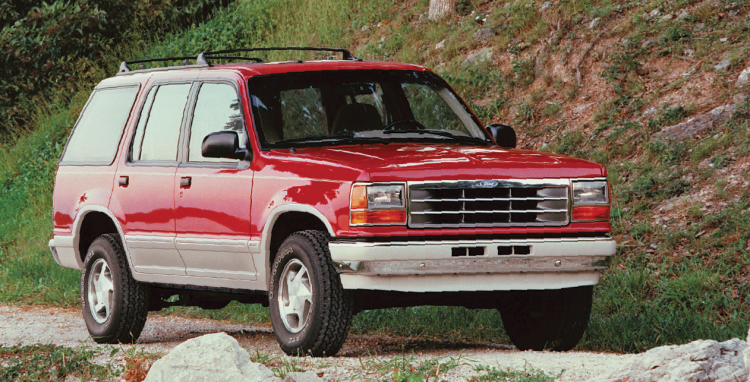
Fuel prices finally stabilized, and the 1990s brought a sea of change that no one expected. That shift kick-started in 1991 when Ford introduced the Explorer.
It wasn’t the first of its kind. Automakers had been enjoying moderate success with such vehicles as the Jeep Cherokee, Dodge Ramcharger, and Ford’s own Bronco II, which the Explorer replaced. Pickup trucks had also been making a gradual shift from job sites to family driveways.
But the Explorer eclipsed them all. It was more luxurious and rode smoother than its competitors, but still promised off-road adventures, even if buyers never got its wheels dirty. Within its first year, it took the seventh-place sales spot among all cars and trucks in the U.S.
The imports had little to compete with it, and had to sit out the resulting SUV craze until they could come up with their own. In Canada, the Japanese automakers sold 323,699 vehicles in 1991, but progressively slid to a decade low of 204,037 just four years later.
Fuel prices finally stabilized, and the 1990s brought a sea of change that no one expected.
Still, times were tough in the showroom for all companies overall, despite the introduction of new tools for Canadians that helped increase consumer confidence, including plain-language leasing contracts, GAP protection, and the Canadian Motor Vehicle Arbitration Plan, or CAMVAP, which launched in 1994.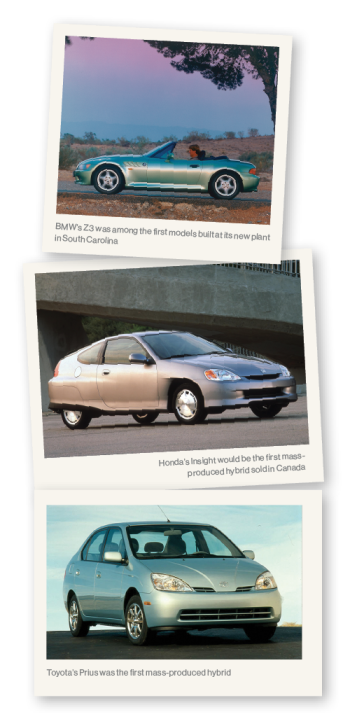
All dealers suffered through the massive recession that started in 1990, and even those who could offer SUVs often waited helplessly for these backordered vehicles to arrive.
Between the economic squeeze and increasing auto reliability, drivers were hanging onto their vehicles for an average of seven years, up from four to six years in the decade prior. And dealerships were closing, especially in the U.S., where the trend was moving away from numerous smaller retailers clustered in an area, to one single and massive multi-brand auto superstore.
This was also the decade when the Internet transitioned from a specialized portal for experts to the World Wide Web that was easily navigated by anyone with a computer. Many retailers underestimated its importance and failed to become early adopters for their businesses.
Perhaps the Web’s most significant effect on dealers was that consumers could now access pricing, specifications and options, and cross-shop vehicles without actually visiting a store. They could also share their horror stories with each other, real or imagined, which revealed unethical practices but also jeopardized legitimate ones.
While virtually every other product would eventually be sold online, dealers in the U.S. would band together and push their state governments to pass laws prohibiting consumers from bypassing showrooms and ordering their vehicles directly from a manufacturer’s website.
Politics would also affect the auto industry with the creation of the North American Free Trade Agreement, or NAFTA, launched in 1994. Canada and the U.S. already traded many commodities freely over the border, but the new agreement added Mexico, which would become the site of several new vehicle and parts factories.
Not only were costs lower, but also Mexico’s independent free trade agreements allowed manufacturers to send their cars to countries that would have levelled hefty tariffs on shipments from the U.S. or Canada.
“Still, times were tough in the showroom for all companies overall, despite the introduction of new tools for Canadians that helped increase consumer confidence”
The decade was also remarkable for cars that would ultimately spearhead the future of fuel efficiency, starting with one that never came to Canada: the EV-1. Unique among all states in its ability to set its own environmental standards, California mandated that a percentage of all cars sold there would have to be zero-emission. Toyota, Ford and Nissan produced a handful of electric models, but the spotlight was on the eleven hundred EV-1 models that GM built starting in 1996.
Those who leased them loved them, but they were prohibitively expensive to produce, and battery technology was nowhere near what it needed to be to supply enough range. When California rescinded its mandate and the leases expired, GM took the cars back and crushed them, which turned into a public relations nightmare.
But if all-electric cars weren’t ready, hybrids were. In 1997 in Japan, Toyota unveiled the Prius, the world’s first mass-produced hybrid vehicle. Honda debuted its Insight hybrid shortly afterwards, but it would be the first of the two by a nose to reach Canadian buyers.
Kia followed fellow countryman Hyundai to Canada, but while Hyundai came here first and then went south, Kia did it the other way around. It already had a model in the market, since Ford rebadged the Kia Pride as its Festiva under an equity agreement.
Kia arrived in the United States in 1995 under its own name with its Sportage and Sephia. The two Korean automakers merged in 1998, and a year later, the first Canadian-market Kia went on sale in Vancouver.
There were other mergers and acquisitions during the decade as well, with varying degrees of success. The Renault-Nissan Alliance turned out very well, but the DaimlerChrysler marriage of 1998 ended in divorce nine years later. General Motors acquired Saab, Ford purchased Volvo, and Rolls-Royce and Bentley were split between BMW and Volkswagen. Through all of it, dealers had to adjust to the changes coming down their pipelines.
The decade ended on an odd note, as people simultaneously cheered a new millennium while bracing for a possible Y2K disaster. Instead, the real meltdown would come later with a global financial crisis, two automaker bankruptcies, and plummeting vehicle sales.
But it had also been quite the century, as cars slowly evolved from horseless carriages to horsepower. And through it all, no matter what vehicle it was, it was a dealership that got it on the road, and helped to keep it there.