LOOKING AT THE TIPPING POINTS THAT HAVE CHANGED THE AUTO INDUSTRY — AND THOSE STILL TO COME
 Canadian author Malcolm Gladwell published his first major book, The Tipping Point, in 2000. His book captured the attention of millions and his thinking has influenced how we interpret society unfolding.
When you study the last twenty or so years in the auto industry, there are many examples of tipping points that have marked changes whose impact we still see today.
I also get the feeling that we’re on the verge of more tipping points, especially with millennials moving into the spotlight as the primary customers of dealers and manufacturers.
WHAT CAUSES A “TIPPING POINT?”
Tipping points can sometimes be defined by one dramatic event, like the oil crisis of 1973, when actions from the Organization of the Petroleum Exporting Countries (OPEC) countries resulted in the price of oil rising dramatically.
In North America, this led to highly favourable conditions for marketing smaller cars with smaller engines. This resulted in some brands becoming household names, such as Honda and Toyota, and changing negative consumer perceptions about smaller vehicles.
But more often than not, tipping points occur because of a combination of factors. I think one of the best articulations of how these changes happen comes from Dr. Philip Gordon, an American diplomat and foreign policy expert who has lived and worked in many countries and has served in both the Clinton and Obama administrations.
Dr. Gordon identifies four key components that cause a tipping point: people, organizations, media and events.
AUTO INDUSTRY TIPPING POINTS
Let’s look at some of the tipping points we’ve seen in the industry over the last decade or so and look forward to developments taking place. I think you’ll see these four factors playing a role, perhaps not to the same extent each time, but they’re always there.
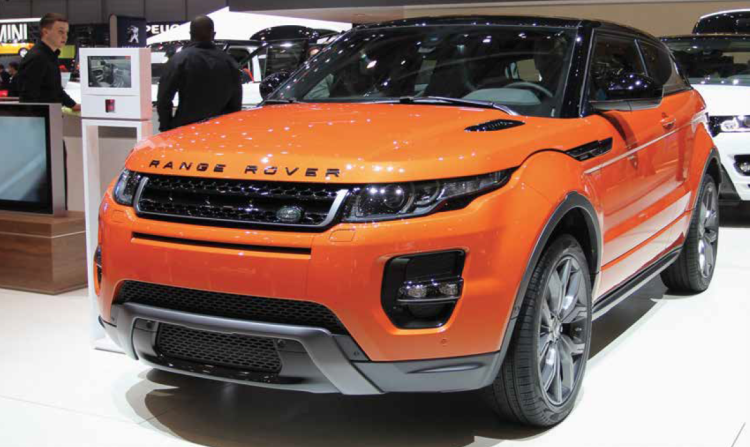
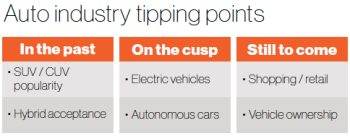
When you look back at two fairly recent tipping points — the rapid acceptance of SUVs and CUVs and their dominance in the market and the acceptance of hybrids as “mainstream” vehicles — both have elements of all four factors.
One thing not as evident in the auto industry is the “people” component.
Consumers wanted more utility, but a little more pizzazz than a minivan. The lines between “car” and “truck” were becoming blurred as manufacturers raced to give boomers what they wanted.
The oil price was relatively stable, so larger, heavier vehicles did not turn consumers off. All of a sudden it was highly acceptable and stylish to be seen in a vehicle that provided utility, as well as a sense of adventure.
With hybrids, there was a long period of time when anyone even considering a hybrid was seen to be almost part of a cult. Then, environmental concerns suddenly took off because government leaders were talking about it, the media was consumed with it and the outliers were no longer outliers.
Now, we’re on the cusp of two more significant changes: electric vehicles are poised to become far more common and acceptable, and autonomous cars are suddenly no longer the subject of science fiction.
I think the acceptance of autonomous vehicles will accelerate rapidly as a result of several factors, such as favourable media attention (compared with scepticism voiced just a year or so ago), growing traffic problems in major cities, and rapid advances in technology.
I conducted a study around three years ago that showed how skeptical consumers were on technologies such as lane departure warning and collision mitigation. That has all changed.
The threads running through these changes are evident. Companies are seeking a competitive edge or being driven by pressures from consumers or government. Media commentary is also shifting, usually from negative and skeptical to positive and accepting.
One thing not as evident in the auto industry is the “people” component.
An exception is probably Elon Musk, who has challenged not only the paradigm of the electric car as a glorified golf cart, but also the way consumers want to buy cars.
STILL TO COME
I believe two of the most interesting and challenging tipping points lie before us. The first is what will happen when millennials decide they actually do want cars.
There’s a lot of disagreement on this subject.
Steven Szakaly, chief economist of the National Automobile Dealers Association (NADA) said, “it takes four millennials to replace one boomer.”
But J.D. Power notes that millennials have now surpassed Gen X in their share of auto purchases in the U.S. and accounted for 27 per cent of all purchases in 2014 (up from 18 per cent in 2010).
We’re on the cusp of two more significant changes: electric vehicles are poised to become far more common and acceptable, and autonomous cars are suddenly no longer the subject of science fiction.
Millennials are not yet at the boomers’ level, but the company said the boomers’ share peaked in 2010 and is on the way down.
There’s a lot of comment about millennials not wanting to own cars any more and shifting to a new model of ownership — sharing. Is this the next tipping point, where sharing will suddenly become the most acceptable way to have mobility?
There are plenty of naysayers.
The Center for Automotive Research in Michigan said, “When the cost of owning a car drops below 10 per cent of income, young people will stop telling pollsters that they can do without cars.”
Demographic Intelligence, a Washington based demographic analytics firm, sees a shift in millennial demographics.
The firm sees millennials as being at a tipping point of their own, predicting that married millennials are coming and 60 per cent of millennials will be born to married parents, up from 45 per cent today.
While this doesn’t guarantee that millennials will come flocking into dealerships, it does suggest that there will be some of the same stabilizing factors present that drove boomers to keep buying cars.
A Bloomberg article said that “economic forces shape societal attitudes. The 25 to 34-year-old has less to spend and is less interested in spending it on a car.” But Bloomberg also said there are “life milestones that necessitate buying a car.”
Put these contradictory thoughts together and it’s clear we’re approaching a tipping point, but the outcome is not that certain.
The final tipping point is in the retail area.
We’re seeing glimpses of new retail models. We know that virtually 80 per cent of car buyers go online before buying.
That’s not news. 
But one study finds that 49 per cent of Americans are prepared to complete a purchase process online and that 20 per cent are willing to put a deposit on a car they find online.
There’s still the chasm between the online and showroom experience. I see that every day in customer comments about the purchase experience.
Customers wonder why everything is simple and transparent online, but not in the showroom. And the question arises when the pricing discussion happens online or in the showroom.
We’ve been getting these messages for a few years now, and it seems certain that someone will break through to establish a truly disruptive retail model.
Millennials might be a big part of that change, as many have not been schooled by their parents or the industry as they wait to enter the market.
The common thing about tipping points is that we usually don’t notice how significant they are until they’re almost on us, or even only after the fact as we rush to keep pace with the changes. That’s what makes life interesting!