CUSTOMERS EXPECT THEIR ONLINE INQUIRIES TO BE HANDLED PROMPTLY, AND DEALERS NEED TO BE READY TO RESPOND
It’s not news that consumers use the Internet actively in their vehicle shopping process and increasingly, to schedule service visits. In many cases, this involves some kind of two-way communication, either by email or via social media.
These methods of communication are beginning to pre-empt the telephone as consumers become more comfortable with all of them, and very often, prefer the relative anonymity of digital communication as the first step in their communication journey.
In this new reality, speed is of the essence. While the amount of time taken to respond to an Internet inquiry or one on social media is probably the most important thing to your prospective customer, digital media guru Peter Shankman astutely observes that while speed is important, “you just have to beat your competitor.”
True, but the bar has risen considerably in just the past couple of years.
Speed of response alone is not enough, and it’s the entire process of responding that is important. Was the response quick? Did the response indicate that the dealership was paying attention to the customer’s need for information? And did the dealership follow through to close the loop and start the relationship off on the right foot?
Which dealers do best on the Internet?
The Pied Piper Management Company in the U.S. recently published the results of their fifth annual study on the responsiveness of auto dealerships to customer enquiries received over the Internet.
The study, called the Internet Lead Effectiveness Benchmarking Study, involves sending emails to dealerships across the U.S. (13,637 stores representing all major brands) asking a question that could not be answered by an auto response or a non-customized email template.
Pied Piper ranks all of the brands using its proprietary Prospect Satisfaction Index, which “ties the ‘mystery shopping’ measurement and scoring to dealership sales success.”
Among the criteria used by the research company to evaluate the responses includes responding in any way to the email and the speed of the response; a response that gives the prospective customer a reason to act quickly; and giving reasons to buy from that specific dealership.
Here’s who ranked best and worst in the study (see chart at right).

It’s surprising to see Scion and Volvo among the bottom five — both brands that one would expect to be on top of this issue. The key seems to be that they both had higher than average incidence of not responding at all (failed to respond to one in ten or more inquiries).
The study also found that customer inquiries received a response within 30 minutes, 50 per cent of the time. So 30 minutes seems to be the number to beat if you want to be better than average.
Dealerships attempted to contact by phone 63 per cent of the time. While that practice is seen to be part of a successful internet sales process, it won’t necessarily make up for a lack of speed and quality of response.
So much for the sales side. What about the service side, where online service scheduling is growing, albeit at a surprisingly modest pace?
Having done some mystery shopping on this aspect, I suspect the issue here is the fact that, while many dealers have systems in place, the internal processes to monitor them and merge them with internal processes are lacking.
Comprehensive scheduling systems that help the dealership identify the customer properly, understand the service need in detail and can tie directly into the DMS to schedule work and technicians, will become more important as consumers increasingly expect this type of
seamless interface.
There are most likely two reasons why online service scheduling is not growing more quickly.
First, customers get frustrated with the inability of some systems to recognize and allow them to be specific with their needs.
Second, when customers arrive at the dealership, they have to go through the whole process again in person.
Once again, speed is key and waiting more than a few hours at most to have a service appointment confirmed is not what customers expect these days.
The challenge to meet customer expectations on digital communication magnifies when things get busy in sales or service. Technology and better marketing practices can drive up the volume of sales inquiries rapidly, especially when a brand is growing in the marketplace.
As customers get more comfortable with online service scheduling, their appetite for using these tools will increase. Clarity on roles and responsibilities, and on digital communication strategies, will become critical.
The world of social media is no longer just an offshoot of the Internet world — it is a rapidly growing and important evolution of our digital lives. Most dealerships have a social media presence, but not all have got their full grasp on it. Again, a speedy response is critical.
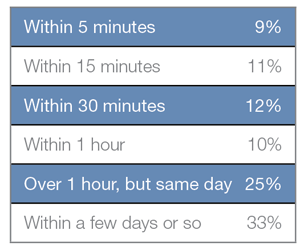 The Edison Research Company in the U.S. conducted a study a couple of years ago, asking consumers who reached out to a company for support via social media. While this is a little different from a general inquiry, the expectations for response times are eye-opening (See chart at right).
The numbers indicate that 42 per cent of people expect a response within an hour. Edison Research makes the point that when a customer reaches out to you on social media, “they want to talk to you,” so the response needs to be quick and should address the request or comment directly — just as you would if the conversation was on the phone.
Where do salespeople spend their time?
The overall challenge for dealers is the increasing volume of communication via the Internet or social media, as well as the customer’s expectation for a speedy response.
In the words of Andre Konsbruck, Audi’s U.K. Director: “Our central marketing efforts bring in so many inquiries and customers expect a reply within 24 hours — that’s where we’re struggling. Firstly, dealers need to understand their capacities and build them up so they can cope with the inquiry level. The second thing is that dealers need clarity on the responsibilities of sales staff — we conducted a number of extensive surveys which showed just how little time sales staff are spending on actually selling a car — most of their time was being spent on hand-overs, administration and meetings.”
What is clear is that communication with the customer or prospect on the Internet or via social media is becoming part of the sales process, and not just a way of pulling the customer into the dealership to go through the traditional dance.
It looks like the old and the new sales processes are on a collision course.