The advent of online shopping tools hasn’t necessarily changed consumer shopping habits
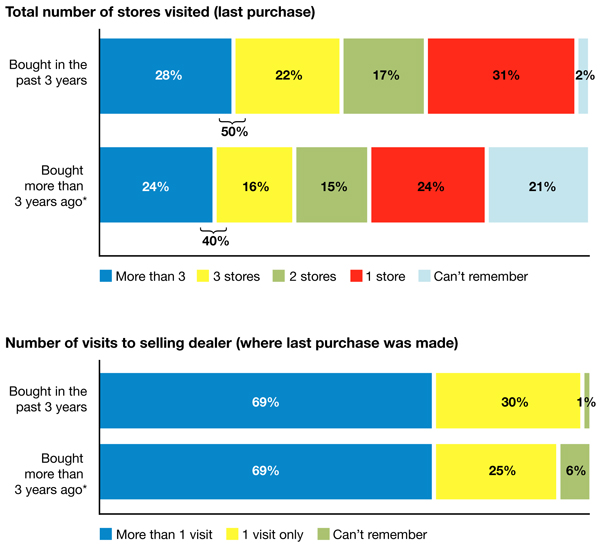
As recently as 10 years ago, many were predicting that the advance of the digital age would have two possible effects on the auto retailing business: first, it would make dealerships obsolete, with consumers willing to bypass the dealership and buy direct online from the manufacturer. Second, it would significantly change the shopping patterns of those looking to buy a new vehicle.
The first prediction has certainly not turned out to be true. What has happened is that vehicle buyers make their decisions with much more information available and enter the dealership with a different mindset. Many consumers now feel they have far more control over the process and the flow of information.
The second has also proven to be inaccurate. The chart on the right indicates that 50 percent of buyers still visit three or more dealerships in the purchase process! The need to “touch, feel and drive” before making a decision is apparently as strong as ever. What’s more, seven out of ten paid more than one visit to the dealership where they actually purchased the vehicle.
These findings are based on a survey we did in December among just under 500 consumers who had purchased or leased a new vehicle in the past three years or plan to do so in the next two years. We also asked those who visited their selling dealership more than once about the follow-up process.
Here’s what we found:
• 75 per cent of these customers indicated that someone from the dealership followed up after the first visit;
• 77 per cent of the follow-up was done by phone and 20 per cent by text or email.
The customers’ perceptions of the follow-up were fairly similar, but the phone follow-up seems to be more timely:
Percentage Rating 9 or 10 on a 10-Point Scale
 While all seems to be “normal” based on these numbers, it isn’t really. While customers and prospects are still coming into dealerships as often as they used to, they are coming in with different expectations.
And this will only become more apparent as the new cohorts of customers begin to show up (those who haven’t really been in the market before). They will have grown up in a digital world and will expect the experience in the dealership to match their experience in searching for a vehicle or for a dealership.
There cannot be “two solitudes” — where the online or digital experience meets expectations, but the in-dealership experience does not. The auto industry is not alone here and many retailers are still struggling with this dichotomy.
Customer follow-up is a vital part of making sure that the visit to your dealership eventually leads to a sale (it seems even more important with female buyers). But there’s a catch — while customer expectations are increasingly for immediate information and quick responses, the customers themselves are much more in control. As we found in another recent study, they are going to take more, not less, time to make their decision in the future. So timeliness in following up is still critical and particularly when communicating via email or text, the expectation is rapid response from the dealership, even if the final decision might take longer.
In this context, customer follow-up done “by rote” (driven only by process requirements) is likely to be less successful and inefficient whether done by phone or digitally. It must be well planned, timely and customer-focussed in order to be effective and not get lost in the digital clutter. It needs to keep the customer engaged and interested and demonstrate that the dealership was paying attention to the needs of the customer.
The numbers here suggest that there is still a heavy reliance on the phone. This is not necessarily bad, but in the new environment, dealerships must hone their skills at using digital communication media with a much higher level of sophistication and intelligence about what the customer has done or said in any contact or communication.
A fancy website and a perfect process for getting canned emails and texts to prospects and customers will simply not cut it in an environment where having a digital communication capability is the price of entry. What will make the difference is the people behind the process and their ability to understand how to use the tools to truly connect with customers.