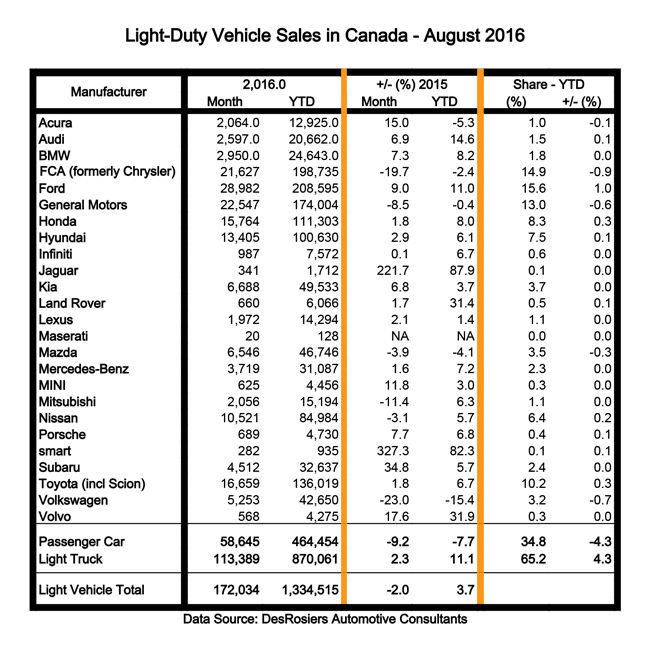
 For the second month in a row and the third in the past four, August’s new vehicle sales in Canada fell below those for the same month a year ago. It’s the first time since early 2013 that there have been two consecutive months of year-over-year declines, according to DesRosiers Automotive Consultants (DAC).
Still, it was a good month in historical terms. While sales of 172,034 new cars, trucks and utilities were down 2.0 per cent from last August, they were still the second-best in history for the month and 8.0 per cent ahead of its five-year historical average, according to David Adams, president of the Global Automakers of Canada (GAC).
Year-to-date sales edged back to 3.7 per cent ahead of 2015, based on that modest decline, but they’re still more than 47,000 units ahead of this time last year. Another new annual record remains firmly in sight.
To fall short of a new record in December would require an almost 12,000-unit decline for each of the next four months relative to their 2015 figures, says Dennis DesRosiers of DAC. And that’s unlikely to happen barring some catastrophic economic collapse.
The seasonally adjusted annualized sales rate (SAAR) for the month held steady at right around 1.9 million units, according to DAC, which also bodes well for another record. The current record, set in 2015, stands at just under 1.9 million.
These recent declines may have further reaching concerns, however, particularly given that they are paralleled in the United States. According to Adams, the August sales decline corresponded with a 3.1-point retrenchment in Consumer Confidence, as reported by the Conference Board of Canada.
If these declines continue, they may forecast a more significant fallback for 2017. Or, things may revert to what had become normal when the country returns to work after one of the most vacation-inducing summers ever. September sales will better define a trend if there is one.
What is a certified norm is that truck sales, including utility vehicles, continue to drive the market, claiming 65.9 per cent of all sales in August and 65.2 per cent year-to-date. That’s another tenth up from a month ago.
Ford pulls further ahead
Ford took the top sales spot for the month by a wide margin, with sales of 28,982 vehicles up by 9.0 per cent from last year. Year-to-date, Ford’s sales are up 11.0 per cent, extending the Blue Oval’s lead to almost 10,000 units ahead of Fiat Chrysler Auto and maintaining a market share gain of 1.0 per cent.
Despite a sales decline of 8.5 per cent to 22,547 vehicles, dropping year-to-date sales to 0.2 per cent behind 2015’s, General Motors surpassed FCA for second place on the month.
FCA sales declined 19.7 per cent to 21,627, cumulatively down 2.4 per cent year-to-date. The FCA and GMC losses alone more than account for the full monthly decline.
Toyota (+1.8 per cent) and Honda (+1.8 per cent) both slightly outperformed the market in fourth- and fifth-place respectively. Hyundai (+2.9 per cent), Nissan (-3.1 per cent), Kia (+6.8 per cent), Mazda (-3.9 per cent) and Volkswagen (-23.0 per cent) filled out the top ten in that order.
In percentage terms, the biggest gainer for the month was Smart, up 327.3 per cent, followed by Jaguar (+221.7 per cent), still thriving on the arrival of its new F-Pace SUV and XE sedan. But all the European and Japanese luxury brands also had a positive month, led (apart from Jaguar) by Volvo (+17.6 per cent) and Acura (+15.0 per cent).
Among non-luxury brands, Subaru (+34.8 per cent) made the greatest advance. Apart from FCA and GM, Volkswagen (-23.0 per cent), Mitsubishi (-11.4 per cent), Mazda (-3.9 per cent) and Nissan (-3.1 per cent) were the only brands to suffer sales declines in August.
FCA adjusts sales methodology
It should be noted that FCA’s comparable figures reported here for both 2016 and 2015 are based on a new sales reporting methodology that has required adjustments to previous sales figures for the company.
According to a written release issued by FCA, under the new methodology sales were higher than reported in 2011, 2013 and earlier in 2016 and lower in 2012, 2014 and 2015.
The maximum variation was within 0.6 per cent of what was previously reported for any given year and overall sales from 2011 to 2016 were 0.01 per cent higher than reported.
While FCA’s sales total for 2015 was adjusted downward by 0.4 per cent to 291,946 vehicles, that number was still sufficient to maintain the Canadian sales title for the year.
[NOTE: Data quoted in this report were sourced from DesRosiers Automotive Consultants, Global Automakers of Canada and individual automakers.]