Honda Canada chief discusses quality, the changing retail environment and the importance of the driving experience
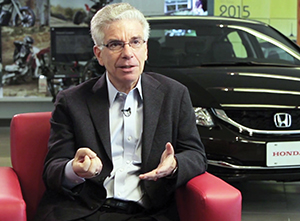
Canadian auto dealer traveled to Honda Canada’s headquarters in Markham, Ont. for a one-on-one interview with the President and CEO, Jerry Chenkin. Here’s part of the conversation with our columnist and automotive journalist Petrina Gentile.
 PG: 2014 marks a milestone for Honda Canada. This year is the 45th anniversary of Honda in Canada. Plus, Honda Canada just sold its four-millionth passenger vehicle in the country — to what do you owe this success?
JC: The success comes from providing products that Canadians want. Many, many years ago when we started off in business, even back then, Honda’s philosophy was to establish businesses in the local communities and supply products that the people in those communities wanted. As a result, Honda became a company that Canadians wanted to exist. That’s been our dream since the company started in 1969.
PG: Speaking of products, the Honda Civic is Canada’s best-selling passenger vehicle — a spot it’s held for 16 consecutive years. With rising competition, how long can it hold onto that top spot?
JC: As long as Canadians want us to. We never intended to be No. 1. What we hope for is that we can satisfy as many Canadians as possible with our products. Canadians have adopted Civic as Canada’s car for the last 16 years and it looks like we’re on track for a 17th year in 2014. But how long that will continue really isn’t up to us. It’s up to Canadians to decide.
PG: I don’t think many Canadians realize that nearly 70 per cent of all Honda vehicles that are sold in Canada are manufactured in Canada. Tell us about your made-in-Canada success stories.
JC: As everybody knows Honda was the first Japanese manufacturer to open an assembly plant in Alliston [Ont.]. The reason that happened was that in Japan the Honda Motors executives knew and could see that the demand for products made in Canada for Canadians would be very, very popular so it made sense to do it. In true Honda fashion they started with a very small factory, producing about 30,000 units a year, which has now grown to three factories — two vehicle factories producing almost 400,000 units a year and an engine plant, which is producing engines for both Canadian market products and for the U.S. It is a huge commitment to Canada and it speaks volumes to the philosophy of the company, which is to produce products where the market exists.
PG: Is the role of the dealership going to change in the future?
JC: The role of the dealership is going to change. There is no doubt. We’re already seeing that with the knowledge customers have when they come into the dealership. For example, you can argue that today, the customer knows more than the salesperson does about the particular product they’re coming in to see. The range of products is so wide, but the customer is really focusing on one product. So what service can the salesperson offer the customer when they come in? That is the kind of debate we’re having in our dealerships right now.
PG: So what services can the salesperson offer to improve the sales experience for customers?
JC: If the customer is predisposed to a certain product when they come in, they’ve already researched it and they’ve already decided that they want a Civic, for example. So the salesperson doesn’t have to convince the person that the Civic is the vehicle they want. Now, the role of the salesperson is to establish a level of trust with the customer, a relationship with the customer and then conclude the transaction as quickly as possible. People’s time is becoming very valuable and they’re looking for a painless process.
PG: What will the dealership of the future look like?
JC: I don’t believe the structure of our industry will change. Many different alternatives have been proposed over the years including buying over the Internet and other kinds of revolutionary ideas, but the fact is our industry is more than 100 years old now. Anybody that’s tried to change the structure of it seems to eventually revert back to the kind of structure that’s been there since day one. I don’t believe that’s going to change. I think the customer still wants to come to the dealership. They still want to take a test drive, which maybe in the future you can do on a virtual basis. But still they want to have that experience. I don’t believe the current way of doing business will change significantly in the future. A test drive is still one of the most important parts of selling any vehicle because the customer can research anything they want to know about the car or the truck, but they can’t experience the drive. This is where the Honda and Acura brands are so important because the actual driving experience is what differentiates us from the competition.