Thanksgiving in Canada is one of those events when traditionally, it’s time to put down our work and be with our families. Yet, as many dealers know, time doesn’t stand still and neither does the competition. And that’s why, this past Thanksgiving Sunday on October 12th, a good number of auto retailing professionals found themselves in Las Vegas, taking in meaty content during the Canada Day session of this year’s DrivingSales Executive Summit.
This was a Canadian event, providing digital marketing information specific to Canadians, by Canadians.
Kicking things off were John Currado, Executive Team Leader of Technology of SCI MarketView and Jeremy Wyant, Manager of Dealer Performance also of SCI MarketView, who discussed the objective of an Initial Quality Response (IQR) and how it leads to better connectivity with a dealership’s customers.
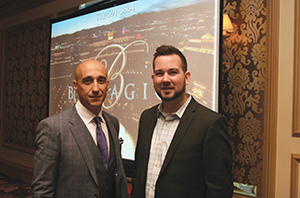
John Currado and Jeremy Wyant
Wyant, referencing the IQR score that Canadians ranked 38.7 out of 100, notes there’s plenty of room for improvement.
Wyant talked about the “battle of the inbox,” in other words, delivering an effective subject line that makes the customer more likely to open your email response amid the thousands of other messages that clog their inboxes.
“Make sure you always include the person’s name in the introduction, always include the vehicle they’re looking for and always introduce yourself,” he says.
Wyant says that the quality question really counts, especially when it comes to the vehicle value proposition. “This is an area where you can build the relationship by asking fun stuff about the vehicle and why they are looking at it.”
Currado added that dealers need to think less about price and more about the value they bring to the customer. “Simplify the process,” he says. “Be common where it’s possible and custom where it counts.”
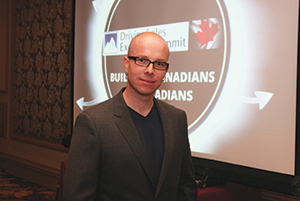
Robert Karbaum
SOCIAL MEDIA: THE NEED FOR PROFITABILITY
Robert Karbaum, E-Commerce Manager for Weins Canada, gave an interesting and eye-opening presentation on the hard truth about social media — for dealers, it needs to be profitable in order to be used effectively.
Karbaum says one big problem is that while social media has become a buzzword of modern marketing, it tends to do absolutely nothing in terms of generating sales for dealers.
He says that social media channels such as Instagram and Pinterest don’t provide much mileage for dealers because there is no way to actually advertise on them. “It’s like being a walrus at a penguin party. We are trying to sell motor oil to a group focused on knitting — it just doesn’t work,” says Karbaum.
On the other hand, Karbaum says that Facebook can provide dealers with an effective way to sell vehicles through paid search. “With paid search we can see exactly what happens,” he says. “We can target men between 25-34, those who speak Spanish or those that have finished school and love cats.”
Karbaum notes that a $348 ad spend on Facebook can yield 700 visits to a dealer website, while it would take approximately $5,000 to achieve the same result via print ads, which can’t be measured in the same way.
“With paid advertising on Facebook, we know exactly what happens,” he says. “So why would you even bother doing anything else?” Karbaum talked about the three phases of social media that dealers need to understand: be on it (phase one); advertise (phase two) and make a profit (phase three).
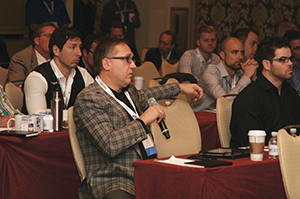
Canada Day session drew a crowd on Thanksgiving Sunday
COMMUNICATE, INTEGRATE
Bill Wittenmyer, Partner with ELEAD1ONE, a leading BDC, CRM and digital marketing provider, talked about how Canadians have among the highest mobile usage rates in the world. “Your buyers are researching online before they visit your store,” he says.
Wittenmyer discussed how 47 per cent of mobile users are actually researching on a dealer’s lot and explained why it’s so important to give customers the information they want and as quickly as possible.
“Buyers won’t wait. You have to be engaged and answering them or you have lost them,” he says.
Wittenmyer says that to provide that level of communication customers are looking for, dealers need to have a service website and one for sales. “Not a link, but a website. Everything you are doing in sales you should be doing in service.”
He also stressed the need for dealers to know what their stock plan is, so that service advisors understand the dealership’s need for used cars and present an option to purchase for every customer that comes in. “In Canada, two per cent of vehicle registrations turn over every month. These are people in your service lanes and they are your first opportunity.”
MEASURING, LEARNING AND IMPLEMENTING
John Germani, Group Moderator, CDK Global Performance Solutions, talked about the need for dealers to understand web performance through numbers, to cut through the noise and regularly monitor website analytics. He stressed the importance of having images and unique content on VDPs and the fact that many dealers in Canada are still struggling with click-throughs and engagement because they don’t.
Grant Gooley, Director of Marketing at the Zanchin Automotive Group, delivered a version of his presentation from Canadian Digital Dealer 6 back in September, in which he talked about the marketing “ecosystem,” and how by taking effective steps to put all the different elements together,dealers can really see an increase in sales.
Gooley drew a chart analysing the web sales funnel, from Unique Visitors, to Leads, Appointments and Sales. Asking two dealers in the audience to participate, the results from their analysis presented some interesting findings.
“Go through the funnel with your sales team and they will start to understand what it does,” says Gooley. He says that at the end of the day it’s a numbers game and that if your sales to appointment ratio is low, you have work to do.
In addition to the specific Canada Day session, the 2014 DrivingSales Executive Summit had plenty of great insight into the world of automotive retail.
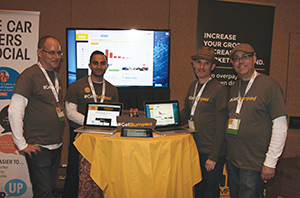
Get Bumped refers to Bumper, a new sales solution from Toronto-based Dashboard
EMBRACE IT FROM WITHIN
An interesting presentation came from Brian Solis, Principal Analyst of the Altimeter Group in Silicon Valley, California. Although not strictly focusing on the auto retail business, Solis talked about things that will impact us all in business, namely the need to embrace innovation and change and to understand that it comes from within us, not technology.
Solis encouraged dealers to question everything and to think outside the box. He says big data is just the beginning and that moving forward, business in general will become even more customer centric. Not only that but also it will be those organizations that are able to truly understand the needs of their customers, those that can really deliver an impactful and human experience, who will be the ones that ultimately succeed in this brave new, digital world.
Jeff Kershner, founder of DealerRefresh, delivered an interesting workshop session on mobile showrooming.
Kershner says that a tablet can be the single most useful tool for salespeople. “Everybody is using mobile devices,” he says. “So give your salespeople the right tools so they can be good at their job.”
He says that when it comes to the modern car buyer, some of the biggest concerns revolve around time and trust, which is why consumers tend to put their trust in a screen that’s in front of them over a salesperson. If left to their own devices, consumers will tend to showroom while in your dealership.
Kershner says dealers can use tablets, not only to keep customers engaged during busy periods (such as Saturdays when many salespeople have to handle multiple prospects) but also to promote both the store and themselves. “Make the tablet your best friend,” he says. “Post your dealership reviews so they are on there, post your individual staff reviews and have a Trade-In marketplace — all these things are going to get the customer involved.”
A great way to build trust, certainly on the used car side, is to employ video reviews where trade-in customers (original owners) talk about the vehicle they traded in, especially if it’s in good condition and well maintained, says Kershner. By doing so, it will enable a dealer to set and get a higher transaction price for the vehicle. “If I have a testimonial from a previous owner on video, who is going to argue the price after that? I wouldn’t,” says Kershner.
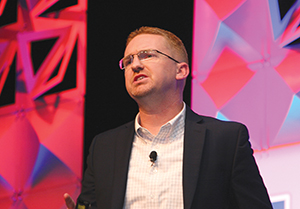
Jared Hamilton
THE NEXT CHAPTER
With consumer’s expectations changing so rapidly, what does the future hold for auto retailing? That was the question DrivingSales Founder and CEO Jared Hamilton posed to an attentive audience in the Bellagio Ballroom.
“The message I’m about to deliver is very heavy,” Hamilton says. “I’m going to talk about the future of automotive retail and it’s something that is really going to be a challenge.”
Hamilton says that among the many challenges on the horizon, the one the dealer can most impact right now is the customer experience. He talked how some non-automotive companies, such as Blackberry, Borders, Amazon and Starbucks, rose and fell and the reasons why it happened.
Hamilton says it’s important for dealers to understand what their customers actually want and that a good experience in automotive retailing doesn’t necessarily equate to luxury. “Research your goals,” Hamilton says. “See what actions lead to engagement or kill the opportunity.”
Hamilton provided actual video feedback from real customers that DrivingSales surveyed and the responses were varied, and in some cases, quite surprising. “We hired three research firms to conduct analysis and when the information came back, our industry earned a F+. He says that auto retailing, as an industry, is still getting a failing grade amongst the general population and a lot of that is to do with a perceived lack of trust.
Hamilton says dealers really need to build processes designed to suit their customers and not try and get their customers to fit around them. He says that because the auto retail business is a mature industry with a legacy stretching back over a century, there’s been too much emphasis on management and too little on leadership. “We need change and we need to implement it.” He says dealers need to take the time to implement change and to not get consumed in management practices. “Learn to implement your ideas otherwise they will fail.”