If there was one clear message from this year’s Auto Remarketing Canada Conference at the Westin Harbour Castle in Toronto, Ont., it was that in the used vehicle marketplace, a storm is brewing and dealers need to take action to mitigate its impact, not just on their pre-owned business but their entire operations.
The event, which took place on March 17-18, contained a mixture of workshops, keynote sessions and panel discussions, providing attendees with a wide variety of subject matter on used car operations, from effective digital marketing strategies, to increasing F& I penetration, fostering trust and loyalty with customers and understanding just where the pre-owned vehicle market is headed and how dealers can adapt to ensure their success long term.
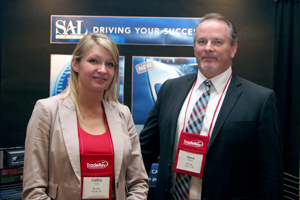
Cathie Clark (left) and Steve Clelland from IA-SAL
BETTER F&I PRACTICES, BETTER PROFITS
Canadian auto dealer was there and attended a number of the workshops and keynote sessions. In Double Your Used Car Profit with Good F&I, Cathie Clark, Director, Remarketing Performance Management with IA-SAL, talked about weathering economic storms and how a good, robust F&I department can play a major part in a store’s overall profitability. “So why aren’t more dealerships embracing, F&I?” she remarked. Clark said that part of the problem is that many dealers simply don’t know enough about the the products they have, refering to the situation as “a lack of belief.” She said there is often this notion that having strong F&I will actually decrease customer value but that in reality, good F&I is not so much about pushing product, it’s about understanding the needs of the customer and their background, including credit history and providing them with the products and services that fit their requirements.
By doing so, Clark said dealers will see a dramatic increase in results from their F&I departments and noted that one Toronto based dealer now generates over 50 per cent of gross profit from his used vehicle inventory via F&I, simply because the store has a process in place which the staff understand and consistently follow.

Dale Pollak
THE MARGIN SQUEEZE
Dale Pollak, founder of vAuto gave a very interesting and perhaps surprising keynote address. Recognized as one of the most savvy experts in the field of used vehicle operations, Pollak talked about four underlying conditions of inventory management and why it is so important for dealers to have them in place to ensure long term success.
He said dealers need to be committed to their used vehicle inventory, price cars rationally, have the right amount of equity to generate a profit and good “age management” discipline.
“Age management to me, is different than what you think it is,” said Pollak. He talked about decreasing margins on used vehicles and that how the situation is only likely to get worse. “There was less spread in 2013 than 2012. The difference between what you own your vehicles for and what they are transacting for is shrinking.” Pollak said a big problem is that nobody in the industry is really talking about this. “The reality is that the spread is compressing, in every retail industry in the world due to the advent of the Internet and transparency. But in the auto retail industry we don’t think much about it, nor about mitigating it.”
He said that too often, dealers are focused on gross profit from their used vehicles when in reality, gross profit is often a lagging indicator. “Probably every single one of you here walked in thinking that if you applied some principles and work hard you will make more money on used cars this year than you did the last.”
Pollak said that alongside shrinking margins on used vehicles, the cost of doing business is increasing and that the approach to sell more volume isn’t the solution, since ultimately there is a limit to how many vehicles dealers can actually sell. “If that is your answer, you are finished,” he said.
Yet despite the doom and gloom, Pollak said there is good news. Nevertheless, for dealers, the answer to shrinking margins and rising costs isn’t easy. He said the key is to viewing your used vehicle department akin to managing a financial investment portfolio and understanding that sometimes, taking a loss is critical to ensuring long term success. Pollak said that while such an approach “violates” long-established rules in our industry its the only way for dealers to not only succeed with their used car operations but their overall business as well.
He talked about “meaningful marginal contribution” of vehicles and that the sooner dealers make those cars which lack this contribution go away, the better off they will be. He said that most typically, those cars under 30 days in inventory carry the most meaningful margin contribution. “If you don’t have 50 per cent of your inventory under 30 days, you don’t have enough meaningful marginal contribution to give yourself a chance.”
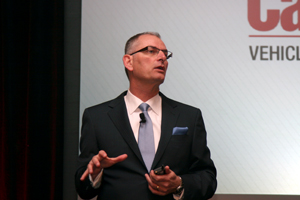
Michael Collins
UNDERSTANDING TRADES, UNDERSTANDING CUSTOMERS
Another great keynote session came from Michael Collins, Vice-President, Lender Finance Solutions and Canadian Operations, Dealertrack Technologies.
Collins noted that while many stores today are busy with their digital marketing strategies “and I applaud you for that,” he said, there are some important things to consider. One, that consumers aren’t traveling any further to buy vehicles, secondly that supply of used vehicles remains a challenge and that thirdly, used car pricing continues to rise.
“Don’t be afraid to charge for low mileage used vehicles, there is demand for them,” he said. Today, Collins noted that the average transaction price for a used vehicle is around $20,000, not far off that from a new vehicle a few years ago. “This is a good, strong, healthy sign of used vehicle remarketing in Canada.”
He said there are two things that will unwind a used car deal, poor trade appraisals and the inability to properly finance the customer. “There is a decline in trade appraisals and this is a challenge, because there are more of them coming in.” He said that whether a store uses their own process or that of a third party, making sure the process dealers have in place is possible and repeatable remains critical.

Among the vendors to make the long haul were Digital Air Strike, headquartered in Sunnyvale, Calif.
“At Dealertrack, we spend a lot of time looking at trade data,” said Collins, “because trades are a good indicator of things going on both in the used car business and the industry as a whole.”
He said that trends continue to point to an increase in used car financing and that as a result it’s more important than ever for dealers to understand the credit quality of those coming into their stores to buy. “This is not the responsibility of the lender,” he said. “If you abdicate responsibility, you don’t understand who is sitting across the desk from you.”
He discussed one of the current big concerns of the industry, namely negative equity as a result of extended financing. “This is going up, even on used cars,” he said. “We don’t want $10,000 cars being capitalized at $20,000.” He said that the gradual uptick in aftermarket (F&I) penetration in the used car sector is helping the business but he cautioned that when dealers look at their profits overall from used cars they need to understand that the number one driver of gross, comes from the back end, not the front end.
Collins also said that the industry needs to really grasp the issue of negative equity and that today’s new cars are the used vehicles of tomorrow. He said that the push towards longer payment terms is “putting risk into the portfolio of lenders” and there needs to be an emphasis towards lower amortization, even though in the short term, it may make many deals harder to close. “There is a ticking time bomb here. We need to be aware of it and curb it as best we can.”

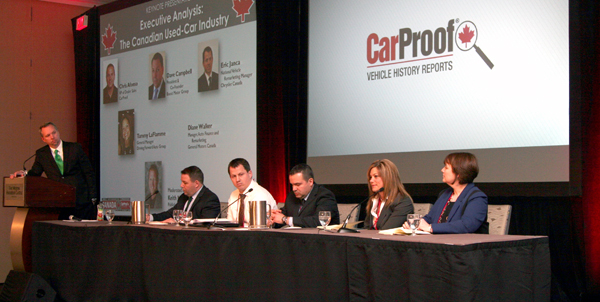
Several panel discussions took place, including one on social media
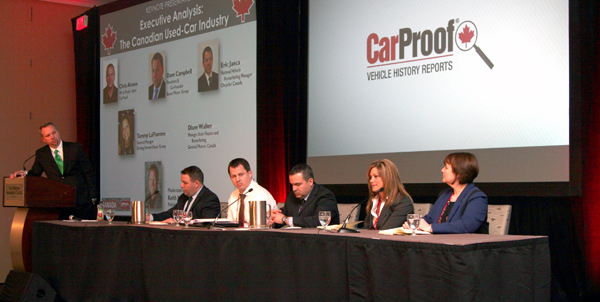
There were several panel discussions at Auto Remarketing Canada this year, which tackled a range of subjects, from an executive analysis of the used car industry, to tools and strategies to help dealers and consignors navigate the wholesale market, financing and social media. Additionally, a trade floor was set up to allow attendees to talk with vendors, network and conduct business.
Unlike some of these events, the breaks were staged in such a way that it gave a good deal of time on the trade floor for both dealers and vendors. In talking with people on both sides of the industry, a number told Canadian auto dealer that in addition to the keynote sessions and workshops, that for them, those breaks were a major factor in making the Auto Remarketing Canada conference a must attend event.
Watch for more coverage on Auto Remarketing Canada in the April 2014 issue of Canadian auto dealer.