DESPITE TOUGH AFTERMARKET COMPETITION AND LINGERING STIGMAS, THERE IS STILL A LOT DEALERS CAN DO TO DEVELOP SUCCESSFUL SERVICE RETENTION STRATEGIES

We often hear stories about how people are reluctant to take their cars to their dealership for service. For some it ranks right up there with a trip to the dentist. But why? And more importantly how is it that independent garages and aftermarket stores have taken away so much business? During a recent dealer conference in the U.S., we discovered that in some locations, independent shops now account for 80 per cent of the service and repair business!
So how do we fix the problem? Jim Bell, founder of Global Automotive Consultants and a well-known Fixed Operations specialist, says part of the issue with retaining service customers is that we don’t ask for the business — even when we have satisfied clients.
“I was in a dealership, in the showroom, talking to the dealer,” says Bell. “A very well-dressed lady came in said she would like to thank the dealer for the great service she’s enjoyed at the store because this was her last visit. How many customers really believe that once the vehicle is out of warranty, we don’t even want the work!”
EXTENDED INTERVALS
Bell says service retention is made harder by the fact that most dealers don’t see their customers as often as they used to thanks to extended service intervals. “In some cases a dealership may be lucky if they see their customers once every two years,” he says.
Yet while the aftermarket continues to provide stiff competition, earning a lot of the so called “gravy” business — tires, wheel alignments, brake services, oil changes and fluid flushes, there are dealers with loyal service customers who simply won’t go anywhere else, even if that means having to drive miles to get there. A good example is Davenport Subaru in Orillia, Ont.
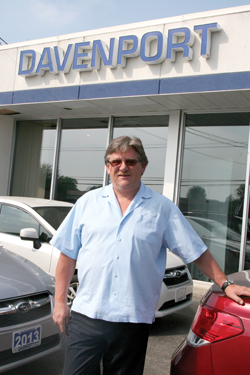
Mike Davenport, of Davenport Subaru, says ensuring you treat your staff well is critical
Dealer principal Mike Davenport says the key to developing and maintaining a good reputation as a place to do business is treating your employees well and being genuinely concerned about their happiness. “If you are going to have happy staff, you are going to have happy customers,” he says. Davenport stresses that a big thing is to make sure you care and to make sure your customers know that. “We have a policy,” he says, as we chat in his office with the door open. “When somebody comes within 10 feet of a customer we acknowledge them, we smile and we greet them.”
Rick Moore, Fixed Operations Manager at Davenport Subaru, says that for many customers it’s about positive presence — projecting a real sense of professionalism. “If they can sense your positivity, that gives them positive thoughts about the whole dealership. They put good money into their vehicles so it’s important [for us] to remember that they leave with the same thing they came in with — their car.”
Davenport Subaru has customers that will travel 200 km just to have their cars serviced at the dealership. Plus, with two out of Subaru’s top four technicians in Canada employed at the store, Davenport makes sure each and every service customer gets the royal treatment.
CLEAR UNDERSTANDING
So clearly, happy staff leads to happy customers. But it’s also the level of trust between both parties that results from it. Jim Bell says part of the reasons dealers often struggle with fixed operations is that “people don’t trust us. Expectations are extremely low. What customers want is an opportunity to talk to their technician, without any surprises and understand what’s on the work order.”
In fact, Bell says that another obstacle regarding service retention is that the work orders themselves are often hard to comprehend, adding to the confusion and mystery of service work. “Have you ever looked at one of your own work orders and seen how difficult it is to understand?”
Denis Ayotte, vice-president at Gus Brown Buick GMC in Whitby, Ont, another store that attracts customers well beyond its catchment area agrees. “It’s mumbled,” he says, “the repair times, the cost, the parts. I do believe that both dealers and vendors should look at ways of improving the system.”
Like many stores, Gus Brown has seen how the service business has changed over the years. “In the old days, if you were a domestic vehicle dealer you had no problem filling your service department,” Ayotte says. “Now it is tougher and people are looking at tools, such as CRMs and BDCs.”
While increasingly sophisticated tools can go a long way to managing the process and ensuring service customers have their needs met and vehicles repaired as efficiently as possible, at the end of the day, it’s important to have the right people, to elevate the experience and build rapport with the dealership’s clientele.
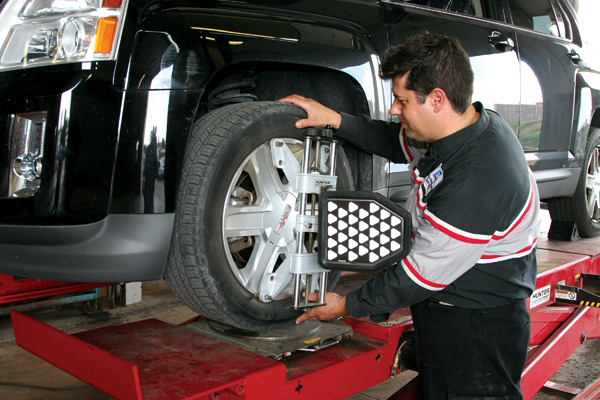
Jobs such as alignments can be big profit centres for dealers and a great driver for retention business, since they are often easy to explain to customers
BUILDING TRUST
Ayotte says that establishing trust is absolutely key for dealers looking to boost their service business and retaining it. “A lot of people talk about trust,” he says “but honestly, it really has to be earned.” He says one way dealers can build retention and boost business is by having alignment checks in the service drive-through. “The majority of vehicles are out of alignment and every car should be checked because it only takes a matter of minutes. It is an unbelievable way for retention,” he says “because it is something you can easily show the customer and they can understand what it means.”

Educating and and walking customers through the service process is a big factor in building trust and boosting retention
At Brimell Toyota Scion in Scarborough, Ont, educating customers is seen as a crucial part when it comes to retention. Mohammad Shahzad, Manager, Customer Management Operations, emphasizes that communicating with customers in a way they understand is critical to building trust and loyalty. He often refers to the service department as a clinic. “We prescribe to customers what is needed to make it better, much like going to the doctor.” He says that explaining the service process to the customer fosters respect and from respect comes loyalty. “The bottom line is effective communication,” he says. “When they understand you and you understand them, they are a walking billboard for your business.”
Back in Orillia, Mike Davenport, says that it’s also really important to have that personal touch. “Our dedicated customer care specialist, Melissa Istead calls everybody today that’s coming in tomorrow and everybody tomorrow that came in today. She’s very personable and people recognize her on the phone. In a town of 30,000 people that’s important,” says Davenport. “If you have poor service with one customer, they will tell everybody and it won’t be long before business dries up.”