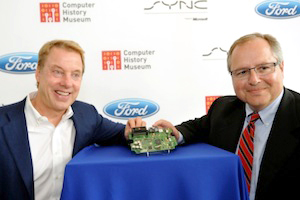
 When people think of the Computer History Museum in Mountain View, Calif., names such as Microsoft, IBM, Cray, Apple and Google come to mind. Today, those technological luminaries are joined by Ford as curators add the SYNC in-car communications and connectivity system to the museum’s permanent collection.
“We are honoured. SYNC has helped us move faster than what is usually assumed of an automaker, providing a new level of openness and access that has forever changed how we look at our business and respond to our customers,” said Paul Mascarenas, chief technical officer and vice president, Ford Research and Innovation. “Ultimately, SYNC embodies what Ford is all about: going further to transform innovative ideas into products that are affordable, attainable and valuable to millions of people.”
Said Alex Bochannek, curator and senior manager of the Computer History Museum: “As cars have transformed into mobile platforms for consumers’ communication and entertainment needs, the intersection of automotive and computing developments is becoming an increasingly important area for the museum to consider. Ford Motor Company’s collaboration with Microsoft on SYNC technology is an example of this changing landscape,” he added.
“The Computer History Museum is pleased to add a first-generation Ford SYNC module to its permanent collection in support of our continued efforts to document the effects of computing on society at large.”
SYNC is the in-car connectivity system that provides voice control for mobile phones and digital music players connected via Bluetooth or USB. Ford co-developed the system with Microsoft using the Windows Embedded Automotive platform.
“When we first teamed up with Ford nearly a decade ago, we knew we wanted to develop a system that connected consumers’ digital lifestyles to the vehicle they love today, and seamlessly for years to come – regardless of the device,” said Kevin Dallas, general manager, Windows Embedded at Microsoft.”Having SYNC inducted into the Computer History Museum’s collection is a testament to the system’s groundbreaking innovation and to all of the hard work of our engineers, both in Dearborn and Redmond, to deliver a product that continues to meet consumers’ evolving needs and exceed expectations.”
By early 2012, more than 4 million SYNC-equipped vehicles were on the road. By 2015, that number is expected to grow to 9 million as Ford introduces the technology into products around the world.
While consumers replaced mobile phones and digital media players every couple of years to keep up with the latest advances, vehicles typically lasted a decade or more. Relying on an embedded system could leave a car hopelessly outdated long before the end of its useful life.
Rather than force owners to pay for another wireless plan for their vehicles, Ford pursued connectivity platforms that would allow drivers to use the technology they already carried with them.
“By the end of 2005, Ford’s Electronics and Electrical Systems Engineering group started active development of a platform that could be kept up to date with the latest technology trends throughout the life of the car,” said VanDagens. “With Windows CE as the base, we could add new functionality through apps that owners could download from the Web and install with a USB flash drive.”
Collaborating with suppliers, including voice recognition leader Nuance, they developed a robust and easy-to-use voice interface. This enabled drivers to make and receive phone calls and select songs, artists, albums, genres and playlists all while keeping their hands on the wheel and eyes on the road.