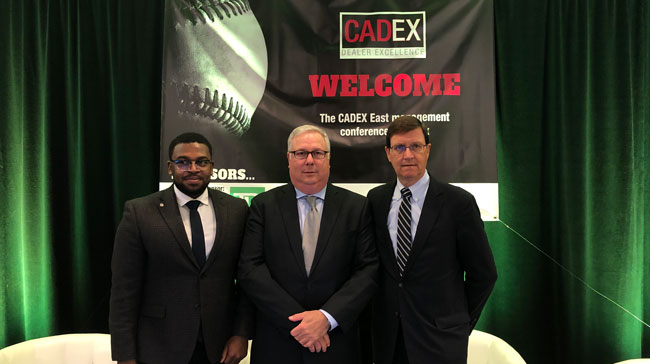
 CADEX 2019 tackled topics like changing consumer preferences, in-store digital media, electric vehicle readiness, government regulations, federal elections, and more.
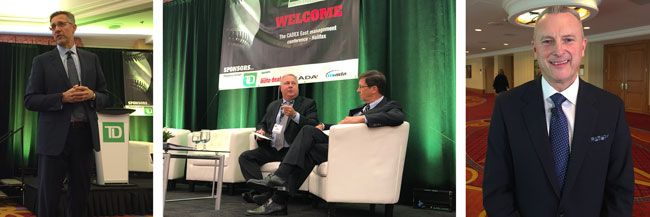
The automotive industry has reached an unprecedented period of innovation, said Brian Fulton, President and CEO of Mercedes-Benz Canada, during the seventh annual CADEX conference in Halifax, N.S.
Fulton was the keynote speaker at this year’s event, and his remark set the tone for what may have been one of the most impactful conferences organized by the Nova Scotia Automobile Dealers Association (NSADA). The event brings together dealers from across the province for a day of learning and networking, followed by a gala dinner event.
This year’s conference comes at a time of significant and disruptive changes taking place in the automotive industry, and the landscape as we know it, is poised for change.
Government regulations
One of the more interesting topics Fulton touched on was government regulations and the impact they have on vehicle manufacturers. In Europe, for example, the Worldwide Harmonized Light Vehicle Test Procedure (WLTP) took effect last year and impacted a range of OEMs.
“If you can just imagine the workload of our certification engineers — not only at Mercedes-Benz, but every other OEM worldwide — the amount of work that they had to do to get the reviews ready,” said Fulton, in an interview with Canadian auto dealer. “It was of course a big priority, (but) it created some slowdowns, and timelines were an issue.”
In North America, the U.S. and Canada are no longer aligned on greenhouse gas emission targets. Canada is aiming to reduce GHG emissions significantly by 2025, while the U.S. is moving along a different linear path — one that doesn’t slope.
Fulton acknowledged that the two administrations appear to be moving in different directions, but said the company was ready to meet the necessary requirements. “Mercedes-Benz is ready to meet whatever requirements come from the government, even the original stringent goals (that Canada still follows).”
Canada in turn has launched several proposals and programs to ensure OEMs, dealers and consumers are headed in the same direction. Some of these include carbon tax, electric charging and hydrogen infrastructure, tax-write offs for fleet vehicles, and the new federal zero-emission vehicle (ZEV) program set to launch in May.
“Government assistance is absolutely crucial for electric vehicle adoption. We need to prepare for the future,” said Fulton.
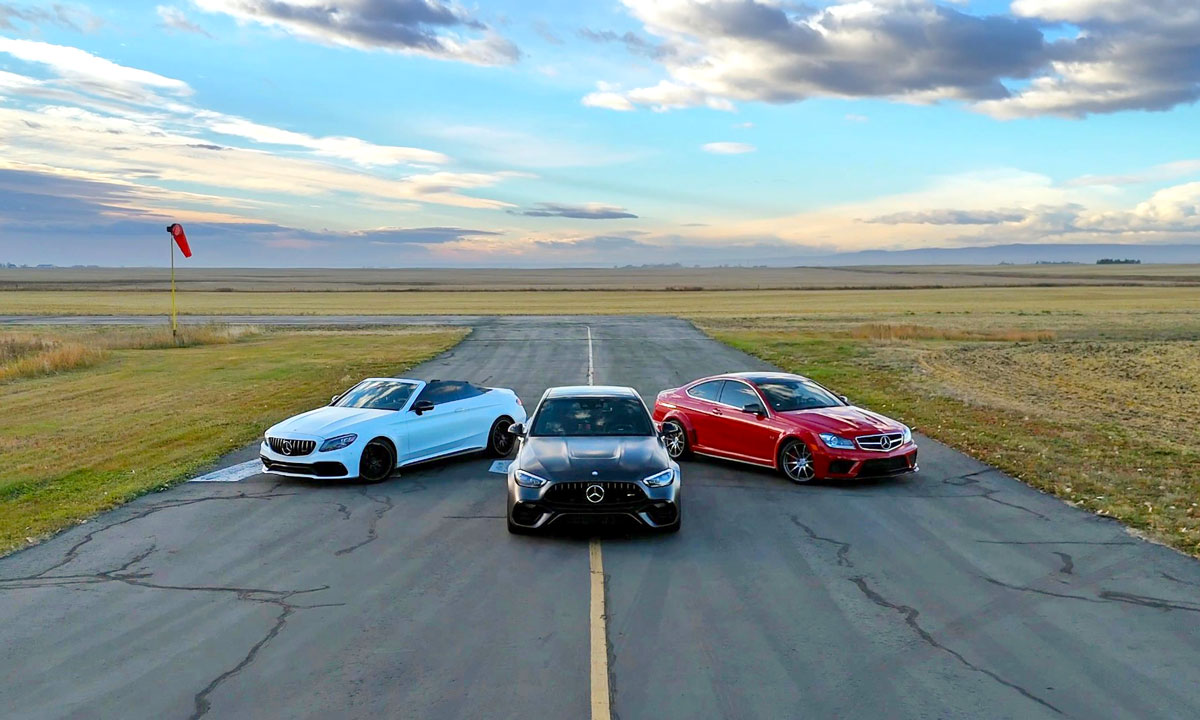
Mercedes-Benz is planning to introduce a number of luxury EV items to its product list.
ZEVs and federal election
CADA Economist Oumar Dicko waded into the federal government’s recently announced zero-emission vehicle (ZEV) program.
He has been observing the growing gap between the truck category and passenger vehicles, noting that SUVs have taken the forefront in consumer preferences and cars have moved out of the limelight.
Dicko is interested in what sort of trend this will create for ZEVs, especially since most of the EV models available in Canada are cars. “When it comes to the demand for ZEVs, it will be interesting to see how much of a boost that will have on passenger cars.”
As for the adoption rate of these vehicles, the numbers are growing, but still don’t represent major volume. In 2018, for example, Nova Scotia sold less than 100 electric vehicles.
In Ontario, the provincial government dropped its electric incentive program in July and sales in the last quarter of 2018 dropped by 50 per cent, said Dicko. “That just shows you the impact of having an incentive program to increase the appetite for these vehicles.”
“The federal election is certainly something to watch this year. Where the polls are standing right now, it’s still a very tight race.”
He said he hopes the new ZEV program will help boost sales for these vehicles in Canada, and is interested in observing the shift from internal-combustion engines towards ZEVs. Will we get new entries, new consumers coming into the market to buy these vehicles?
That might depend on the upcoming federal election, which could see the ZEV program remain intact or gutted much the same way the Ontario government scrapped its EV rebate plan.
“The federal election is certainly something to watch this year. Where the polls are standing right now, it’s still a very tight race. We are not sure who will be governing Canada next year, but if we do change government, that might have significant repercussions on the programs that are here right now,” said Dicko.
The current Liberal government has set an ambitious target: it wants to see 100 per cent light-duty ZEV sales per year by 2040. “A government mandate proposes to deal with the issue of advocating for ZEVs by bringing forward a program that will change the supply side of the market. But at the same time, the market has certain dynamics,” said Dicko.
The federal government plans to invest $130 million over five years (2019-2024) towards ZEV charging (level 2 and higher) and refuelling stations across the nation. But this attempt to increase ZEV adoption could result in a greater number of electrified vehicles on the road sooner than later, and the country is not yet set up to deal with an abundance of electric vehicles.
Furthermore, do consumers even want to invest in adding a charging station to their homes? Would the government subsidize it? “These are things the government will need to consider and will need to look at on the supply side,” said Dicko.
Future of automotive retailing
ZEVs and government regulations are just one part of the overall equation. Consumers, and how they will impact the industry more directly (and even indirectly) is another.
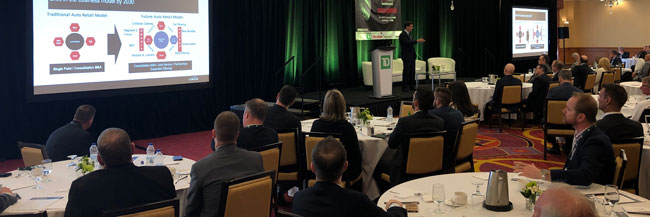
John White, CADA President and CEO, presented for the first time in public an overview of the association’s report Driving the Road Ahead: a Look into Canadian Automobile Retailing, which brought to the surface a number of concerns that dealers are facing.
One of those concerns has to do with riders and drivers. “We have a definition of the consumer today, and basically the automotive consumer of the future,” said White. “We have dissected them into a rider and a driver.”
He said a rider is someone who seeks ease of access. They don’t actually want to own a vehicle, but they do want to have access to it at any point in time.
Drivers on the other hand don’t care if they are financing or leasing the vehicle. They want flexibility and convenience. The whole notion of control and deciding when they will use a vehicle is very important to them.
“If we look at the future, especially if you look at urban and metropolitan areas, you are probably going to see more and more people that see themselves as riders. What’s interesting is that, in those markets, you can actually be both,” said White. “So the dealer is going to have to look at that consumer a bit differently.”
Subscription services will play an interesting role in the future of Canada’s automotive retail industry. A greater number of vehicles in fleets are expected to be used for these services, along with ride-sharing, in the future. While the same amount of vehicles sales are anticipated, the vehicles will be sold in a different way to different people, said White, “and we are going to see shifts.”
OEMs will experiment with these services, as they are doing now (think about Genesis, Tesla, and Volvo). They will try out new concepts and test new services in different markets, which will inevitably lead to some friction with auto retailers.
“Yes, we need good factory and dealer relations. But we also need to respect the territory that a dealer has generated and created and fostered.”
“It’s going to make for a bit of a messy relationship, but at the end of the day, we will (come to an understanding of) what works and what doesn’t work,” said White. “OEMs and dealers have always had this sort of love-hate relationship, and both need each other. The line will just be a little more wavy as we go to the future.”
The important thing, he said, is to realize that these shifts will not be quantum leap changes. Instead, dealers can expect small, incremental steps over the next decade.
“We are telling dealers to keep their eyes open, be aware, plan, take a look at your business, and then adapt and you’ll be okay,” said White.
OEM-dealer relationship
A panel discussion that included three students from the Automotive Business School of Canada (ABSC) offered some insight into how their co-op experience changed their perspective on the OEM-dealer relationship.
According to Joshua Katzman, 21, the problem with this relationship is that not enough people from the OEM side, or the dealer side, have worked for the other party.
“By doing this and ensuring that these two are working together, and working well, they need to have a good relationship and have respect for what the other party does, and the processes that go along with it.”
He said hiring someone that has worked for both sides is “hugely beneficial,” as they can bring that experience to the OEM or dealership culture.
In a separate panel discussion, CADA Chairman Perry Itczcovitch also touched on the OEM-dealer relationship and the notion of respect when it comes to data. “Yes, we need good factory and dealer relations. But we also need to respect the territory that a dealer has generated and created and fostered. The data-sharing agreement is important to protect the rights of the dealers.”
He said dealers works to build a database or a customer base that they service, but a lot of data-sharing agreements are being re-written and manufacturers are coming in asking them to share their data. “I think it’s important that dealers know, if it’s their customer, it’s their data,” said Itzcovitch.
He said the problem is that OEMs have the perce
ption that the data is theirs. If they decide to re-distribute an area of responsibility for the dealer, some of their customers may no longer belong to them. “Should the dealer be suffering because they (OEMs) take a postal code or two out of their area of responsibility?”
In-store digital media
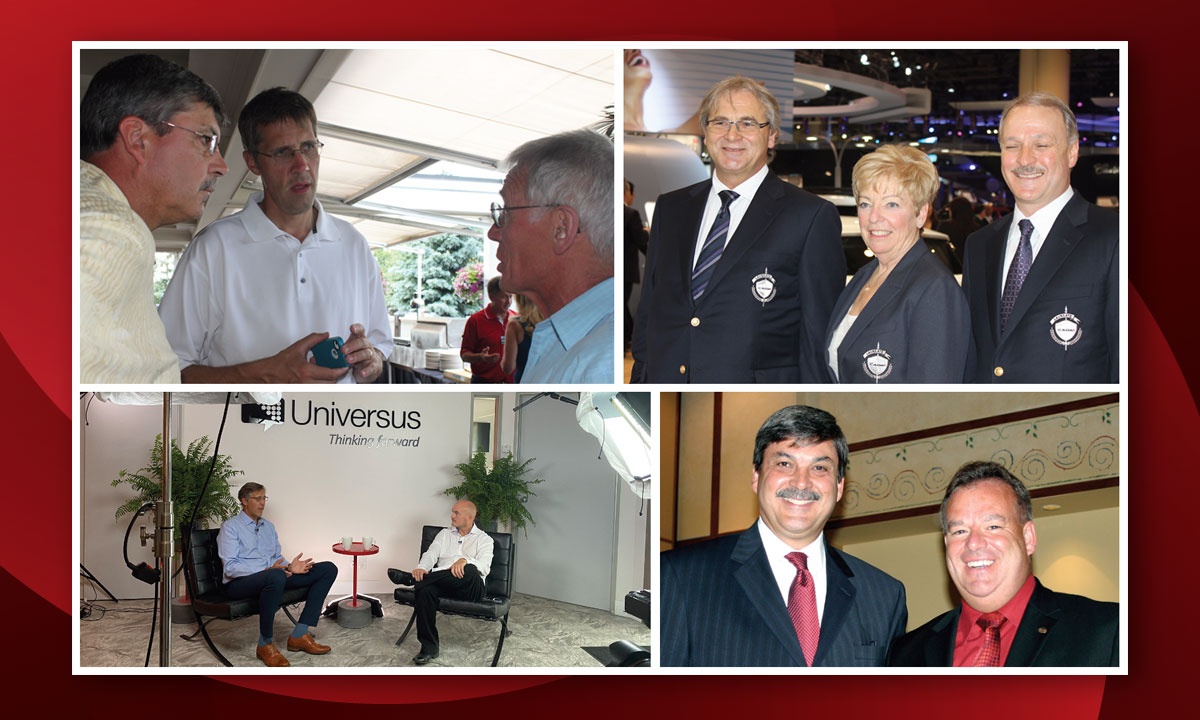
Many speakers touched on the digital front, but Niel Hiscox, President of Universus Media really dove into the nitty-gritty of in-store digital media, or digital signage.
“One of the things we hear from dealers a fair bit is: ‘Well, I don’t want to have screens all over my store. I’ve got to keep my cable TV up because my customers want to see the TV,’” said Hiscox. “I completely get that, but the reality is modern retail is digital based. Your customers are coming in expecting that, because it’s part of every other retail experience they have.”
He said consumers are used to retail environments where printed point of purchase (POP) is no longer the focus. Now it’s all about digital screens with current and contextual offers — things like touchscreen applications.
Consumers expect the same thing from dealers because of the complexity of products like new and used vehicles, and Parts and Service offers. “They are expecting you to build these sorts of things into your retail environment,” said Hiscox.
This was only one of many key messages he offered during his presentation, though Hiscox said the single most important one has to do with technology.
“Don’t get excited about the technology. Don’t get excited about a new app, a piece of code, or a shiny box,” said Hiscox. “There’s an awful lot of players in the market knocking on dealers’ doors saying ‘We’ve got this thing.’ It may be a touchscreen kiosk with four or five pre-programmed apps, or something else. Don’t get excited about the shiny toy.”
Instead, he urged dealers to think about what they are trying to accomplish in their business. Where are their bottlenecks, and where are they having a hard time getting information to the customer?
Are dealers trying to offer their message in multiple languages, or use digital signage to ease the lineups in their service department? Are they trying to improve the way they advertise local offers?
“Make sure the first part of the focus is the business case. Then you’ll be able to find the technology that will support what you’re trying to do,” said Hiscox.