In 2018, only eight per cent of women occupied a position on an executive committee within the top 20 automotive companies in the world — up from seven per cent in 2014, according to 20-First’s 2018 Global Gender Balance Scorecard.
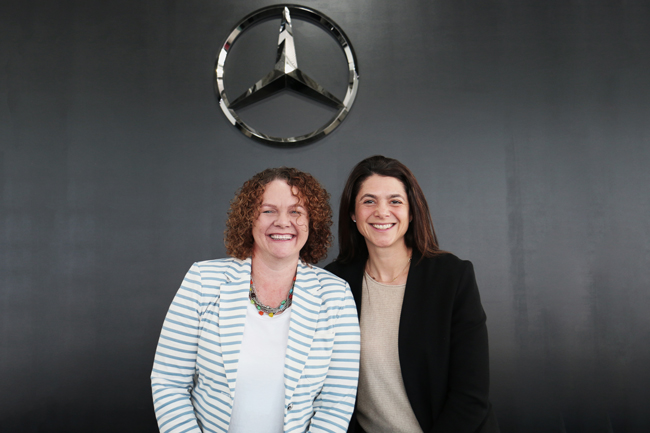
As minor as those figures may appear, women continue to make their way up the ranks and into executive positions that hold sway over company decisions, said Nicolette Lambrechts, Vice President, Mercedes-Benz Vans.
“We all know how important it is to have diversity around the boardroom table,” said Lambrechts, in an interview with Canadian auto dealer. “We bring a different element to the business and the industry, and we’re very proud of what we have achieved, but we also realize that we still have a very long way to go.”
Lambrechts said there has been a lot of focus over the last decade on developing women into leadership positions within Mercedes-Benz Canada, Daimler and also globally. She said it’s up to the women in these leadership positions to drive gender diversity.
Daimler is now starting to move in that direction, with 20-First’s report revealing two women and six men on their executive committee. One of the two women hold a line or operation role (CEO, CFO, Country Head, Business Unit Head, etc.), while the other holds a staff or support role such as Communications, HR, Legal, IT, Strategy, Public Policy or another such position.
In comparison, Ford Motor had three women and 12 men on its executive committee of as April 2018; Renault has three (and nine men); Peugeot has 2 women and 16 men; and General Motors has two women (including CEO Mary Barra) and nine men. Other OEMs had either one or none.
“We have a big responsibility to inspire and support our female employees — to continue to show them the opportunities that exist and support them in their journey to get where they want to be,” said Lambrechts.
As more female leaders are emerging within the industry, Mercedes-Benz Canada, a division of Daimler, has taken steps to improve the situation: they are offering mentorship programs and have partnered with the Women’s Executive Network.
“We are a category owner this year as part of our sponsorship, which is called the Mercedes-Benz Emerging Leaders,” said Virginie Aubert, Vice President, Marketing at Mercedes-Benz Canada. “It represents women between the ages of 30-40 years old who show vision, leadership and authenticity in their approach and innovative thinking when it comes to what they are doing in their business field. We want to recognize those women, and we have 12 winners each year.”
When asked how other companies within the Canadian automotive industry can bridge the gender equality gap, Aubert said it was about securing the right person for the right role based on that person’s talent.
“I think over the years more women have certainly come into this industry. I started at a very junior position here, like many of my colleagues, and we have grown throughout the organization,” said Aubert. “For us, as an organization, I think it’s about making sure we are empowering the right candidate for the right role, based on their skill set and their knowledge base, and the culture that they bring with them to better the organization.”
Both Lambrechts and Aubert are the first women to occupy their respective post at Mercedes-Benz Canada.
In 2016, the Canadian auto retail sector included 23.5 per cent of women; motor vehicle manufacturing included 19.9 per cent; and automotive repair and maintenance included 13.7 per cent of women, according to Catalyst.
For automotive manufacturing, that number climbs to 24.2 per cent in the European Union and 24.4 per cent in Sweden. Germany includes 17.6 per cent and the U.K. has 15.8 per cent of women working in that sector.
International Women’s Day is March 8, 2019.