The Global Automakers of Canada says its members are not pleased with the pronouncement by the B.C. government that they intend to introduce legislation to ensure all new cars and trucks sold in the province in the year 2040 will have to be zero-emission vehicles.
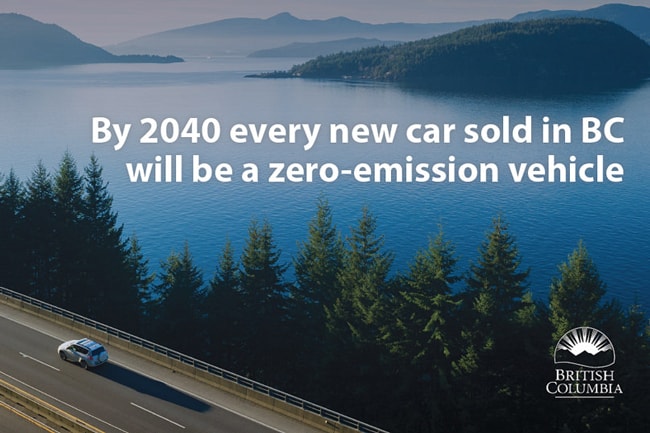
B.C. Premier John Horgan said his government intended to introduce legislation in the spring that would require 10 per cent of all new light-duty vehicles sold by 2025 to produce zero emissions, with those percentages climbing to 30 per cent by 2030 and 100 per cent by 2040.
“There’s nothing more important than taking care of the place we call home,” said Premier Horgan in a news release. “As a province, we need to work together to put B.C. on a path that powers our future with clean, renewable energy and reduces air pollution.”
“The goal for government and industry should be the reduction of GHG emissions, not the specification of a particular technology,” said David Adams, President, Global Automakers of Canada in a news release. “In that respect, we are disappointed with today’s announcement, given that Canada already has GHG emissions regulations for light duty vehicles that will absolutely drive greater introduction of zero emission vehicles as one way of meeting more stringent emission standards.”
Global Automakers of Canada represents the Canadian interests of its 15 member companies from Europe, Japan and Korea. Adams says that group has expressed support for the broader objective of decarbonizing transportation today in the face of the announcement from the Government of British Columbia that it will be pursuing legislated zero emission vehicle targets.
“Our members have been leaders in the introduction of alternative propulsion technologies and technologies to reduce greenhouse gas emissions from our products,” said Adams.
Adams says he’s optimistic the B.C. government says it is willing to consult with industry to help reduce the negative impact on the auto industry. “We’ve not yet seen what the Government has in mind but the importance of dialogue and collaboration in this context cannot be understated,” he said.
The association also praised the B.C. government for agreeing to top up the Clean Energy Vehicle incentive program to help bridge the purchase price gap between electric and fuel cell vehicles and traditional vehicles, but said more funds will be needed.