In the first of a new historical series, Canadian auto dealer looks at some of the significant (and perhaps oft forgotten) milestones that helped form our nation’s auto industry into what it has become today

Canada’s first automobile, and possibly one of the first in the world, was a steam-powered carriage built by Henry Seth Taylor, a jeweller and watchmaker from Stanstead, Que. It was as old as Canada, completed in 1867, but its success wasn’t to prove as long lived as our nation. Taylor showed it to the public a few times but couldn’t generate much interest, and then on a downhill slope, remembered that he’d never put brakes on it. With the buggy’s subsequent crash, Canada’s auto industry came to a temporary halt.
Most historians give joint credit for inventing the gas-powered automobile to Karl Benz, who patented his self-propelled three-wheeled machine in 1886, and to Gottlieb Daimler, who that year produced a four-wheeled version. In the U.S., several people were also experimenting with self-propelled vehicles, including those powered by steam or electricity, but the first successful American gasoline car is considered to be the one-cylinder Duryea, created by Frank and Charles Duryea and first driven in 1893 in Springfield, Mass.
Blacksmith repairs
For the most part, early cars were expensive and unreliable. They were generally hand-built, often using components made by blacksmiths. As a result, “smithies” were essentially repair shops, especially if the car’s owner wasn’t close enough to the manufacturer and couldn’t take it back.
Many of those early automakers sold their vehicles directly to the public, especially if they were small start-ups still finding their footing. For example, in 1903, a man named Dr. E. Pfenning became the first person to buy a Ford, paying $850 directly to the company for a two-cylinder model.
But both carmakers and entrepreneurs had seen the need for distributors right from the start. Not only did this get the vehicles out to a wider audience, but also it provided a quicker cash flow to keep the process going. In 1897, William E. Metzger of Detroit set up the first American independent car dealership, selling Waverly electric cars. Two years later, he helped organize the first car show in that city.
In 1898, H.O. Keller, an agent in Reading, Pa., was believed to be the first franchised dealer for a U.S. car company, selling cars for Winton, an Ohio bicycle-company-turned-automaker that survived until 1924.
By 1901, there were still numerous tiny companies turning out equally small numbers of cars in all price ranges, but that year, Oldsmobile introduced its Curved Dash. This relatively inexpensive model is considered to be the first mass-produced car, built on a rudimentary assembly line. But the car that truly introduced widespread gas-powered mobility came in 1908, when Henry Ford abandoned all of his previous models to focus solely on his new Model T, built on the moving assembly line he’d developed. He also set up a network of franchised dealers across North America to sell it.
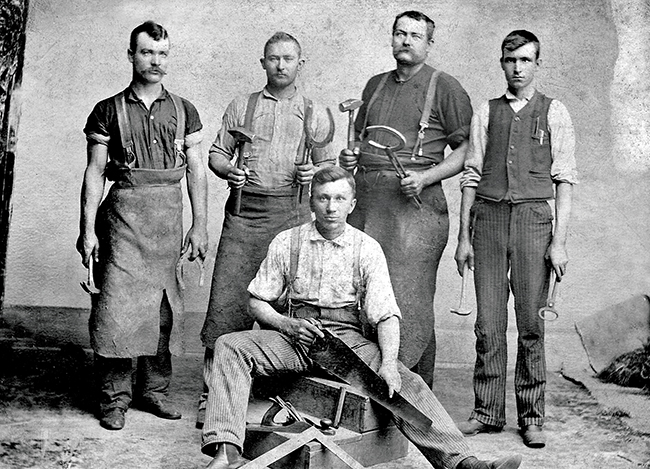
For the most part, early cars were expensive and unreliable. They were generally hand-built, often using components made by blacksmiths.
Independent assembly plants
The major automakers also set up several factories, but in Canada, these were often operated by independent companies. Wagon builder Gordon McGregor of Walkerville, Ont. inked a deal for the rights to build Fords for Canada and the British Empire, creating the Ford Motor Company of Canada in 1904, while the McLaughlin Carriage Company of Oshawa, Ont., built Buicks under license in 1907 and, in 1918, became General Motors of Canada. Many other smaller Canadian companies built their vehicles either under license from U.S. companies or from U.S. components, but tweaking and renaming them for the domestic market. These included cars such as the Ontario-built Tudhope of 1908-1913, the N.S.-based McKay of 1911-1914, and N.B.’s Maritime, founded in 1913 but which only lasted a year.
Showrooms and dealerships handled distribution in Canada’s larger cities, but it was far more difficult to get vehicles into the vast rural areas where much of the population lived. In some cases, it was up to the owners themselves, such as the drivers in N.S. who bought the province’s first cars at the 1904 New York Auto Show and had them shipped back. (P.E.I, meanwhile, solved any potential distribution issues by banning cars in 1908. The edict wasn’t completely lifted until 1918).
In many cases, farm implement dealers got into the car business, offering them alongside horse-drawn wagons to rural customers. Other early sales points included bicycle stores and carriage vendors. However, most of these agents ordered cars from the manufacturer when a customer asked for one, rather than keeping vehicles in stock.
Cars through catalogues
The T. Eaton Company even sold cars for a short period through its department stores and mail-order catalogue. It was convenient for customers, but Timothy Eaton soon discovered that the unreliability of most early cars was at odds with the “Goods Satisfactory or Money Refunded” guarantee he placed on all of his products, and that venture soon ended.
Meanwhile, those who did sell cars soon found there was far more to it than just handing over the keys. Many buyers were making their initial switch from horse to horsepower, and salesmen had to teach them how to drive. Dealers had to repair cars, usually with factory parts if they sold major brands. If they handled smaller manufacturers, they might have to go back to that trusty local blacksmith to have pieces repaired or fabricated. Gas stations were also a rarity, with fuel generally sold as a sideline by pharmacies or grocery stores, and some dealers made a little extra money filling their customers’ cars.
By the end of the 1910s, horses were still a common sight and paved roads were still rare.
But the horseless carriage had established a foothold it would never relinquish, and Canada’s auto dealers were ready for the future.