HOW TO REACH YOUR CUSTOMERS, HOW TO ENGAGE THEM
It’s hard to believe that the Trillium Automobile Dealers Association (TADA) has now hosted six of its Canadian Digital Dealer Conferences and the latest, which took place over September 17-18 in Ottawa and Toronto, continued the trend of being packed with meaty and useful digital marketing content.
Todd Bourgon, Executive Director, TADA says one thing he’s noticed with these events is that many attendees are consistently returning each year. “We had a lot of veterans this year, along with some new faces.”

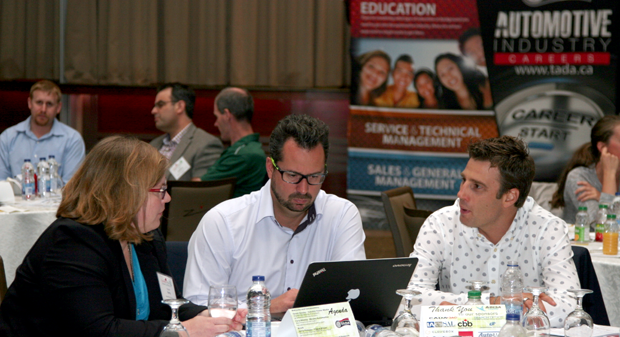
Jerry Thibeau with audience participant Franny Alway, of Brantford Honda
At the Toronto event, which took place at the Paramount Event Venue in Vaughan, Ont, the day’s session kicked off with a presentation by the charismatic Jerry Thibeau, CEO of Phone Ninjas.
Thibeau, who has many years experience in auto retailing, says that our industry still suffers from a poor reputation among the general population. “In the U.S., we rank below attorneys and politicians,” he says. Thibeau says that often, a big part of that perception is due to the way salespeople try to approach consumers. “Our salespeople fail because they’re trying to sell a car over the phone.”
FOCUS ON THE APPOINTMENT
Instead, he says, sales staff need to focus on selling the appointment, not the vehicle. “It’s a lot like online dating,” he says. “It should start with an email, move to a chat session, then a phone call and then setting the appointment (date). If you’re good on the Internet and good on the phone, you will get more dates.”
Discussing how to effectively manage Internet leads, he says that often, dealerships don’t have salespeople trained to properly handle them. “We should be doing certain things but we don’t do them.”
He says an effective approach is to use a rotation system, so that leads are evenly distributed among sales staff, cherry picking is avoided and that managers can see which salespeople are performers and which aren’t.
Thibeau says that when it comes to effectively responding to leads, he’s not a big fan of auto responders, especially during business hours. “The first email is the most read,” he says, “there is no reason why our first lead response can’t be from a real person.” He says even if stores use auto response after hours, having a personalized message, with a signature and contact information are critical.
Thibeau also says that a common problem is that many salespeople don’t call customers enough. He says that for an average dealership with a 100 per cent lead contact rate, just six dials result from it. He says that once salespeople do follow up a lead via the phone, they often fail because they don’t take the right approach. “Prepare yourself to do business with the customer. Use first names and don’t sound like a telemarketer. Get permission to talk to them before telling them who you are — am I calling at a bad time?”
A OR B CHOICES
He says that an effective approach is to give the customer reasons why now is a good time to buy a car and when it comes to setting the appointment (traditionally the big stumbling block), ask the customer if they are available today or tomorrow — “it’s hard to say no to that,” he says. “When you give people A-B choices, it makes things easier. People tend to pick one or the other.”
When it comes to actually setting the appointment, Thibeau says actual studies have shown that appointments set at 15 or 45 minutes past the hour tend to be more punctual than those at the top or bottom of the hour. He also notes that salespeople should let the customer know that they work by appointment, implying that they are busy and provide the customer with a couple of options and provide at least an hour and a half of time to sit with the customer.
Thibeau also says that today, the power of video and using testimonials can work wonders for individual salespeople, building their own personal brand and reputation online. “Every salesperson should have an ‘about me’ video,” he says. Thibeau notes that a young saleswoman at a Honda dealership named Elise Kephart, did this so well, that customers would drive from four hours away simply to do business with her.
MOBILE AND VIDEO
Tim Lamch, from Google Canada, discussed consumer shopping habits and why 2014 really is “the year of mobile.” He also discussed the growth in video and how the average Canadian now watches 41 hours of online video per month, second only to the U.S.
Tim Lamch
Video is maybe something you’re dabbling with,” he says “but it’s something we need to get into as an industry.”
He says that today, consumers are looking for instant gratification but also want to be treated uniquely. “People want to feel like they’re individuals, especially millennials.”
He says that while there continues to be a huge swing towards mobile usage, it’s important to note that it’s not just teenagers and millennials. “There’s been a huge swing to mobile for those 45 and under,” he says, but Lamch also noted that while television continues to be a preferred viewing medium for older people, around six per cent of 65 year-olds now consume online video in lieu of TV.
Lamch says that for dealers, video plays a key role for mobile users when it comes to researching cars, especially younger buyers and that the tools available today enable stores to upload decent, informative videos at little to no cost, via a YouTube channel.
Lamch notes that consumers are looking for videos that are authentic and that provide additional information as they move down the sales funnel. Citing the fact that YouTube now witnesses 500 hours of video content uploaded each minute and that video viewing of vehicles online has essentially doubled in the last two years, dealers should note that “video content is going to be huge and will really make a difference with consumers.” Lamch says that right now, both mobile and video represent “a great opportunity to test things, to do things efficiently and then build from that.”
DON’T FOLLOW BEST PRACTICES
Cory Mosley, CEO of Mosley Automotive, discussed why best practices tend to kill sales.
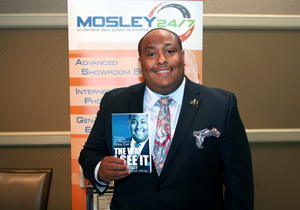
Cory Mosley with his new book – The Way I See It
Mosley kicked off his presentation with an analysis of the “monkey see, monkey do,” mentality. He referenced an actual experiment conducted by the University of California at Berkeley where two out of three monkeys in a cage, repeatedly stopped the other one from trying to grab bananas, even after each of the original monkeys had been swapped for new ones. He says that in the car business, we often suffer from that same approach — focusing too much on best practices and not on ways to set the stage and really gain a competitive edge.
He said part of the problem, at least on the sales side, is that too many of us are still using the same practices from 20-30 years ago. “We haven’t changed,” Mosley says. “I want us to start looking at some of the things we are doing to see how we can create domination.”
Mosley says one way is to start with a culture change in the organization. “When you create an appointment or sell to the customer, do you believe that customer is better off? Do your staff believe it?”
Mosley says part of the problem is a reluctance to try anything new or different, hence the monkey see, monkey do approach. “Just because you haven’t invested in a strategy, it doesn’t mean that it doesn’t work. The most powerful, sustainable growth will come from the mindset in how you run your dealership.”
Mosley talked about the “me plus three rule” — essentially that when a salesperson is talking a customer at your store, so are sales people at three other dealerships. He encouraged sales staff to put themselves in the customer’s shoes and understand what they are saying over the phone. “Would you call yourself that way? Have you ever listened to sales calls? It’s often like a relationship break up – there’s acceptance and then denial.”
VALUE PROPOSITION
Mosley says that too often, we don’t place enough emphasis on the actual words we use when dealing with customers. “The right words are huge when it comes to the next steps.” He says that if we don’t like the customer’s answer, then we need to ask them different questions.
He pointed to the differences between the words global warming and climate change and how despite referring to the same topic, come off sounding very different.
Mosley says that the notion of trying to find “common ground” with the customer has to be genuine and that the idea of salespeople being great actors, is simply bunk.
He says a far more effective approach is for dealerships to really establish a unique selling proposition and provide value, even though customers may ask for price. “So you’re thinking about one of those new Toyota Camrys. I’d love to get the best price for you, but first let me tell you about our exclusive benefits package when you buy one.”
Mosley talked about FMA (First Mover Advantage) how dealers can list build and take pre-orders prior to a new product release, much like Apple has done with its latest iPhone. He says that too often, we wait until a car is on display at the auto show and then use the show to build up market leads. “That isn’t true market interest.”
He says that when it comes to actually closing the deal, dealers need to focus on finesse and influence instead of trying to move in for the kill. With vehicles closer than ever in terms of features and quality, it’s the experience that sets a dealership apart. “By shifting the consumer experience you can take an entry-level brand upmarket, so your Chevy customer is treated like a Mercedes-Benz customer. This can make people change brands.” He says this is especially powerful today, given the advent of social media and the fact that one customer can share their experience with millions across the country and across the globe.
For part 2 of our Canadian Digital Dealer 6 coverage, click here.