WHY DOING WHAT WE’VE ALWAYS DONE IN AUTO RETAILING SIMPLY ISN’T GOOD ENOUGH ANYMORE
 We talk about change and adopting the ways of a dynamic retail sector, but many things remain the same in auto retailing. Customer expectations continue to evolve rapidly and customers are less likely to separate their retail experiences from different sectors. They will expect to encounter many of the same services and capabilities wherever they spend their money.
Consumers today can purchase multiple services or items, do comparison shopping, check out reviews or gather more information, customize an order or buy something they didn’t know existed all within a short space of time. They can check out physical products with much more precision and likely know much more about the product or service than would have been possible in the past.
It is far more likely under these conditions that consumers will connect their retail experiences and will, even if in their own minds, make comparisons and judgements about how good or bad each one was. No wonder customer expectations are rising — they are bringing new retail benchmarks into the dealership and expect a comparable experience.
Look beyond your business
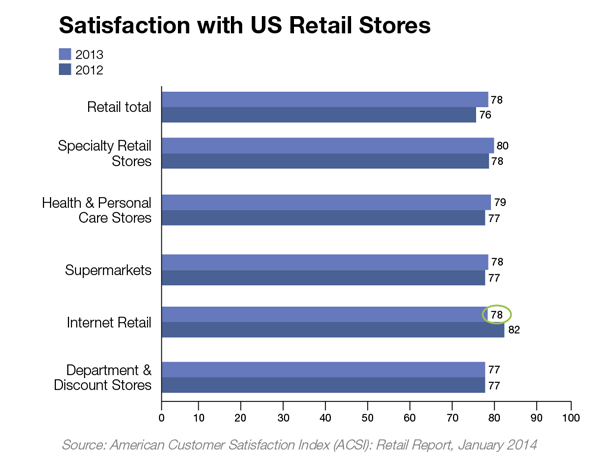
There are major studies conducted in many countries that measure customer satisfaction across multiple sectors, using common metrics. Two of the most relevant to us are those done in the U.S. and the UK. While auto retailing hasn’t been specifically included in either country, there are some interesting findings in each study that can help us to understand the dynamics and what to watch for in our own backyard.
The striking thing about these results is the sharp downturn in satisfaction for the Internet Retail Sector (note the green circle on the U.S. study). While the authors of the study do not provide a published opinion, evidence would suggest that these retailers are constantly innovating and surprising customers and prospects. Expectations are being raised all the time, leading to some frustration among consumers.
While the U.S. study saw three straight years of gains in customer satisfaction across segments, the UK study sees a levelling off and an actual decline since early 2013.
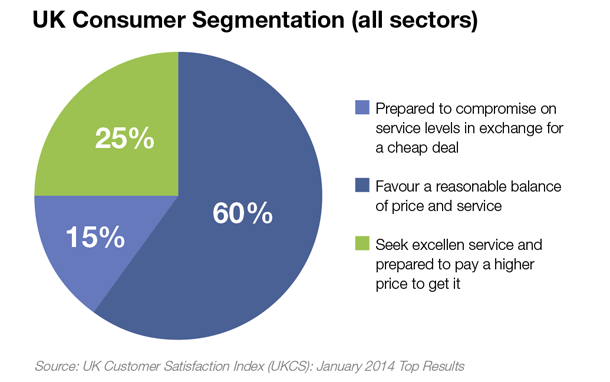
The UK study also finds a high level of correlation between Customer Satisfaction and Trust — something I think we should be measuring more carefully in all of our studies. Another interesting finding in the UK is how the market is segmented:
We hear a lot about how expectations are rising and that dealerships need to “wow” customers. Those are empty words that don’t mean much unless we can understand what actually leads to changing expectations.
A very informative Yale University text suggests that we form expectations on both objective factors (e.g., price, features, colour, availability) and on subjective factors (e.g., brand image, personal motivations, previous experiences). These may be very different, but they are interrelated. The text identifies a key element in how our expectations can change — it is the ability to be “surprised.” That happens when our “expectational equilibrium” is disturbed. In essence, we are surprised by something that goes against our current expectations. In today’s ever-changing environment, that can happen much more easily and also very quickly and that’s what consumers often experience. The aim is to bring that element of surprise into the dealership.
Montreal-based Multidev Technologies’ ChainDrive Integrated Retail Management Solution identifies 10 tips for retailers on meeting the changing expectations of today’s customers. These are truly retail oriented and there are some excellent ideas here that can help find areas where you can upset your customers’ “expectational equilibrium” and deliver a surprising experience. Here they are (summarized and put into an automotive context):
• Offer a seamless experience (across all your channels of communication or contact with the customer);
• Consistency of service, no matter where or how the contact is made with the customer;
• Product information that is transparent and consistent;
• Pricing that is also transparent and consistent (vehicle and service pricing);
• Define and communicate your understanding of your customers and of the trends taking place in the business;
• Identify your customers’ behaviour patterns and find your core customers (they will be the mainstay of the business);
• Make sure your dealership delivers what you want it to deliver;
• Captivate your customers through mobile communications;
• Implement in-dealership technology (hand-held devices, electronic information);
• Give customers a reason to come back (summarized from ChainDrive’s website information).
Many dealerships likely have some or all of these components in place, but this is a very useful checklist that pertains to all departments and can get everyone working in the same direction. The points are highly relevant to any retail environment and that’s where the auto retailing business will have to move if it is to succeed long term.