HOW TO ENSURE YOUR DEALERSHIP SURVIVES AND THRIVES IN THE EVENT OF DISASTER
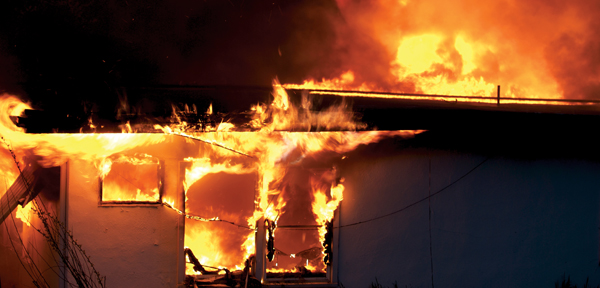
During the small hours on Wednesday July 11, 2012 a fire broke out at Gus Brown Buick GMC in Whitby, Ont. Because the dealership was closed at the time, it spread quickly, causing a great deal of damage. By the time emergency crews arrived at the store, much of the central part of the building had been gutted. “It was just horrible,” says president Gus Brown. “I was away at the time and Denis Ayotte, vice-president [who was on the scene] called me.” Brown says that initially, the damage was pegged at $500,000 but as is often the case, the original estimate proved to be far short of the total impact caused by the fire.
The incident might have caused some businesses to close up shop but Gus Brown wasn’t going down without a fight. Recently vacated premises up the street were quickly occupied, the store’s computer systems back up and running and staff once again at their desks serving customers. “It’s amazing how resilient us human beings can be when we’re put to the test,” says Denis Ayotte. Given the dealership’s prominence in the Whitby/Oshawa community and its major contributions over the years, people rallied around, providing desks, equipment, food and other supplies and assistance to help Gus Brown Buick GMC get back on its feet.

Team dedication has ensured that despite
incredible odds, the dealership has survived and thrived, including the parts department run by Jim Horner (left) and Alvin Beech
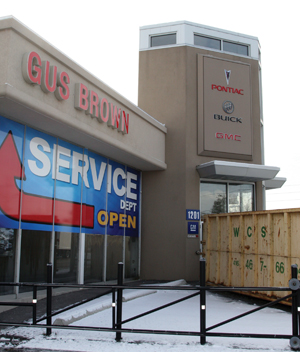
Now, almost a year and a half later, things are on track. Brown and Ayotte are getting ready to move back into the building at 1201 Dundas Street East. In fact, service operations and the dealership’s collision centre are already in place there, all that remains are parts (located in a portable building on-site at 1201) and new/used cars, which continue to operate out of the facility up the street.
“We’re looking to be back in there by the end of May or June [2014],” Brown says. He’s quick to point out however, that despite progress, there is still a lot that needs to be done before Gus Brown Buick GMC can close the page on this unfortunate chapter of events.
THE RIGHT COVERAGE
For Brown, a key issue during the whole process has been dealing with insurance related issues, including litigation. Circumstances have made the process of settling claims and getting on with rebuilding difficult. It’s something he says not many would understand unless they’ve gone through it themselves. “My $12.9 million insurance policy was the best,” he says. “If the building had burnt to the ground they would have immediately put up a brand new 37,000 square foot facility at around $200 per foot, up to a total of $7.5 million.”
However, because his dealership burned on the inside and remained standing, things have been a lot more complicated. “There really isn’t a policy for what happened to us,” he says. “The original estimates didn’t factor in the real amount related to damages.” At present, the total cost has been around $6 million with the dealership still waiting on approximately $1.5 million of that amount to be reimbursed. By the time, the process is completed, Brown estimates the total cost could be close to $10 million, since on top of rebuilding, the store still has to undergo a revamp to GM’s latest factory imaging standards. He also says that the insurance policy will only pay for repairs back to the building’s original configuration.
Brown notes that as a result of his own experience it’s important for dealers and their insurance companies to really understand the terms and conditions of policies before reaching a final agreement, otherwise there can be difficulties and grey areas when it comes to understanding what is and what isn’t covered. “I think with our situation, we have potentially uncovered a new insurance category,” says Brown. He also notes that it’s important to learn from experience, one such lesson being that most dealerships would require more than a one-year Business Resumption. “We now know this is available,” says Brown, “though at the time we didn’t.”

Denis Ayotte
DATA PROTECTION
Besides insurance, another key factor is making sure data is protected in the event of a disaster. Denis Ayotte says it’s important to have data files backed up to multiple tapes. “It’s something we did.” he says “but when your store is impacted by disaster it’s important to go a step beyond that. You also need to make sure your data restoration process is tested on a regular basis to make sure the recovery process works.”
It’s something Roy George of Velocity Business Solutions concurs. George, who serves as manager, business development for the Thornhill, Ont.-based firm, which among other things, provides disaster recovery and business continuity strategies for dealerships — says that while high capacity digital tapes remain one of the most affordable methods of backing up data offsite, their relative fragility means the data needs to be tested and frequently restored. “Grab a few files just to make sure it is still there,” he says. “We typically recommend that if a tape medium is still in use, about 13 tapes be in rotation.” He also says it’s important for dealerships to have at least two tapes stored off-site.
Given the risks of backing up data to tape, namely the potential for damage, not to mention the fact that tapes tend to degrade over time, more and more businesses are using cloud-based data, for things like email, communications, client information and safety manuals. By subscribing to a third party service that seeds their data into a data centre, stores reduce many of the risks associated with having to keep equipment and files physically at the dealership.
George says that the costs and services associated with these third party providers can vary widely. “One vendor might offer 400 gigabytes in the cloud for $500 a year, while another might offer 200 gigabytes for $500 a month.” While both will harvest data onto a server that is located off-site and is connected to the Internet, the more expensive services tend to have multiple servers on standby — sometimes as many as the dealership subscribes to.
As far as Velocity Business Solutions is concerned, George says that should the business declare a disaster “we will load all of your communications, all of your files and allow you to connect to everything in the cloud. It avoids having to acquire extra servers when you can just rent them.” George likens the concept to a hotel, where “you have everything at your disposal once that flight or trip is required.”
MAKE A PLAN
Doug Hodgert, director, technical services at Velocity, says that while the proliferation of cloud-based systems, whether hosting services or newer dealership retail management systems such as ADP’s Drive, mean more of the actual disaster recovery burden is being shouldered by vendors, dealerships still need to have their own strategies in place.
Hodgert says one way stores can really plan, is by saving all of their critical data to protected locations on the server, even while staff are working and to get that data replicated off-site. “The most vulnerable pieces of equipment in the whole chain are individual computers or laptops. If you have a fire at the dealership, even if it is a small one, such as in a service bay, it can set off your sprinkler system and that will be the end of your computers.”
Back at Gus Brown Buick GMC, despite the fire and the urgent need to find new premises, the store’s DMS system was up and running within 24 hours. Nevertheless, the servers had to be moved from the damaged building to the alternate location up the street and cables and phone lines re-routed. However, because Gus Brown also operates other stores, including one in Port Perry, Ont. the need to re-route everything from one site to another in Whitby (even though it was less than a block away), impacted the Port Perry store too.
“Our Port Perry store was down for three days since our main server was in Whitby and it linked our Port Perry DMS over a private network link,” says Denis Ayotte, “so when something like this happens make sure you have a backup system for your data, even if it is a temporary manual one via paper and make sure it is ready to go.”
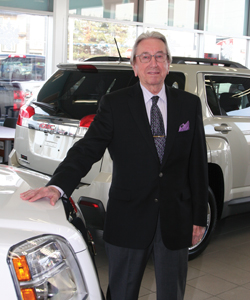
Gus Brown
INDEPENDENCE
Ayotte says that the fire at the Whitby location amplified the need to ensure each dealership was able to operate independently from the others in the case of an emergency, so if you do have a central hub, each of the locations can be recovered independently on site or from another location. “Centralization is a great idea but you also need to have the ability to be self-contained,” he says.
Shortly after the fire, the store had another unexpected wrench thrown in the works when the firm’s outside chartered account became ill. As a result, because he was unable to look after the dealership’s finances, another source had to be found.
In such cases, Gus Brown says it can prove difficult for the store to access statements and other critical accounting data, especially if the accounting firm in question isn’t familiar with the business. Both he and Ayotte acknowledge that when you also factor in abnormal events such as a fire, having access to such information and maintaining open channels of communication with banks and lenders is essential — particularly when it comes to parts of the business that are set up for receivables such as service and collision operations.
OPEN COMMUNICATION
“When a disaster of this magnitude happens, it is not going to be business as usual. The financial numbers will be affected,” says Ayotte. “Your banking partner needs to understand that. Lenders have certain requirements you have to meet and if you have a fire, like in our case, it can be difficult to stay within those guidelines while business gets back to normal. Make sure you maintain open communication at every turn.”
As a result he says, ensuring that you have access to your statements, even if that requires retrieving the data from another location goes a long way to to minimizing the impact of events such as a fire on business operations.
 At Velocity Business Solutions, Roy George says it all goes back to planning the infrastructure. “The reason why we try and harvest as much data at the dealership level as possible and place it onto the servers is because they have so many redundancies in place.” George says it’s important for dealers to think about redundant locations, as opposed to redundant parts — locations for the data to be stored and replicated off-site, so it can be bumped back up live to those that needed it the most when disaster strikes.
At Gus Brown, not only did incredible circumstances highlight the need for redundancies and new ways to ensure business continuity, it also demonstrated the strength and can-do approach of the dealership and its staff. Today, both Brown and Ayotte are optimistic and they should be. Not only has the store continued to thrive despite seemingly insurmountable odds, Gus Brown’s generous support of the local community has continued throughout.
“We thought about canceling our annual Gus Brown Golf Classic tournament,” says Ayotte. “It was scheduled a month after the fire happened. But we went ahead, even though our original prizes were affected by the fire.” As it turned out, the community rallied and the 18th annual Gus Brown Golf Classic proved to be the most successful ever, raising over $100,000 for charity from just a single event.