WITH NATURAL RESOURCES CANADA CONSIDERING MAKING ITS ENERGUIDE VEHICLE LABELS MANDATORY, CANADIAN AUTO DEALER TAKES A LOOK AT THIS ISSUE

In 1998, Natural Resources Canada (NRCan) introduced its first EnerGuide labels. The idea was to provide consumers shopping for vehicles, fuel economy figures for each individual new car or truck sold in Canada and the estimated annual costs buyers could expect from driving them. These labels were affixed to the vehicle by the manufacturer and designed to be displayed on dealer’s lots, while the information contained within them was the result of testing procedures conducted by NRCan.
The aim was to help potential buyers make informed choices, so they could compare official fuel economy figures and determine whether a particular vehicle was suitable for their needs or budget.
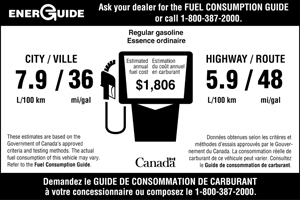
Revised EnerGuide fuel economy labels will be phased in for 2016 model year vehicles
MOVE TO MANDATORY
Fast forward 15 years and Natural Resources Canada has brought the labels into the spotlight once again, consulting both the public and industry whether or not to make the current voluntary program mandatory. At the same time, NRCan is also in the process of overhauling its fuel economy testing procedures, designed to better reflect real world driving conditions. This is an important consideration, especially in view of recent controversies about fuel mileage claims by some automakers (particularly in the U.S.) and with saving at the pump still on the minds of many car buyers.
For dealers, the labels have often proven to be a mixed blessing. While some say they have helped customers reach major decisions in the buying process, others have found them to be a bit of a burden. Stories of labels getting damaged or torn while vehicles are in transit to dealerships are common. Additionally, depending on the vehicle, some labels end up being attached to the windshield or passenger side window, causing obstruction during test drives. As a result, since the program is currently voluntary, a number of dealers choose to remove the labels, once the cars hit the lot, long before they are actually delivered to the customer.
AN ANSWER WITHOUT A QUESTION?
According to Michael Hatch, Chief Economist with the Canadian Automobile Dealers Association, the information contained within the labels should be made available to consumers, since for shoppers today, fuel economy is “the number one factor other than price.”
Nevertheless, Hatch says the association believes that choosing to make the labels mandatory “represents a 1970s solution to a problem that really doesn’t exist.”
He notes that today, consumers are able to get fuel economy information from a wide variety of sources, whether it’s online, such as via NRCan’s official website or from brochures or literature that dealerships carry. As a result, the idea of affixing a label to a vehicle today is viewed almost as superfluous. Furthermore, he says that while the government says it’s taking steps to reduce the red tape burden on businesses “they are considering imposing a greater paper burden in the form of these labels — 1.4 million pieces of paper.”
From an environmental perspective, such a move appears to be a retrograde step, especially when many governments, organizations and individuals are trying to reduce their reliance on paper in a nod toward greater sustainability.
So what exactly is the NRCan’s take on all this? In contacting the department and asking it about some of the reasons for making the labels mandatory, we received the following response. “Natural Resources Canada enjoys a collaborative relationship with the automotive sector. The government periodically reviews the performance of different initiatives, keeping in mind, current alternative approaches.”
Not much to go on then. However, when we mentioned that labels getting damaged or posing an obstruction during test drives was an issue and if the government is aware of this problem, NRCan did say that it is looking into several placement options designed to provide “more flexibility to manufacturers and dealers.” The department said the results of those consultations “will be announced in the coming months.”
In response to the question of whether or not funds could be better used elsewhere instead of printing more labels under a mandatory program, because the OEMs bear the cost of producing them (both here and in the U.S.) NRCan’s stance is that whether the labels are either voluntary or mandatory, the cost in producing them is the same. And since that cost falls to the manufacturer, that is perhaps a good indicator that the labels could become mandatory. But rather than making the labels mandatory, wouldn’t a better approach be to make the actual data itself compulsory and give both dealers and manufacturers a choice when it comes to the method in which they present it? Michael Hatch thinks so.
“That was the gist of our submission a couple of months ago,” he remarks. “Give dealers a choice in how they provide that information,” he says, “either via paper labels, brochures or online — information which both dealers and consumers have access to.”
THE COMPLEXITY OF FUEL ECONOMY TESTINGBesides the labels, as briefly mentioned in the main story, there is controversy over the fuel economy figures themselves. In the U.S., several OEMs have had lawsuits filed against them, citing the fact that in real world driving, actual observed fuel economy on a number of models falls significantly short of manufacturer claims. However, the situation often isn’t as clear cut as one might think. “There is always a range,” says Michael Hatch, “depending on certain factors such as who is driving the vehicle, how they are driving it, whether it’s being driven in city traffic or on the highway.” Other factors also include altitude, ambient temperature, tire rolling resistance, even the quality of fuel used. In Canada, the added problem in referring to official government fuel economy data in recent years often lies with the fact that the two-cycle test procedure used to measure fuel economy by NRCan doesn’t really reflect the actual driving conditions most of us experience on a regular basis. As a result, NRCan is introducing revised test methods and will display the results on new EnerGuide literature (including window labels), beginning with 2016 model year vehicles. This follows a move by the Environmental Protection Agency in the U.S., which introduced new five-cycle testing in 2008. This added three additional tests to the original two-cycle procedure, designed to better reflect modern real world driving (the original laboratory tests, instigated back in the mid-1970s, included city and highway cycles where average speeds achieved were just 21 mph (34 km/h) and 48 mph (77 km/h) respectively, reflecting that 55 mph (88 km/h) speed limit, post energy crisis era). The new tests, include a cold-start procedure and higher ambient temperatures (95 F/35 C instead of 75 F/24 C as well as higher engine loads). That said, even with revised testing methods and results, due to uncontrollable variables outside the laboratory or track environment, the issue of fuel economy is always going to be a contentious one, which is why, even when armed with a whole slew of different sources of information, whether they be labels, brochures or online data, both dealership staff and their customers should |