 At this year’s Geneva Motor Show, the lustre appeared to be somewhat dimmer than in the past, as automakers grapple with an ongoing economic slump, persisting problems relating to manufacturing overcapacity and new vehicle registrations that seem to be in freefall mode. However, according to Reuters, there is one bright spot and it concerns the market for small, subcompact crossovers.
BMW’s MINI brand with its Crossman and Paceman models, plus others like the Nissan Juke and Qashqai have proved popular (the Juke has sold 97,000 copies in Europe since its launch in 2010).
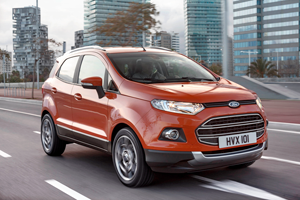
As a result, other automakers have been eager to jump on the bandwagon, with Ford, Peugeot Citroen and Renault all revealing mini crossovers of their own (EcoSport, 2008 and Captur respectively) at Geneva this week. Even Fiat is getting in on the act with upcoming 500X, which is based on the reborn Cinquecento and could very well be headed to North American showrooms.
According to Francois Bancon, Nissan’s upstream development chief responsible for the Juke, the fact that new vehicle sales in Europe are approaching 20 year lows, yet buyers are still clamouring to pay an almost $4,000 U.S. premium for what is essentially a car on stilts “isn’t very rational.”
Nevertheless, it does represent good news and allows automakers, especially those that have leveraged small vehicle architectures to accommodate multiple models, a chance to stem losses. Good examples include General Motors, which recently launched the Chevrolet Trax and Opel Mokka models, targeting this new mini SUV segment.
The trend can also be seen as further evolution of the original crossover phenomenon which began in North America in the late 1990s, with consumers wanting car like comfort, ride and convenience but with a higher driving position traditionally associated with trucks. However, this time around, not only is the trend towards smaller vehicles, its also on a much bigger scale, reaching into new markets.