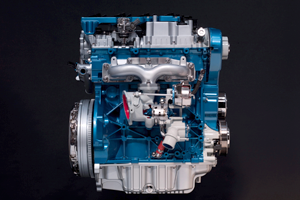
 Not one to shy away from controversy, Consumer Reports has said that small displacement turbo engines don’t deliver the fuel economy their manufacturers claim. In a press release yesterday, the magazine said that while the idea of a downsized, turbocharged motor delivering the power of a larger engine with the fuel economy of a smaller one, is sound in theory, in actual testing such powertrains “are not delivering on those promises.”
Consumer Reports cited its recent test of the 2013 Ford Fusion, equipped with turbocharged, direct injected, four-cylinder EcoBoost engines as good examples. It said that the 1.6-litre version “trailed most competitors” and that its measured fuel economy of 25 miles per gallon U.S. (9.4 L/100 km) “places it among the worst crop of recently redesigned family sedans.”
Even the larger 2.0-litre EcoBoost Fusion delivered “slower acceleration and reduce refinement,” as well as delivering 22 miles per gallon (10.7 L/100 km) which the magazine said “paled in comparison against the 25 and 26 mpg recorded for the best [normally aspirated] V6 sedans.”
Chevrolet’s Cruze powered by the 1.4-litre EcoBoost turbo engine was also tested against its 1.8-litre normally aspirated counterpart, Consumer Reports declaring that the former “was barely faster faster to 60 mph (96 km/h) and got the same [gas] mileage as the larger engine.”
Turbocharging, is nothing new to the auto industry. GM first offered turbo engines in the 1960s, and by the early 1980s the technology was also seen as a way of increasing fuel economy in view of gas prices and fuel economy standards that were expected to rise significantly in the coming years. A generation later, with automakers facing many of the same challenges again, it’s making the comeback. Nevertheless, in order to be able to deliver effective power “on demand,” the right air/fuel ratio needs to be achieved. As a result, Consumer Reports correctly points out that any potential fuel savings offered by smaller turbo engines are often hampered by the extra fuel required to mix with higher air volumes in order to achieve optimal combustion.
In response to Consumer Reports, a number of automakers have been hitting back; a spokesman for General Motors, Tom Read, said in response to comments on the Cruze, that “mileage is really dependent on how you drive. If you have a heavy foot, you’re not necessarily going to see a lot of fuel economy benefits.”