By Chuck Seguin and Todd Phillips from NADA
The first press conference at the NADA Convention and Expo this week was held to release the findings of the much-anticipated report about the return on investment from OEM image programs. Glenn Mercer, an independent consultant summarized the report to a standing room only gallery of international media and dealers.
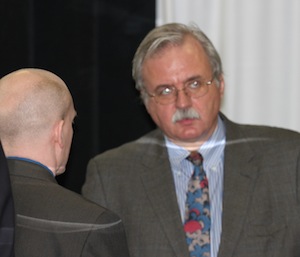
Glen Mercer fields questions from reporters after authoring a new NADA report on the merits of factory image programs
“These programs — intended to encourage dealers to invest in store expansion, modernization and standardization — can place significant financial burdens on dealers, yet there is little hard evidence on the return on investment this spending might yield,” says Mercer.
In his remarks, Mercer cautioned dealers not to expect any simple answers to solve the issue from this report. “There is no silver bullet in this report,” said Mercer. “The report does not comment on any specific OEM programs.”
In general terms, the report found dealers and OEMs both believe that clean, fresh, customer friendly facilities are in everyone’s best interest. Where they disagree is the lack of choice and flexibility and the unrealistic requirements in some programs. In interviews with dealers for the report, some said they believe that they could lower the costs of these projects by 20-30% if they could be more involved in handling them.
The report captured opinions from dealers, OEMs, experts and consumers and reported on some of the traditional grievances over issues such as OEMs demanding specific types of products and materials to ensure standardization while dealers complained these specific demands add cost and add little value.

The NADA report found consumers aren't as concerned about a dealer's facility as OEMs and dealers appear to be.
“Dealers are supportive of the concept of facility programs, but wary of their economics. Expert observers such as CPAs and dealership brokerages tend to echo this view. The OEMs for their part are understandably enthusiastic about the programs, but approach them in very different ways, which tends to undermine dealer faith in their value. And consumers seem to be mostly indifferent,” write the report’s authors.
The sample size for the interviews was fairly low. Six public companies and 24 privately held dealers, 4 lenders, 5 accounting firms, six legal firms, 2 brokers, 12 OEMs, a restaurant franchisee, a hotel industry executive and a few others for a total of 75 interviews.
“The NADA research project brought all the various perspectives on this issue out into the open by speaking with a wide range of industry participants,” said Mercer. “Our goal was to open up a dialogue in which all parties could discuss facility requirements on a more rational, informed and fact-driven footing.”
The researchers did capture some consumer survey data based on surveys of a few hundred in-market consumers. This data shows that consumers rank facilities near the bottom of considerations when it comes to selecting either a new vehicle or a dealer.
The report’s authors issued three recommendations, grouped into three areas, value, cost and the future:
1. Value. It should be clear that we firmly believe that it is incumbent upon OEMs to provide dealers with more persuasive business cases for investment in facilities, especially for Modernization and Standardization expenditures.
2. Cost. Even for those dealers who are convinced of the value of facility programs, there is equal conviction that the cost of these programs is needlessly high. The typical estimate of how much more costly it is to execute one of these programs, compared to doing it oneself, is 20%-30%. Accordingly, we urge individual OEMs and their dealers to work together to tackle cost levers such as unnecessarily high or rigid materials and fixtures specifications, needless limits on the numbers of qualified vendors and unstable volume forecasts, etc.
Further, we encourage OEMs to revisit again how they “tier” their programs to make them more affordable for the smallest rural stores. Beyond these structural cost issues, there are also needless costs incurred during program implementation due to poor communications, unclear chains of command and antagonistic behaviour on both sides. Our further recommendation is for dealers and OEMs alike to step back, recognize their mutual interests and dependency, revisit how many resources they need to devote to the process (e.g. OEM field staff and dealer principal attention), and – most crucially – “turn down the heat” in regards to rhetoric, complaints and accusations.
3. The Future. Our first two recommendations deal with the here and now—the costs and benefits of current facility programs. However, by generating and sharing research into retailing trends, we would recommend to both OEMs and dealers alike to jointly tackle the issue of whether the dealerships we are building today are going to be the successful dealerships of tomorrow.
You can read the executive summary and full report at: www.nada.org/facilitystudy