 According to IDTechEX, a UK consultancy firm that helps companies profit from emerging technology, 1,000-mile battery-electric vehicles are “easy to make,” coming soon, and will have a profound effect on the market.
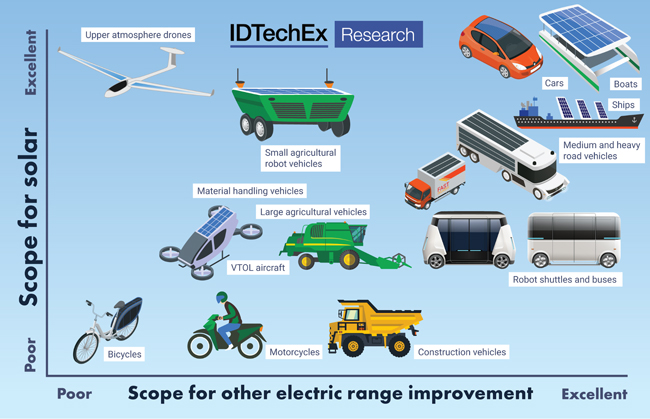
In the company’s report, Solar Vehicles 2021-2041 2nd edition, new designs include folding solar panels, single-crystal silicon sides (as seen in Sono Motors’ vehicles), glass vehicles, solar windows, and translucent solar roofs (an innovation promised by Hyundai).
Existing technology is currently being advanced and will be harnessed to make electric vehicles increasingly common. “In 2018, Tesla began to adopt wide-bandgap semiconductors (silicon carbide) in the Model 3’s main inverter, which are more efficient and save on the weight and space of the cooling equipment,” IDTechEX reports. “Supercapacitors are barely used in on-road BEVs, but they can improve range in many ways now that they appear with higher energy density and at a lower price. They grab more braking energy, and they facilitate deep discharge of the newer batteries,” the firm explains.
IDTechEX also reports that other range-extending technologies are on the horizon, including transparent heater film, infra-red harvesting surfaces, wind turbines that are used when the vehicle stops, and although challenging, higher voltage batteries designed to increase range.
“VW Group and many others are working on structural batteries and supercapacitors to increase range,” Raghu Das, CEO of IDTechEx, says. “The 800-1000V is pioneered by VW Group, Lucid, Rivian, GM, Hyundai, Kia, and other carmakers and their suppliers such as Hitachi, Borg Warner and others. In principle, it increases efficiency and lightens weight.”
According to ZF Friedrichshafen AG’s (ZF) Bert Hellwig, who is responsible for electric drive system development, ZF is currently supplying a “Chinese OEM with a complete electric driveline, including power electronics, for several models.”
IDTechEX also points out that “Volkswagen’s new targets include 40% more energy density by 2030. In other words, vehicle designers can now choose which of the many routes to the 1,000-mile range they will pursue.”