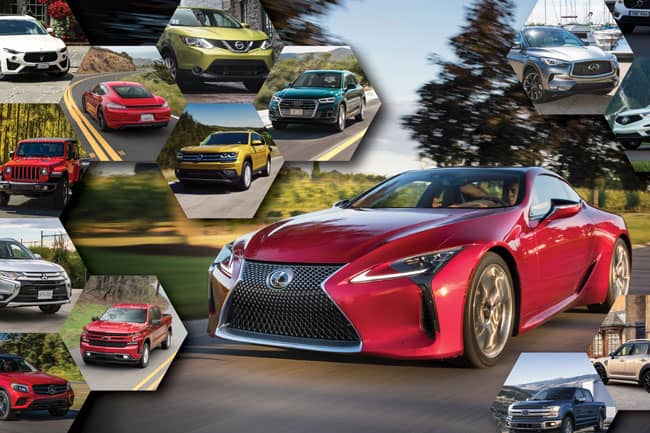
For the first time since March 2013, new-vehicle sales in Canada for the year-to-date fell below their year-ago levels in June. Cumulative sales of 1,036,677 cars, trucks and SUVs in the first half of 2018 were 0.2 per cent below last year’s record numbers for the period, ending five years of continuous sales growth.
It’s more a leveling off than a sharp downturn and analysts suggest that this will be another near-record, if not record year for sales. But, as is always the case, some automakers are faring better than others as the market tightens up. Here’s how we grade them in our annual mid-year report card:
Acura: B+
Acura’s sales were relatively flat in 2017, but they’ve improved by 2.4 per cent through the first half of 2017, slightly ahead of the industry average. As is the case for most of the market, what growth there has been is on the utility-vehicle side, so it’s good news that an all-new version of Acura’s best-selling model, the RDX, is fresh on the market for the second half.
Audi: A+
Audi continues to be one of the industry’s big success stories, with a 17.9 per cent sales increase in 2017 and a further 10.5 per cent gain through the first half of 2018. Unlike most other brands, Audi’s passenger cars are maintaining their sales pace, while its SUVs — in particular the top-selling Q5, which is all-new for 2018 — account for most of the gains. As a result, Audi surpassed BMW for second place among luxury vehicle sales at mid-year, albeit by just 300 units. Expect more of the same for the rest of the year
BMW: A
BMW’s sales were relatively flat (+1.7 per cent) in 2017 but they’ve increased by 5.3 per cent through the first half of this year, thanks largely to the success of the new-for-2018, American-built X3 CUV. While it has taken over from the 3 Series as BMW’s best seller, the brand’s refreshed passenger cars are holding their own in a declining market. Still, Audi has now overtaken the Bavarian brand for second place in the luxury ranks, so it’s game on for the rest of the year.
Fiat Chrysler Automobiles: B-
Canada’s market leader just two years ago, FCA is suffering the greatest sales decline of any major automaker — off by 11.1 per cent at mid-year, on top of a 3.7 per cent drop in 2017. Apart from tiny Alfa Romeo, only Jeep among FCA’s many brands is showing growth, primarily thanks to its Compass CUV and the all-new Wrangler. As a result, FCA has fallen to third-place overall and given up 1.6 per cent in market share, falling to 13.0 per cent, in the past year. The potential bright spot is the arrival of an all-new Ram pickup for 2019, which should strengthen its position as the second-best selling vehicle in the country.
Ford: A
As it has been for much of the past decade, Ford is the mid-year sales leader. But unlike most of those prior years, this time its position is precarious. The Blue Oval is ahead of General Motors by just over 600 units and its sales are down by 2.9 per cent, following a 1.3 per cent increase in 2017. Of course, the F-Series pickup remains Canada’s best-selling vehicle by a huge margin, but its sales are down almost 8 per cent; and Ford’s car sales are off more than 10 per cent, primarily at the expense of the mid-size Fusion. It’s still a healthy position to be in, but can it continue to lead the market through the second half?
General Motors: A+
A year ago, General Motors was about 1,000 units behind FCA in a fight for second place. This year, it’s an even smaller margin behind Ford, fighting for first. After finishing 2017 with a 13.3 per cent increase, GM’s sales are up by 3.0 per cent through the first half of 2018 — the only one of the Detroit Three in positive territory. Along with those gains comes a 0.4 per cent increase in market share, to 14.9 per cent. As was the case a year ago, there’s strength across GM’s lineup in both cars and trucks, but most of the gains have come from the Chevrolet brand, which has new Silverado pickups and Traverse SUVs in its portfolio.
Genesis: A
Hyundai’s upscale Genesis spinoff is doing very well indeed as a stand-alone brand. Not only did it more than quadruple its sales in 2017 from its model-only status the year before, it achieved a 159.2 per cent gain so far this year, thanks to the introduction of its G70 model, which has been acclaimed as a legitimate 3 Series competitor. Topping the charts in J.D. Power’s Initial Quality Study undoubtedly hasn’t hurt. The big question is, can this momentum be maintained?
Honda: A
After a solid 6.3 per cent gain in 2017, Honda’s sales are relatively flat in 2018, up just 0.8 per cent at the mid-point. The Civic remains Canada’s best-selling car by a wide margin but its sales are down 4.4 per cent and the Accord’s significantly more. What has kept the brand in positive territory is greater availability of the Ontario-built CR-V, which has earned the title of best-selling utility vehicle with a 17.6 per cent surge in sales through the first half. Having two top-sellers, both built in Canada, is not a bad spot to be in.
Hyundai: B-
In spite of winning quality accolades, Hyundai sales fell by 6.1 per cent in 2017 and they’re down by 8.4 per cent so far this year, giving up a half-point of market share (to 5.9 per cent) in the process — the second-poorest performance of any mainstream manufacturer. The addition of the hybrid Ioniq to the lineup has helped passenger car sales, but not enough to offset Veloster declines. Similarly, the all new Kona sub-compact has boosted utility sales, though not enough to offset Tucson and Santa Fe losses. An all-new Santa Fe promises some relief in the second half but it’s a tough year for Hyundai.
Infiniti: A-
Infiniti finished 2017 with sales up 2.8 per cent, just slightly behind the market, and they have declined by 3.3 per cent through the first half — again below the market average. Infiniti’s car sales actually increased, thanks to a refresh of its best-selling Q50 sedan. But utility sales flagged, particularly in the lower echelons of that hot market. The mid-year arrival of an all-new QX50 mid-size sport-ute, which is expected to become the brand’s best seller, should provide some respite to the current doldrums.
Jaguar: A
Jaguar was among the hottest brands on the market in 2017, with sales up an outstanding 52.3 per cent at year-end. It was a difficult pace to maintain and sales are down by 4.6 per cent through the first six months of 2018. Sales of most existing models (except the F-Type sports car) were off slightly, but that deficit was substantially offset by the arrival of the new E-Pace compact utility vehicle. The brand has won multiple awards for its recent products and has an all-electric I-Pace coming to keep the buzz going so its future continues to look bright.
Kia: B+
Kia sales were up 6.7 per cent in 2017 and they’re ahead by 0.4 per cent in 2018, in a slightly down market. Unlike most of their rivals, Kia has maintained virtually flat car sales but van and utility sales have remained flat as well, with the new Niro and redesigned Sorento just offsetting declines in Sportage sales. The imminent arrival of a new Forte compact sedan should boost numbers through the rest of the year and a refreshed Sportage, including a hybrid model, promise longer-term relief. And, ranking highest among non-luxury brands in J.D. Power’s Initial Quality rankings can’t hurt.
Land Rover: A-
After making a huge leap the year before, Land Rover sales remained flat through 2017. But they’re up by 14.7 per cent in 2018’s first half, thanks primarily to the arrival of the new Discovery and the addition of the all-new Velar. The availability of new, four-cylinder engines and a couple plug-in hybrid models will keep the products fresh. There’s nothing else major that’s due imminently, but the strength of both the luxury and SUV markets bode well for the British brand.
Lexus: A-
Lexus sales jumped by 10.0 per cent in 2017 but they’ve declined by 5.5 per cent so far this year, in spite of an image injection via the brand’s hot new LC coupe. Most of that decline was on the passenger-car side, spread across the lineup, but it was exacerbated by near-flat sales on the utility side as well. Sales gains from the NX compact SUV were largely offset by declines for the brand’s best-selling RX mid-size crossover. An all-new ES sedan, based on Toyota’s Global Architecture-K platform is due before year-end, but probably not in time to have much impact on this year’s figures.
Maserati: B
Maserati was the hottest brand on the market in terms of percentage sales increase at this time last year, thanks to the introduction of its Levante SUV, and it ended the year with sales up by 83.8 per cent. Now that the blush of newness has faded, its sales have subsided, resulting in a 36.8 per cent decline for the brand by mid-year. Still, it’s a significant net gain for what was traditionally a sports-car-based company. The Levante continues to be its best seller and two new high-performance versions, with Ferrari-developed V-8 engines, should help maintain interest in the 2019 models.
Mazda: A
Mazda bounced back from a down year with a 7.0 per cent sales increase in 2017 and it’s keeping that run going with a 5.9 per cent further gain through the first half of 2018. Most of those gains came from its sub-compact CX-3 and compact CX-5 utilities, the latter of which has replaced the Mazda3 sedan as the brand’s best seller. A refresh of the larger CX-9 helped as well. Mazda’s passenger-car sales were off commensurate with the market, though refreshes to the Mazda6 and MX-5 boosted their sales and reinforcements are on the way in the form of an all-new Mazda3 for 2019.
Mercedes-Benz: A
Mercedes-Benz remained solidly in first place among luxury brands with an 11.8 per cent sales increase in 2017, and it’s up by 1.4 per cent so far in 2018. This year’s gains have come on the truck side, which includes Sprinter and Metris vans as well as five SUVs and their derivatives. The C-Class passenger-car range is the band’s best seller but it has lost some ground while both its GLC and GLE utility vehicles have made big gains and aren’t far behind. Beyond covering every facet of the luxury market, Mercedes maintains a steady stream of newly refreshed models, including an A-Class sedan now in the wings, so its reputation and position both seem secure
Mini: B+
Mini finished 2017 up by 6.7 per cent, thanks to a year-end surge, and it’s holding its own in 2018 with a 1.3 per cent gain, thanks to its utility-oriented Countryman. Sales of the traditional models are off by 18.1 per cent and there’s nothing new on deck until a plug-in model arrives sometime next year. Still, the brand maintains a niche appeal so its status is expected to remain quite quo.
Mitsubishi: A
After a slow start to 2017, Mitsubishi’s sales were up by 1.9 per cent at year-end. They’ve come on much stronger in 2018, increasing by 17.7 per cent at mid-year — the best performance of any non-luxury brand. All those gains have come from the brand’s all-new Eclipse Cross compact and larger Outlander SUVs — the latter of which is now available with a highly-acclaimed plug-in hybrid system. Almost 80 per cent of the brand’s sales come from SUVs so that’s where it is focusing, with a refreshed RVR model said to be next in the pipeline. It may be the best time ever for Canada’s smallest Japanese brand.
Nissan: A
Nissan finished 2017 with a solid 10.0 per cent sales gain and it’s up 2.6 per cent through the first half of 2018 — enough to keep it ahead of the market and ahead of Hyundai for fifth-place in the rankings. Apart from some modest gains by the Titan pickup, however, almost all those increased sales came from just two models — the second-generation electric Leaf and the all-new Quashqai CUV, which accounted for the bulk of the increase. Sales were down by 11 per cent across the passenger-car lineup, slightly more than the industry average. There’s a new Sentra in the works but don’t expect much change for the rest of this year.
Porsche: A+
Following a 16.8 per cent gain in 2017, Porsche sales are up another 5.0 per cent at mid-year. But, unlike most of its competitors, it’s the passenger-car side of Porsche’s lineup that’s driving those increases, with all four models making gains, while the brand’s two utilities both lost some ground. An all-new, all-electric Taycan SUV will arrive next year to challenge Tesla on that front, the 911 will get a major refresh, and there seems to be a continuous stream of new iterations on existing models — so Porsche’s fortunes continue to look bright.
Smart: C
Given its low absolute sales numbers, small changes make for big swings in Smart’s percentage sales figures, which may account for the 80.4 per cent decline in sales in 2017. But the switch from gasoline to electric powertrains hasn’t had much impact on sales over the past 12-month period as they’re down just 0.5 per cent from a year ago. While there may not be much downside, there doesn’t appear to be much upside to Smart’s prospects either, apart from car-sharing fleet sales. The question becomes, is there any future at all for the brand on this continent?
Subaru: A
With an 8.7 per cent sales increase in 2017 and another 5.5 per cent advance through the first half of this year, Subaru continues its relentless march up the sales charts, having now consolidated its 11th-place position in the rankings. While sales of its conventional sedans are off by 13.7 per cent — greater than the market average — that decline has been more than offset by increases for its Crosstrek CUV. With the long-awaited arrival of the seven-passenger Ascent SUV, Subaru’s sales ascent looks set to continue.
Toyota: A
Toyota’s sales were up 2.3 per cent in 2017 and another 2.4 per cent in 2018’s first half, keeping the Japanese market leader slightly ahead of the industry average and picking up 0.3 per cent of share, to top 10 per cent once again. Passenger car sales were down, consistent with the market, as losses for the brand’s best-selling Corolla were partially offset by increases for the Camry and Yaris. The gains came on the truck side, primarily from the C-HR sub-compact utility and the Tacoma and Tundra pickups. Arrival of a new Corolla hatchback should provide a boost in the second half.
Volkswagen: A+
While fallout from Volkswagen’s diesel scandal still resonates in the courts and the news, it’s history in the marketplace. VW’s sales rebounded by 16.0 per cent in 2017 and they were up another 16.8 per cent in H1 2018. Car sales were down, along with the rest of the industry, although Golf sales increased. But the brand’s switch in emphasis to utility vehicles has paid dividends, with big gains from all three models on offer, especially the new-for-2018 Atlas. Increased availability of the redesigned 2019 Jetta promises help on the car side as well, so things are looking up for VW.
Volvo: A+
Volvo followed up a huge sales increase in 2016 with another 16.8 per cent gain in 2017. Sales jumped a further 42.6 per cent in the first half of this year, making the Sino-Swedish brand the hottest volume-production player in the market right now. That growth has all come from Volvo’s trio of multi-award-winning utility vehicles, including the new-to-North America XC40. The imminent arrival of an all-new, American-built S60 sedan, spiced with some electrified Polestar models, should keep the Volvo buzz going, though it has created a hard act for itself to follow.