 Fifth consecutive month of sales decline is the greatest yet
By Gerry Malloy
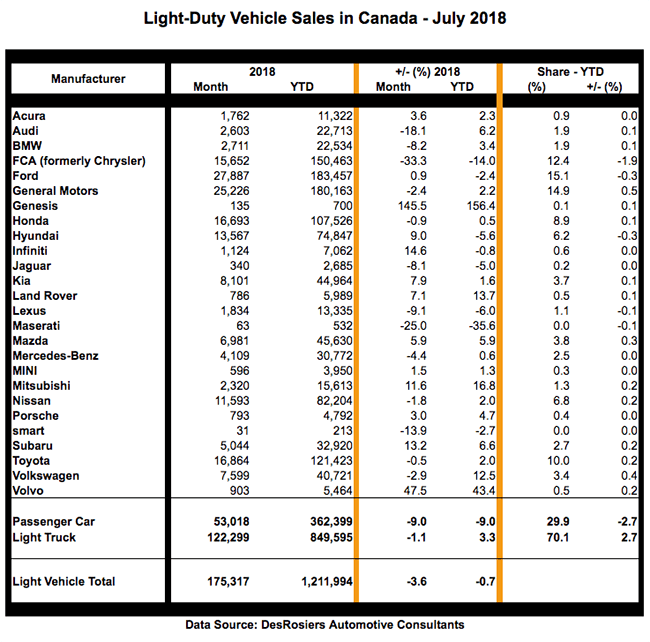
A 3.6% drop in new-vehicle sales in Canada during July is the greatest single-month decline so far in the five-month sales slide that began in March. A total of 175,317 cars, trucks and utility vehicles were sold in the month.
That’s still the fourth-highest volume for any July ever, according to industry analyst Dennis DesRosiers, of DesRosiers Automotive Consultants (DAC). But it does mark a significant escalation in the rate of decline and, after five consecutive months, it might be considered a trend.
Emphasizing that point, the SAAR (Seasonally Adjusted Annualized Sales Rate) for the month was about 1.93-million, according to DAC — the lowest level this year and about 500,000 units below the average SAAR through the first half.
July’s negative numbers further depressed the year-to-date sales figures, in percentage terms. Total sales of 1,211,994 units are down by 0.7% from this point last year.
That’s not a dramatic decline and the market is still strong. “We’ve had an extended period of sales growth in Canada for eight years now, so at some point the expectation of continued growth is unrealistic,” said David Adams, president of the Global Automakers of Canada. He noted that if we can continue to move forward with very modest sales declines, “the industry will still be in a very healthy position.”
He cautioned, however, that, “the largest threat to modest sales declines is possible tariff action on autos by the Trump Administration and the retaliatory measures that are likely to follow. If that happens both the vehicle production and the retail sales components of the Canadian automotive industry will be adversely impacted in a very dramatic way.”
Even considering the modest downturn in the overall market, “there was notable strength among many brands,” commented DesRosiers. And light trucks, including SUVs, continued to dominate the market, although their sales declined by 1.1%. Passenger car sales declined by 9.0%, claiming just 29.9% of the market, to trucks’ 70.1% That’s a 2.7% decline in passenger-car share from a year ago, with a corresponding increase in truck sales.
Dramatic decline for FCA
Digging deeper into July’s sales figures reveals a dramatic shuffle among the top five players. Ford and GM continued their tight fight for the number-one position, with this month’s victory going to Ford.
But Fiat Chrysler Automobiles (FCA), fell from its usual third-place position all the way to fifth, with a 33.3% drop in sales compared to last July. Not just Toyota but also Honda leapfrogged FCA to claim third and fourth places.
It wasn’t just the industry-wide decline in passenger-car sales that affected FCA; its best-selling Ram pickups and Grand Caravan minivans also took a big hit.
In fact, if FCA’s decline had remained consistent with its previous months’ experience (-11.1% through June), not only would FCA have retained its usual third-place ranking but the overall market decline for the month would have been just 0.7.
The big question is, can FCA make up those lost sales; will they go elsewhere; or are they lost to the market forever?
Ford strengthens its sales lead
Ford sold 27,887 new vehicles to retain its number-one ranking in July, a 0.9% increase from the same month a year ago. Its sales of 183,457 units year-to-date are down 2.4% from this point last year, however, which cost it 0.3% of market share, down to 15.1%.
In second-place, General Motors’ July sales of 25,226 vehicles were down 2.4% from a year ago, putting it further behind Ford for the year-to-date. Still, its cumulative total of 180,163 is up 2.2% through the first seven months and it gained 0.5% in market share, to 14.9%.
Third-place Toyota sold 16,864 vehicles in July, a decline of 0.5% from the same month last year. Year-to-date, however, its sales are up by 2.0%, resulting in a 2.0% gain in market share to an even 10.0%. In spite of its surprise July ranking, Toyota remains well behind FCA in fourth place for the year to date.
Honda’s wasn’t far behind in fourth for the month, with 16,693 sales, down by 0.9% from a year ago. Year-to-date sales are up by 0.5%, and market share is ahead by 0.1%, to 8.9%, leaving Honda unchallenged in fifth place.
With its sales decline of one-third, FCA sold just 15,652 vehicles in July, dragging its year-to-date total of 150,463 sales down by 14.0% from a year ago and cutting its market share by 1.9% to 12.4%. Still, FCA remains solidly in third-place for the year to date.
FCA’s big decline for the month helped drag the Detroit three’s collective share down by 1.8%, to 42.4% of the market in July.
Close races further down
Hyundai bounced back to reclaim sixth place for the month with 13,567 sales, up 9.0% from a year ago. Year-to-date, however, the Korean brand remains seventh in the rankings, with cumulative sales down by 5.6% and a 0.3% decline in market share to 6.2%.
Nissan’s July sales of 11,193 units were down 1.8% from last year, relegating it to seventh place for the month. Year-to-date, however, its sales are up by 2.0%, maintaining sixth place and advancing market share up by 0.2% to 6.8%.
For the second consecutive month, Kia ranked eighth in July, with a 7.9% sales increase, which pushed year-to-date sales up by 1.6% and increased market share by 0.1% to 3.7%, That gain was still not enough to move Kia up from its ninth-place YTD ranking.
For the first time this year, Volkswagen’s sales fell slightly — by 2.9% — in July but they were still strong enough to move up to ninth-place for the month. VW still ranks 10th year-to-date, with sales up 12.5% and a 0.4% increase in market share to 3.4%.
Mazda fell to tenth for the month, in spite of a 5.9% sales gain, but maintained eighth-place in the year-to-date ranking with a 5.9% increase and a 0.3% share bump to 3.8%.
Subaru continued its steady advance in 11th place, well clear of Mercedes-Benz for both the month and the year-to-date.
Further down the luxury rankings, Audi and BMW remain locked in a tight race with BMW gaining a slight advantage in July but Audi maintaining a lead of less than 200 units year-to-date.
Winners and losers
On a percentage basis, the biggest winners in March were Genesis (+145.5%), Volvo (+47.5%), Infiniti (+14.6%), Subaru (+13.2%) and Mitsubishi (+11.6%).
The biggest losers, in percentage terms, were FCA (-33.3%), Maserati (-25.5%), Audi (-18.1%), and Smart (-13.9%).