General sessions drew a full house
At the third annual TalkAUTO Canada conference, jointly hosted by J.D. Power and Canadian Black Book, the overall theme that seemed to resonate was making that real connection — how modern auto retailers can develop true, personal relationships with their customers.
As was the case with previous TalkAUTO events, a lot of data was presented, both in the general sessions and afternoon breakouts. Overall, in terms of sales the Canadian vehicle market has proved incredibly robust over the last few years, delivering record volume on the new car side and a strong demand for used vehicles too. That said, there are some potential bumps in the road ahead.
Josh Bailey, Vice-President, Research and Editorial at Canadian Black Book, provided some food for thought in his general session, entitled Long Term Financing — A Viable Option or Mortgaging the Future? Bailey pointed to the mushrooming in long term financing contracts over the last few years — a legacy of the 2008-09 recession. “As an industry, today we are doing some finance things that we really don’t want to do,” he said.
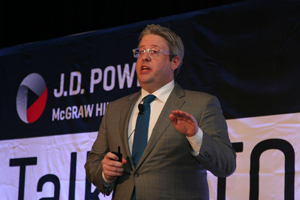
Josh Bailey
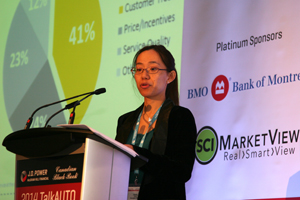
Sashy Jiang
THE ONLY CHOICE?
Bailey pointed to the fact that following the recession, leasing became virtually impossible for some brands and in order to keep customers in newer vehicles, longer financing was the only alternative to keep payments affordable.
“Everybody deserves a new car,” Bailey said, noting that although cash transactions have been fairly consistent since the recession, the notion of cash “as the monster in the room,” is a misconception. “Cash incentives may be huge,” Bailey said “but the market is mainly driven by credit line buyers.”
Pointing to CBB’s own data, Bailey noted a drop in residual values had resulted in many brands and their dealers scurrying away from the leasing table. “I took our residual price and calculated how much money was being lost per car and it was around $3700 per unit.”
Looking to the future, Bailey said that the shortage in lease returns is likely to ease, resulting in more positive equity in those off-lease vehicles and an upswing in residual values.
He said that ultimately, the industry needs to find a balance between leasing and finance. “Canadians tend to have fairly long ownership cycles,” he said “but we want people coming back to us. Nobody is going to be sitting at their desk wondering how many parts sales are coming at month end, they want to sell cars.”
He said that getting back into leasing is a good opportunity and will help push the Certified Pre-Owned programs that both OEMs and dealers have invested in heavily. “If customers don’t show up, these programs don’t get the support they need and it’s tough to keep them alive.”
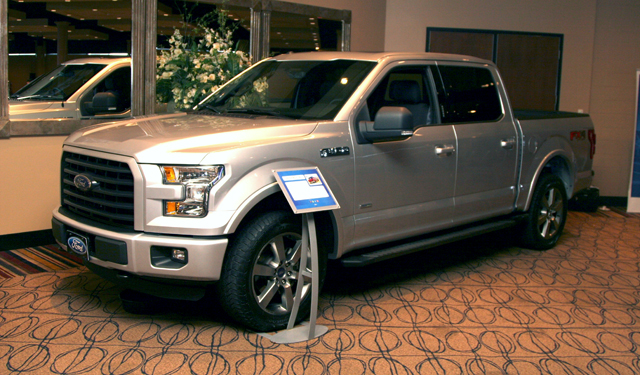
Ford showcased its new F-150
PREMIUM TREATMENT
Sashy Jiang, a student from the Automotive Business School of Canada at Georgian College in Barrie, Ont., who worked with J.D. Power on a co-op program, gave a very interesting presentation, presenting the findings of a study looking at the industry issues from both a consumer and dealer perspective.
Among common misconceptions, such as the profit consumers think dealers made per transaction and the actual numbers, as well as the perceived notion that dealers try to up-sell service customers instead of actually right-selling them, Jiang noted that customers, more than anything else, want premium treatment from the retailer they choose to do business with.
“Consumers want the buying process to be transparent,” she said. “They want a memorable experience, a sensible transaction and quality service. By increasing transparency in the process, we as an industry are doing ourselves a great favour.”
One of the highlights of TalkAUTO is the dealer discussion panel and this year was no exception. Moderated by Darren Slind, Senior Director, Regional Practice Leader at J.D. Power, the 2014 panel consisted of Michael Croxon, President and CEO of the NewRoads Automotive Group, Jamie Johnston, General Manager, Orangeville Honda, Peter MacDonald, President, Alex MacDonald Ford and Pieter van der Griend, Dealer Principal, Stouffville Hyundai and Stouffville Chrysler Dodge Jeep Ram.
The dealer panelists agreed that while sales growth in the future might not match the pace we’ve seen recently, clouds on the horizon don’t appear particularly stormy, at least at this juncture.

Darren Slind (left) and Michael Croxon during the dealer panel discussion
WORKING TOGETHER
Michael Croxon said that within his group, one franchise has witnessed phenomenal growth while another — essentially forced down the path of long-term financing is finding it tough to bring customers back. “We need to focus on as shorter terms as possible,” he said. “If both OEMs and dealers are creative enough to keep the business going and the market is on their side, things will work out.”
The sophistication and expectations of today’s customers was also another hot topic. Referencing Mike Bataglia’s presentation earlier in the day (which focused on the evolution of automotive retail), Pieter van der Griend said that tablet technology is something dealers need to embrace and although sales managers might see it as losing control of the process, customers simply won’t tolerate the traditional “back and forth” routine of salesperson to manager’s office during the sales process.
Noting current concerns regarding factory imaging programs and the general trend toward larger stores, the dealer panel offered some interesting views. Jamie Johnston said it wasn’t so much about size but what you’re able to do with the space provided, a sentiment echoed by Pieter Van Der Griend. “I think we can do a better job with the square footage,” he said. “We’ve been open for four years and already asked to rebrand. We can do better with the 14,000 square feet we have instead of tearing it down to build a 25,000 sq.ft. facility.”
Michael Croxon, whose Subaru franchise continues to witness record growth, despite operating out of temporary accommodation, said this example alone points to how little an impact facilities can actually have on a dealer’s operation. “We are operating out a facility that’s about the size of this stage and last month, we had our best gross profit ever. Bricks and mortar have little impact. I’d rather invest in my people over buildings,” he said.
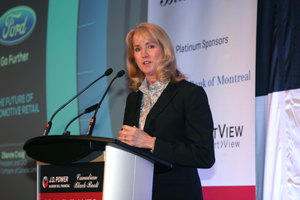
Dianne Craig
GENERATION Z AND THE IMPORTANCE OF REAL RELATIONSHIPS
This year’s keynote address came from Dianne Craig, President and CEO, Ford Motor Company of Canada.
Although citing the industry’s incredible performance over the last couple of years “this year we think sales will be close to 1.8 million and next year 1.9 million,” she said, Craig also remarked that the present “isn’t an easy time for us.”
She noted that the car buying experience should be fun but often, it falls far short of that. Craig said that 89 per cent of consumers contact dealers but one out of four end up going with a different brand because they didn’t get the response they expected.
Craig said that when it comes to satisfaction, loyalty doesn’t necessarily equate to satisfaction but engagement does. “What we are focusing on is emotionally engaging with our customers.”
Using a video to demonstrate how real, quality engagement can make a difference, Craig also talked about Generation Z (those in the roughly 13-20 year old age bracket). She said that by 2020, around 40 per cent of the population will comprise of Gen Y or Gen Z and their purchasing power will equate to $10 trillion.
“Since birth, Generation Z have had mobile technology. They are used to multi-screens and multi-tasking.” Craig made a very interesting point in that not only are Gen Z completely embroiled in a technology environment, they are also influencing older generations too.
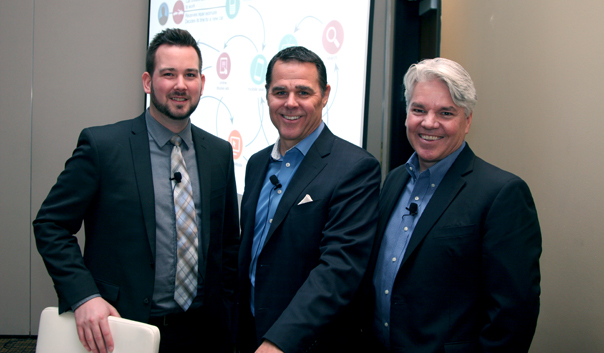
Among the breakout speakers were Alan Bird of SCI MarketView (centre) with Jeremy Wyant of SCI MarketView (left) and David Kain of Kain Automotive
She said this creates an interesting situation. On the one hand, technology has made it harder for businesses to really engage on a personal, one-to-one level with their customers and yet at the same time, people are craving that human contact more than ever. Showing another video where an actual person pops out of a screen in a mall, much to the delight of those interacting with it, she noted that despite the growth of online shopping, dealers still have a real chance to provide that true human contact via the test drive.
“This is our greatest opportunity to make an impression,” she said. “A genuine, lasting impression.”
Besides the general sessions, this year’s TalkAUTO witnessed four breakouts, giving attendees an option to attend two during the afternoon.
These were: Reimagined Retail: The Evolution of Buying and Selling Cars in Canada, presented by J.D. Ney, Manager, Automotive Research and Consulting, J.D. Power; Digital Lead Marketing: Navigating Your Way Through Digital Media, presented by Alan Bird, President and Chief Executive Leader, SCI MarketView; The Agile Facility: How to Meet Customer and Employee Expectations Today and Be Ready for Ever Evolving Trends and Social Marketing in the Automotive Space, presented by David Henderson, Co-founder, SocialDealz Inc.
The sessions were well attended and provided a meaty amount of solid, practical analysis and tips to help dealers better meet the needs of their customers. With more than 300 registered attendees, 2014 TalkAUTO Canada continues to deliver exceptional content and has quickly established itself as one of the premier automotive conferences on our nation’s annual auto industry calendar.
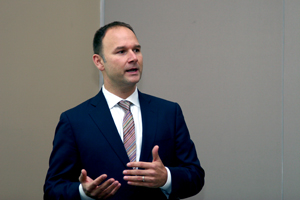
Breakout speaker and Canadian auto dealer columnist Monte Weis
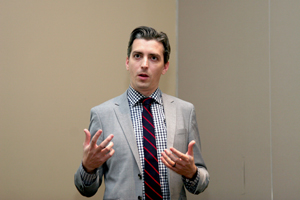
J.D. Ney