TESLA MOTORS IS LOOKING TO CONTROL THE CUSTOMER EXPERIENCE BY PURSUING A CORPORATE APPROACH TO AUTO SALES
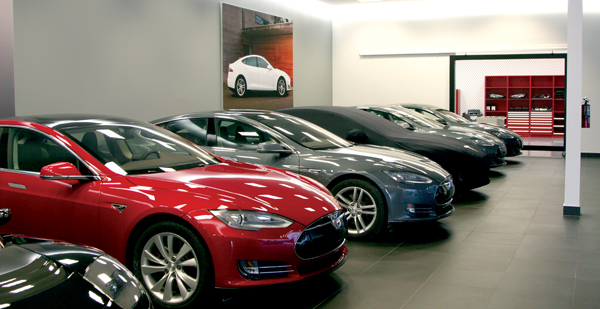
Dealerships have been displaying cars in shopping malls for years. Sometimes it might be to highlight a new image builder for showroom traffic, such as a Chevrolet Corvette or Ford Mustang. Sometimes it might be to showcase special year-end offers or promotions. Yet, until recently, the idea of actually having a proper store inside said mall, where shoppers could go in and ask product specialists about cars on display was something of an anomaly.
Tesla Motors is planning to change that. The Palo Alto, Calif.-based manufacturer of the all-electric Model S has already generated quite a bit of controversy, particularly in the U.S. with its approach to retail. With its factory operated mall stores and the ability for customers to schedule a test drive during their day out at the shops, it’s an about turn in the face of traditional automotive retail which has largely relied on independent franchises to service the needs of a particular vehicle brand’s end customers.
But will Tesla CEO Elon Musk’s plan succeed and more importantly, could we witness other automakers and auto brands trying to foster a similar approach? To find out more about Tesla’s retail strategy for Canada, Canadian auto dealer paid a visit to Tesla’s Toronto location.
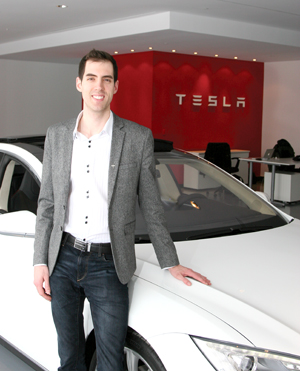
Martin Paquet
Regional sales manager Martin Paquet says that many consumers still view the car buying experience as intimidating, despite huge strides by the industry to change such perceptions. “Traditionally, the customer will specifically have to head to the store, sit down with the salesperson and negotiate a price on the vehicle.”
Paquet says that by taking a different approach, such as placing a boutique store in a mall where consumers can browse at their leisure, it creates a more comfortable environment, one that is more welcoming and far more likely to result in engagement with the brand.
CREATING AWARENESS
Tesla began its foray into the Canadian market almost five years ago and in 2012, opened its first retail location at the high profile Yorkdale Mall just north of Toronto, Ont.
“Our objective was to create awareness,” says Paquet, who today notes that the store has become one of the most visited of all Tesla’s locations, period. “I think because of where we’re situated it generates a lot of interest and visits, not only from people in the Greater Toronto Area but from across Canada and beyond.”
He says that for any brand to make a lasting impact in its target market, you need to create awareness and by placing your product in an environment people would not expect feeds curiosity and the need to know more. And a high traffic location such as the Yorkdale Mall presents the perfect opportunity.
Here, consumers can chat with non-commission product specialists, learn more about electric vehicle technology and even discuss options and features. At the Yorkdale location, Tesla has allocated spots in the parking garage where cars are kept ready for test drives.
Although the actual ordering of a Model S takes place online, Paquet says that Tesla is very much about physical interaction with the product and encourages consumers to sit inside the vehicle, play with the features and learn more about it — the objective being that a greater understanding will lead to the greater chance of a sale.
FURTHER EXPANSION
In fact, Paquet says that response and deliveries for the Model S have been such in Toronto that the company has had to look for additional retail space. “Between our Yorkdale store and our original service centre in Mississauga,” we found ourselves needing greater capacity, so we opened a second location in December 2013.”
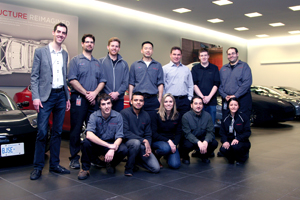
Product specialists and technical staff are on hand to serve customer needs
The facility in question, located at 1325 Lawrence Avenue East, measures 17,000 square feet and in a former life served as a Lamborghini dealership. Tesla conceived it mainly as a service centre where more vehicles can be brought in and worked on or stored, though it still offers its Ranger service whereby actual service technicians will travel to the customer’s location of choice and can perform most warranty repairs.
Tesla has rolled out a variety of service plans which range from those billed annually to prepaid programs that cover each vehicle for up to eight years and 160,000 km.
Alongside the expanded service centre, Tesla also decided to make use of the building’s existing showroom element and has created an alternative to its Yorkdale location for those customers that might want to talk product in a more “traditional” automotive retail setting.
Nevertheless, Paquet says that no matter the retail location, Tesla’s goal is to make its customers experience the shopping and ownership process in the same fashion, no matter where in the world they might happen to be. And that applies whether it’s online or within its retail locations. “We get a lot of compliments about our website and the configurator — how easy it is to build a Model S.”
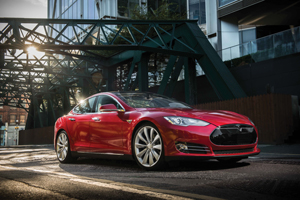 He does note however that despite the high-tech image the brand cultivates and the ease of ordering a car online, most of Tesla’s customers, at least in the Toronto area prefer to come in and physically take a look at the Model S before they order or take delivery.
“The combination of having both that online and direct experience with the customer go hand-in-hand in order to offer excellent customer service,” says Paquet. “You need to have that relationship, to engage with the customer and make sure you can understand their questions —that you’re taking care of them — and they understand the implications of buying a car.”
Whether Tesla’s retail model will become more prevalent remains to be seen, yet with plans to expand into the Vancouver and Montreal markets in 2014 and other cities after, the company remains ambitious in its projections. Perhaps, much as we’re witnessing with vehicle powertrain technology and as the way consumers continue to shop for cars evolves, we might come to see a variety of approaches to auto retail, instead of one largely dominant method.
Whatever the future may bring, it does appear certain fundamentals are unlikely change — namely the fact that customers still want to touch the metal and be satisfied with the vehicle purchase they have made.