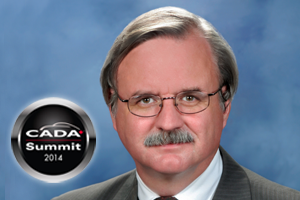
Glenn Mercer
As the 2014 CADA Summit edges ever closer (February 12), auto industry leaders are taking an increasing interest in some of the topics that will be featured in this year’s panel discussions.
As the auto sector continues to change and evolve more rapidly than ever before, it can be hard to predict how things might be a decade or two from now. That’s a topic the retail panel, moderated by Chuck Seguin of Seguin Advisory Services and featuring highly respected industry consultant and expert Glenn Mercer, along with the most recent CADA Laureates, Al MacPhee, Joe Medina and Sean O’Regan, aim to tackle.
Seguin, who has many years experience focused on automotive retail issues, ranging from tax and audits, to succession planning, transactions and dealer consultation, says that in relation to the panel discussion, looking at where the industry could be 20-30 years from now, presents a great opportunity for discussion and debate.
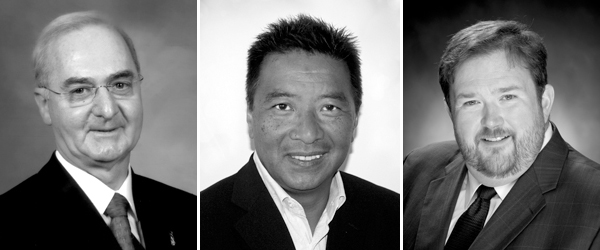
From left to right, the most recent CADA Laureates, Al MacPhee, Joe Medina and Sean O’Regan
“Dealers have traditionally made a lot of money on real estate,” he says but if consumer preferences drive change to a more virtual model, where there is less “bricks and mortar” it could very well change the value proposition when it comes to actually owning a dealership.
As consumers become more comfortable researching and even purchasing goods and services online (Seguin refers to the fact that today, in an environment where Internet banking has become widely accepted and customers can even scan and transfer cheques by smartphone), it is very likely that the entire vehicle purchase and ownership experience will become more virtual and convenient, right down to the test drive and delivery process.
He also notes that a more virtual model could significantly impact not only the “value” of a dealership but also the relationship between dealers and OEMs, especially when it comes to aspects such as factory imaging. “As consumers become more comfortable purchasing online, that begins to change the influence the OEM has on its dealers and what they are required to do,” says Seguin.
He notes that going to a more virtual model could also lead to the rise of mega used car operations, especially if consumers will buy a new vehicle, drive it for 50,000 km and then change it for another. “If the banks are able to get into leasing that will really change the game, especially on the used side.”
He says that besides discussing how the retail model itself could change, another focus of the panel aims to analyze how dealers will continue to be profitable in a more virtual world and how value is created for both themselves and their families.
Given the caliber of the retail panel participants and a topic that tends to ignite all kinds of different viewpoints, expect the discussion to be lively, engaging and thought provoking.
For more information visit: cadasummit.ca