MORE DEALERS ARE GREENING UP THEIR STORES, BUT WHAT ARE THE REAL BENEFITS? CANADIAN AUTO DEALER INVESTIGATES.
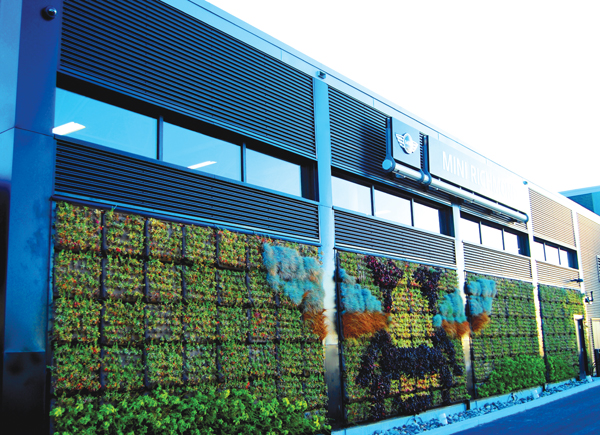
Evergreen Living green wall, MINI RIchmond, B.C.
It’s popular with customers, it’s good for the environment but is investing to green your dealership good for your dealership’s bottom line?
“On average, we save about $2,900 a month on electricity,” says John Strickland. “He’s referring to his Toyota store, Stratford Toyota, which was the first LEED (Leadership in Energy and Environmental Design) gold certified dealership in Canada.
During our interview, Strickland shows me more details such as around $630 per month in water use savings and $470 in natural gas. “This isn’t a hoax, this is real.”
For Strickland, whose store first opened on Erie Street in Stratford, Ont. in January 2009, there are obvious benefits by choosing to follow the LEED certification process, yet it’s still a concept that’s not widely recognized, whether in the sphere of automotive retailing or the building community in general.

Pamela Tiller, LEED specialist with Weis & Associates
Pamela Tiller, a LEED specialist with building consulting firm Weis & Associates in Toronto, says that for dealers, despite the savings they might be able to incur long term, certification is an upfront cost (often a substantial one) and requires a great deal of planning to ensure procedures are followed for the store to achieve LEED status.
Four different categories of LEED buildings exist — certified, silver, gold and platinum, though Tiller says that in reality, those facilities that are able to achieve platinum status represent a very low percentage.
She pulls out a document entitled LEED Canada for New Construction Credit Distribution that illustrates the points (credits) required to achieve each LEED status. “For each credit you get points and those points added up, give you the level you need to achieve a certain certification.”
These range in everything from erosion and sedimentation control, to site development density, alternative transportation, stormwater management, heat island effect, water use reduction, renewable energy usage, CFC reduction in heating and ventilation and best practice commissioning.
EXPERT HELP
The complexity of the LEED process, means that to ensure dealers meet the standards, working with a qualified consulting engineering group is a must. In Strickland’s case he chose to go with Orangeville, Ont-based Fluent Group. “It was a very good thing to do,” he says, “because they walk you through the process. They were onsite almost every day during the building of the store, just to make sure things were going as planned — that we were going to meet the standards.”
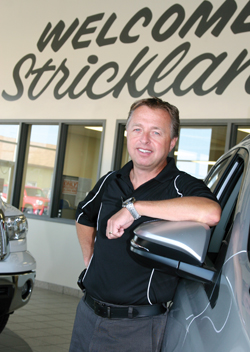
John Strickland, dealer principal, Stratford Toyota
Strickland was originally planning to obtain silver status but agreed to gold once the tenders were in. “We figured out the design and how we wanted it to be,” he says. Local firm Hyde Construction, was brought in to handle the building process and although Peter Hyde and his team hadn’t built an auto dealership before, the actual construction progressed fairly smoothly — aided by a plan that factored in everything, right down to the last floor tile and light fixture.
Strickland says that besides the building process, the plan ensured there also weren’t any nasty shocks and credits the fact that the builder was on board, right from the start. “Peter [Hyde] and his estimators were really good,” says Strickland, so the cap cost on the LEED side wasn’t a surprise.”
Going with LEED represented a logical choice for Strickland since he was looking to acquire a Toyota franchise and with the automaker having placed a strong emphasis on green initiatives, including growing its Prius hybrid vehicle lineup and encouraging dealers to build more environmentally friendly stores, the decision seemed a no-brainer. It’s now four years down the road and it’s worked out well from an efficiency standpoint, though he says that awareness of “green” dealerships among consumers shopping for cars, is still very small.
Pete Sargent, project manager at AutoWest BMW and MINI Richmond, in Richmond B.C., says that getting the green message across to the public still remains a challenge, even at stores that service premium brands.

AutoWest was named the most sustainable BMW dealership in the world by the Munich-based luxury OEM
AutoWest BMW is an interesting example — it’s been a pioneer in this country in terms of sustainability, incorporating such features as a vertical axis wind turbine that generates energy for a self-sustaining recycling auxiliary building, as well as rooftop gardens, beehives and at the MINI dealership, 168 solar panels — the largest number yet installed at an automotive retail facility in Canada.
We first became aware of AutoWest’s green initiatives a few years ago and since then, Sargent says that along with the opening of the MINI dealership, the rooftop gardens are now used to grow vegetables which are donated to the local foodbank. “I just harvested red onions, green and white onions, bell peppers and beets,” he says during a phone interview.
MOST SUSTAINABLE
But perhaps an even bigger impact has been recognition, as the most sustainable BMW dealership in the world. “We were in the final running,” says Sargent. “Alongside us was a store in China and one in the Netherlands.” In the end, it came down to water.
AutoWest BMW recycles over 90 per cent of the water it uses for cleaning cars, and two 15,000 litre (4,000 gallon) tanks retain stormwater runoff for irrigation of the property gardens and plumbing use.
“They [BMW AG Management] were fascinated that we implemented the stormwater runoff retention” says Sargent, “especially considering that here in B.C. we would go to that extent to retain water, when it doesn’t cost us any money.”
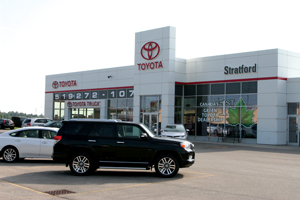
Stratford Toyota was Canada’s first LEED Gold Certified dealership
Yet for all this recognition and efforts to promote sustainability both within the local community and beyond, Sargent says there’s still very little real awareness either from the public or even government, despite B.C.’s reputation as a “green-centric” province. Aside from credits for electric vehicle charging stations, every green initiative AutoWest has carried out has been self-funded. “We have never done any of this for subsidies,” says Sargent “we’ve done it because it is the right thing to do.”
Yet right thing or not, Sargent still believes we have a long way to go before consumers will buy a car from a dealership, simply because it cares about the environment. “Maybe someday it will change,” he says, though he notes that today’s buyers are still very much driven by purchase price and to a lesser extent service cost. Nevertheless, AutoWest is continuing with its environmental efforts, planning more charging stations, ready for the arrival of BMW’s electric i3 and plug-in i8 models.
Much like green dealerships themselves, buying into such vehicles requires a substantial cost up front but in the long term, the savings can be beneficial. “To charge a car overnight at your house, you are talking less than $1.50 to cover 60 km. With the average person in Vancouver traveling less than 50 km each day,” says Sargent, “it would certainly be a good benefit if people started embracing this.”
THE DEVIL IS IN THE DETAILSWhen planning “green” elements into a dealership there are many that might not seem obvious at first but can have a major impact on the efficiency and environmental impact of the store.  Roger Desautels III At Montmorency Ford Lincoln in Brossard, Que. environmental considerations were very much at the heart of the store’s recent renovations. Philippe Leblanc, of Construction Vincent & Dussault, the firm that oversaw the dealership renovations, says that some, perhaps not so obvious initiatives included reusing old asphalt from the lot, which was crushed and utilized as stone for the parking substructure, plus a roof mounted CO sensor to monitor and control air quality, as well as reducing heat/cooling energy. Dealership President Roger Desautels III, says that already he’s seen positive feedback following the renovations. “Customers take more time to walk through the building and enjoy our facilities,” he notes while staff find it easier  Philippe St-Pierre Others included orienting the direction of the building facing to the south to take advantage of natural sunlight through the massive windows, geothermal heating and cooling, extensive use of low energy lighting (95 per cent) and full automation for temperature regulation inside the building. “There is no light switch,” he says “some of it is timed according to our business hours and some of it relies on motion sensors.” St-Pierre says even when you have a clean sheet (the site of Mercedes-Benz Gatineau was previously farmland), it can still be hard to figure out what to incorporate in your plans. “You’re trying to plan in advance of what is coming,” he says and from an ROI standpoint “you have to figure the amount of years for payback based on today’s numbers.” |