The Canadian auto dealer / Harris Decima Research series has a look at vehicle purchasing trends for 2013, which could present both significant challenges and opportunities
What will 2013 bring? Apart from the obvious fact that a lot will depend on which way the Canadian, U.S. and global economies move, it looks as if there will be a lot of caution out there when it comes to buying new cars and trucks. With three years of volume growth, more vehicles being financed over longer terms and an uncertain economy, 2013 will be more about the fight for market share and customer retention than for new volume overall.
In our most recent survey, we asked almost 750 Canadians across the country, how likely they are to buy a new vehicle for personal use in 2013. Only five percent indicated that they “definitely will” and thirteen percent indicated they “probably will” buy in 2013. So, less than one in five are reasonably sure that they will do so and one in twenty who will definitely buy. The one-in-twenty represent about 1.2 million units, so the fight is on to get those who are in the “probably” camp! Don’t count on B.C. and retirees, as those have the highest proportion of consumers who say they “definitely will not” purchase a new vehicle in 2013.
The looming fight for market share is further emphasized by the fact that 54 per cent say they are likely to buy the same make again (or at least a different model within the same make) and only 31 per cent say they will switch brands (mostly younger buyers). There is a 15 per cent swing vote out there (those who haven’t yet decided if they’ll buy the same or a different make).
FUEL ECONOMY A MAJOR FACTOR
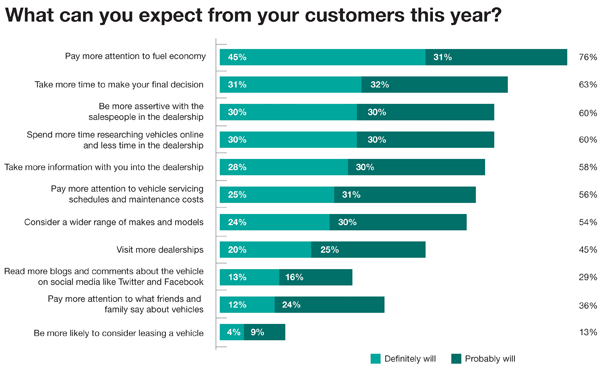
Given a tougher market in 2013, what can you expect from the customers who do walk into your store? The chart shows what buyers say they will do more of than they have in the past. Fuel economy is clearly top-of-mind and this is borne out by the increasing share of smaller vehicles and the growth of hybrids. A few other things stand out: buyers seem to want to take more time making their decision and in doing their research — a clear indication that they feel that they are now much more in control of the information they have and how to use it to their benefit. Pressure tactics may backfire even more in the future.
Also interesting is that, with all the information more readily available, buyers say they will be more assertive in the dealership — sales consultants will need to know their stuff! Looking at the responses to the social media item, it’s clear that not everyone is caught up in Facebook or Twitter, but dealerships ignore this at their peril — there needs to be a process in place to take full advantage of these forms of communication with prospects and customers.
These are all signs that the old sales processes and techniques will become less and less effective and that much of the training curriculum will need to be rewritten (as will hiring criteria for salespeople). Add to that, a rapidly shifting demographic profile of buyers in the high volume urban markets (more new Canadians, with different expectations and different ways of making decisions) and the year will not be without its challenges for dealerships.