Tariffs are reshaping Canada’s light vehicle import mix as some automakers shift their sourcing away from the United States.
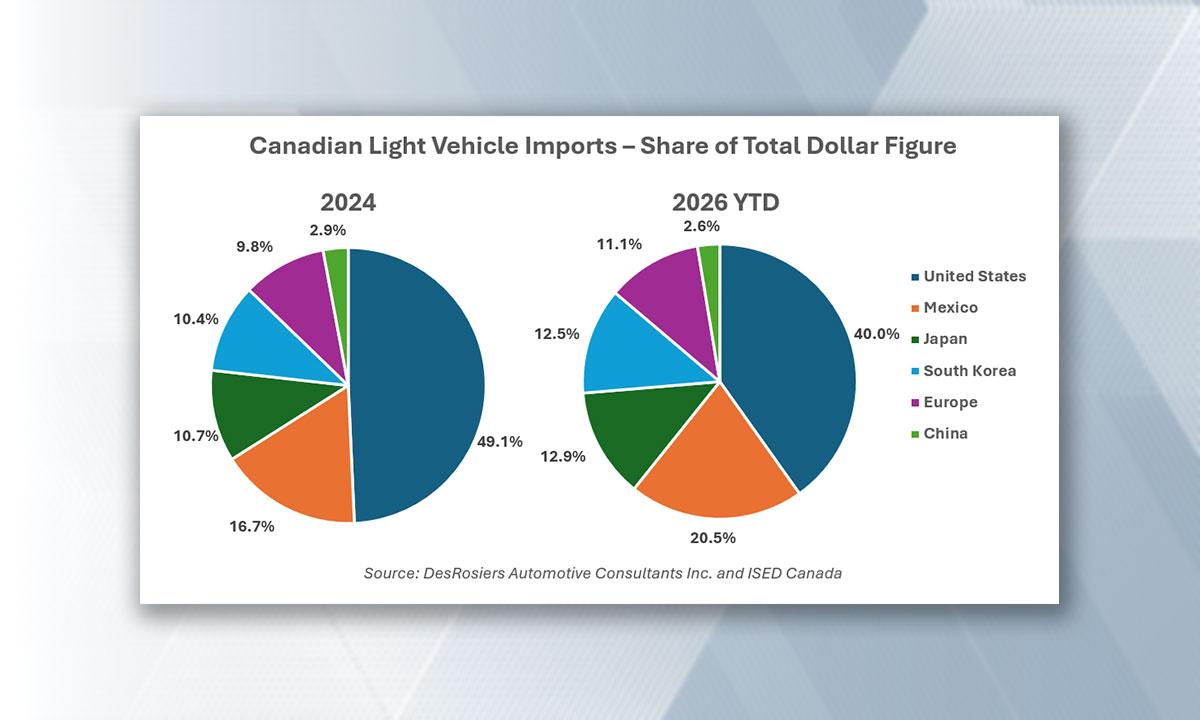
The latest analysis from DesRosiers Automotive Consultants (DAC) reveals that the U.S. accounted for 40 per cent of the dollar value of Canadian light vehicle imports so far in 2026, down from 49.1 per cent in 2024.
DAC attributed the shift to sourcing decisions by select original equipment manufacturers (OEMs) seeking to avoid Canadian counter-tariffs on U.S.-built vehicles. The decline in the U.S. share has been accompanied by gains across several major vehicle-producing markets.
Mexico recorded a notable increase, with its share rising from 16.7 per cent in 2024 to 20.5 per cent in 2026. Japan’s share increased from 10.7 to 12.9 per cent, while South Korea’s rose from 10.4 to 12.5 per cent. And Europe’s combined share also increased, reaching 11.1 per cent compared with 9.8 per cent in 2024.

Meanwhile, despite the attention surrounding the Canada-China electric vehicle trade agreement, China’s share of Canadian light vehicle imports remains below the 2.9 per cent recorded in 2024.
DAC noted that the extent of the sourcing shift is particularly significant given that some of the highest-volume automakers are largely unaffected by Canadian counter-tariffs.
“The select OEMs impacted by the tariff situation have moved rapidly to seek other sourcing where possible and to continue to provide Canadians with vehicles at the best possible price,” said Andrew King, Managing Partner at DAC, in a statement. “What the (the) U.S. lost in share was captured readily by the other major light vehicle exporters, with the trade war helping to diversify Canada’s sourcing in this space.”
The analysis comes amid renewed attention on Canada-U.S. trade discussions following the U.S. midterm elections.