 The aftermarket, along with the used vehicle market, was among the few pillars of stability in the automotive industry in 2020 and it escaped the year with relatively minor wounds, according to DesRosiers Automotive Consultants (DAC).
They conducted a survey with the Automotive Aftermarket Retailers of Ontario (AARO), in which members were surveyed between January 27 and February 5 on the effects of 2020 on independent aftermarket installers. They also provided their outlook for 2021.
“2020 extended its volatile reach to all corners of the automotive space, but the impacts were far from uniform,” said Andrew King, Managing Partner of DAC. “Independent aftermarket installers showed us that while the previous year was a challenging one, some portions of the industry saw success and sales gains.”
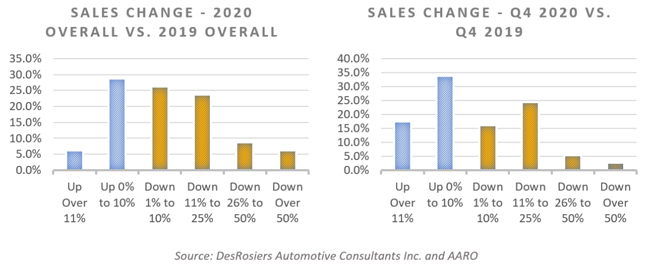
DAC said the survey revealed mixed fortunes for aftermarket installers last year: 65.0% of respondents noted sales decreases in 2020 compared to 2019, although there was a notable group of shops that were successful in 2020 — with 28.8% of those shops seeing sales increase by as much as 10.0%, and 6.3% noting even greater increases.
The fourth quarter of 2020 revealed a period of recovery across much of the automotive market, which was reflected in the survey results: 51.4% of respondents noting sales increases compared to Q4 2019.
As for their outlook for 2021, the response was again mixed: 52.7% expected 2021 to offer a decrease over 2020, while 47.3% expected no change or a sales increase.
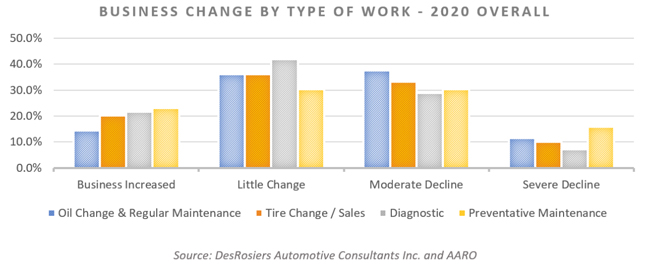
“In terms of changes in different types of repair and maintenance, the most common responses ranged from little change to moderate declines,” said DAC. “Moderate declines were noted most frequently for oil changes and regular maintenance.”
Tire changes and sales, and diagnostic work were more likely to have no noticeable changes.
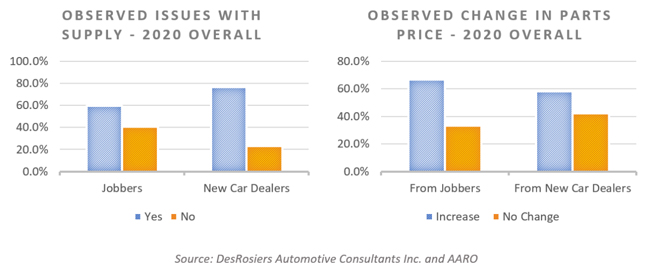
However, a common issue in 2020 was the lack of parts supply for the aftermarket and the new motor vehicle assembly sector. In total, 59.4% of installers noted supply issues derived from jobbers, while 76.8% observed supply issues stemming from new car dealers.
“With a constrained supply, prices are likely to increase,” said DAC.
From jobbers, 66.7% of installers observed parts price increases last year and 33.3% observed no change. From new car dealers, 58.0% of installers observed parts price increases, and 42.0% noted no change. And no independent aftermarket installers noted price decreases.