The future of fixed ops involves adopting new technologies, improving marketing and upgrading facilities to better meet the needs of customers. We talk to a few providers to get their thoughts on what the industry needs.

The showroom floor has long received the greatest share of attention from car dealers, but that could change significantly as the auto retail industry continues to evolve based on shifting consumer expectations.
Financial pressures have forced auto retailers to focus more on the fixed side of their operations as a source of profits, according to Dealer-FX President Gary Kalk.
“Dealers are looking for ways to improve their efficiency. Great technicians are a difficult commodity to find, and with the car park increasing, dealerships want to get more customers through their shops as quickly as possible,” said Kalk, adding that “they are looking for tools and technology to help them do that.”
One such tool is offered by Dealer-FX through its ONE Platform, and provides dealers with the ability to track every step of the fixed ops process.
For example, the system provides dealerships with insights on how to improve the way they move vehicles in and out of the shop. It also offers the ability for the dealer to connect with the customer through “automated communication” to keep them updated on the status of their vehicle. Customers can follow the progress of their vehicle service online.
“It’s kind of like shipping a parcel through FedEx or UPS, where you’re able to track each stage of your parcel,” said Kalk. “Or if you ship something through Amazon, you can track where it is in the process. We are providing that tool to allow dealerships to now offer that to their guests.”
Giving customers what they want
The tool is not just useful for consumers in general; it’s also relevant for millennials who, as research demonstrates, are the least satisfied with their service experience. And as dealers continue to struggle with retention, satisfying the upcoming generation of car owners will be important.
According to the Cox Automotive 2018 Service Industry Study, 70 per cent of consumers who purchased or leased a vehicle from a dealership did not return to service their vehicle within the past 12 months.
Divided by generation, 25 per cent of millennials were found to be dissatisfied and unlikely to return to the same place to service their vehicle. In comparison, 14 per cent of Generation X consumers are dissatisfied, along with 8 per cent of Baby Boomers. This is across all providers: general repair, the dealership where the vehicle was purchased, specialist, quick lube, tire storage/repair chain, body shop, and retail auto service.
Ultimately what consumers want is peace-of-mind and a stress-free, “ultra-convenient” experience, with the “must-have benefits” of saving time, money and effort.
Circling back to the Amazon analogy of tracking the status of the vehicle, Cox Automotive’s survey also indicates that two-in-five consumers want an ongoing, remote connection to the dealer. They want visibility, transparency, and to be informed.
“After a vehicle has had an inspection, today the dealership picks up the phone, calls the customer and communicates what work needs to be done on the vehicle,” said Kalk. “We’ve digitized that entire process so that the guest can actually receive a text, they can view repairs or actual pictures of their vehicle, and respond and approve the estimate — all on their phone without having to speak to the dealership.”
Kalk said the service is convenient for the customer and it helps increase the approval time for the dealerships, which in turn allows them to push vehicles through the service turnstile faster. He’s also seeing higher up-sell rates and approval percentages from customers with this type of approach.
Cox Automotive’s survey also reveals that 45 per cent of Gen Z and millennial consumers are interested in a minimal click scheduling option through their smartphones; 43 per cent want to receive pictures or videos of recommended services; and 39 per cent want in-lane bill payment as an option.
Thanks to a recent partnership with Hunter Engineering, Dealer-FX also has a tool that improves efficiency and helps dealers build trust with their customers. The Dealer-FX platform is integrated into Hunter Engineering’s tread depth and balancing machine; when a vehicle drives over the tire tread depth alignment machine as it enters the service drive, all the information appears on a tablet.
The tool allows the dealer to have an “intelligent discussion” with their customer, right beside the vehicle, so that the customer can see exactly what’s going on with their tires. “(They) get that work pre-approved so that when it goes into the shop, the technician doesn’t have to do all of those stamps,” said Kalk.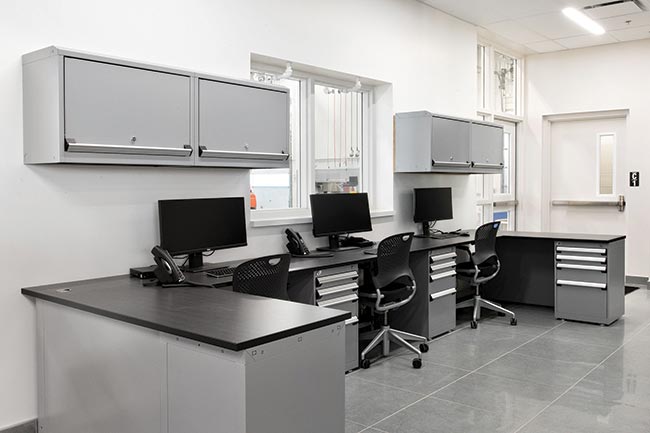
Spending where it matters
On the marketing side, dealers need to ensure they are allocating dollars to the right areas — and that includes digital, according to Charlie Bass, Vice President of Sales at PureCars.
“In general, I think maybe 10 per cent (at most) of new car franchised dealers actually invested in digital fixed operations marketing,” said Bass. “(But) people are more likely to pull up their phone and search ‘oil change near me’ or ‘I need new brakes’ — whatever the micromoment might be.”
He said a consumer may be looking at Google, Bing, or another search engine and typing in “my car just broke down” or “where is a dealership near me?” But dealers that are not investing in this form of marketing chance losing business to an independent facility.
Bass believes that new car franchised dealers can capitalize on “search” most importantly because that is the moment a consumer is looking for a service department and has some sort of issue with their car.
“This untapped revenue potential is not only a method for upholding exceptional customer retention and satisfaction — it’s also an aspect of your dealership that should absolutely not be left out of your digital marketing strategy,” said Bass. “Search engine marketing (SEM) dollars must be devoted to your fixed ops department to showcase the value that accompanies having service and repairs done at your store in comparison to the competition.”
PureCars also offers a Waze solution: a GPS navigation software app that is also owned by Google. If a consumer’s car breaks down and they type in “oil change” or “car dealership near me,” for example, PureCars can help the dealer advertise online.
“When the consumer clicks on the (dealer ad link) that takes them to that dealership, we can track back and say here’s how many Waze ads you ran, and here is how many people interacted with them and actually drove into your dealership and got some service work done,” said Bass.
When asked what dealers can do to boost their fixed ops revenues, Bass advises focusing on the “I need it now” customers and the low-funnel opportunities. He adds that dealers also need to back up their digital stance with an equally aggressive mobile strategy.
Upgrading the dealer image
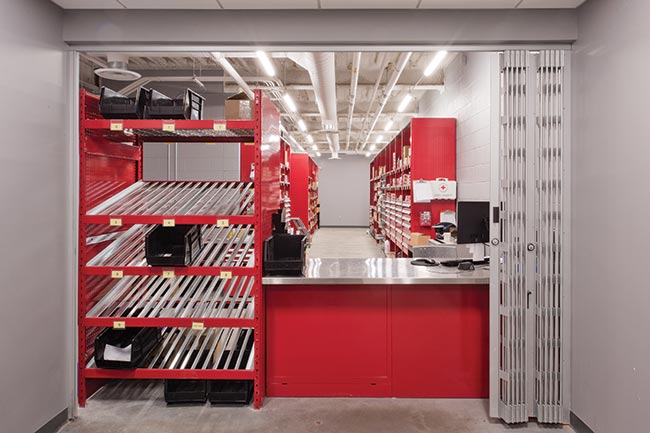
On the brand side, it may be time for dealers to freshen up their image — or rather — the store’s image within the fixed ops area. As more customers enter the facility, it will need to meet their expectation of organization and professionalism, according to Braeden Harmanm, General Manager, Automotive, Metric Storage Systems.
“I believe that customers have a desire to have their vehicles serviced in state-of-the-art facilities that reflect screening centres from the OEM factories themselves,” said Harmanm. “They want that reassurance that the dealership they are bringing their vehicle to is a highly-trained, highly-qualified facility.”
Harmanm said a lot of dealerships have been in place for decades, some in the same facility for more than 15 years. Many of them face the challenge of working within the constraints of the current building infrastructure. Metric Storage Systems works with dealers to design a solution that will help them bring the facility up to par with modern expectations.
“Ultimately what we offer is the facelift to a dealer image, but it’s also beneficial to the staff that work in the building,” said Harmanm. “A lot of times there are changes made to the showroom — ongoing renovations because it’s customer-facing, and sometimes the backend or fixed ops portion of the dealership feels like they miss out on all those enhancements to the building.”
Those changes are both good for business and for the staff in the building. The benefit to upgrading the dealership image is not only connected to consumer expectations and the revenue they bring in — it’s also connected to technicians that traditionally have had to purchase their own setup for their bay, which is often paid out-of-pocket.
Harmanm said dealerships that offer a modernized setup offer those savings to their technicians as well, and they can save hundreds if not thousands of dollars by retaining those employees.
For dealerships that are overwhelmed with work and find it difficult to make changes and invest in upgrading their service facility, Harmanm suggests seeking the advice of professionals in the industry. Dealers can have a consultant come in, free-of-charge, to take a tour of their fixed ops area and “see if now would be a better time to make the change rather than waiting.”
Whether it’s fixed ops tools that boosts efficiency, digital marketing that drives more revenue, or an upgraded facility that helps with consumer and employee retention, one thing is clear — dealers will need to tackle these areas to ensure they don’t fall behind with the industry’s evolution.