Dealers will need to stay abreast of evolving consumer needs as their demands begin to alter the vehicle ownership playing field
We live in a complex world. On the one hand, we are increasingly able to personalize the products and services we use; on the other, these products and services are beginning to converge in terms of shared technology and connectivity to simplify our lives.
I say “simplify,” because at first, the complexity can be overwhelming, but it’s never long before we take things for granted and wonder how we ever managed without our network of options and connectivity. What does this mean in the context of the auto industry — or at least the part of the industry that is currently focused on selling and servicing personal vehicles? I think it means that big changes are on the way — perhaps not next year, but within the next decade.
Are consumers still intent on vehicle ownership? It depends how you ask the question.
Most auto industry experts and observers seem to agree on one thing: car ownership isn’t going away soon, but the whole ownership model is in for a change. How soon that change will come and what it will look like is where things get interesting. While industry players —
traditional manufacturers, technology companies, auto finance providers, dealerships — and companies like Uber and Lyft are all vying for a role in the future, the consumer still holds the key.
In a recent study entitled “The Future of Personal Vehicle Ownership,” the National Automobile Dealers Association (NADA) surveyed American consumers and concluded that, “Only 11 per cent of car owners in our study were interested in giving up their personal vehicles to move exclusively towards a ride hailing service.” They state that “millennials (19 per cent) aren’t that much different — but that’s one in five
of those consumers, and they will
be the most influential group over
the next few decades. NADA also concludes that “People want freedom, flexibility and control that only vehicle ownership provides.”
I would agree with this if ride hailing were the only alternative to vehicle ownership, as we know it. That’s how the question was posed in the NADA survey and it presupposes a very narrowly defined and binary world.
In reality that probably won’t be the case for long as consumers will have an increasingly wide range of personal mobility choices. Already, Porsche (Passport), Cadillac (BOOK), Volvo (Care) and Ford (Canvas) are experimenting with subscription-like services for customers who find outright ownership of a vehicle unappealing and want more flexibility. There are also hybrid services like Ford’s Credit Link and General Motors’ Maven to add to the mix. It’s just a matter of time before still more options become available.
Is it a car or a Personal Mobility Device?
Here’s where the convergence in consumer needs begins to be evident. Just as we buy access to technology with our cellular phones through a subscription model, these new services could bring the same model to car ownership. A vehicle then becomes a personal mobility device rather than a fairly expensive (and depreciating) asset.
Leasing certainly provides an option today, but there are still some drawbacks that many consumers dislike and probably won’t learn to like. Some of the benefits of a subscription-type model would likely be very attractive to consumers, especially to millennials, who want access to the latest technology without being tied down to a lengthy “ownership” period.
Potential benefits of a subscription model to millennials include:
- Low risk (control over usage costs);
- Frees up capital for other purposes;
- Access to the latest vehicle technology; and
- Ability to change vehicle as desired or needs change.
If the industry can avoid some of the negative aspects of subscription models (as we experience with our phones), this model, or some version of it, might well work and the impact on dealerships could be significant.
Who will foot the bill?
What will be the game changers and the catalysts in the evolution of ownership? It could be the OEMs. It could be Uber or Lyft. It could be a tech company like Google or Apple or Amazon. One interesting item I read recently, in a TechCrunch blog, suggested that a major player in the industry is being overlooked and could become key to the shape of vehicle access — in which case ownership will change. This player is the auto financing industry. As the article puts it: “without individual financing products, auto sales don’t happen.” Given the complexities of this industry, this is likely to be even more the case in a new ownership or access model.
If consumers pivot to a subscription type model, who will actually own the vehicle? Who will service and maintain the vehicle? What will happen to the vehicle when it’s returned to the dealership? What will the dealership’s role in the “selling” process be? The auto retail world could look quite different from the way it is today.
You can’t generalize when it comes to what consumers want.
So many articles are written and opinions expressed about car ownership, and many of them are contradictory. Some predict the end of car ownership entirely. Others say car ownership will always be something we aspire to and that we’ll never lose our love of cars and driving and the pride we take in our vehicles.
I believe the truth is somewhere in-between and that one of the key drivers is consumer needs. There are such vast differences between consumers when it comes to the reasons they need to own (or lease) a vehicle. Occupation, geography and life-stage are all factors that determine exactly what consumers need from a “mobility device.”
Some of the factors are also non-rational in nature. An interesting study was conducted by the universities of Michigan, Texas A&M and Columbia, following the cessation of service by Uber and Lyft in Austin, Texas, when the two companies withdrew as a protest against new local legislation. The survey asked consumers who had been using Uber or Lyft what they missed most about having a car and could no longer do when they used the ride-share services. See Chart 1 below for their responses.
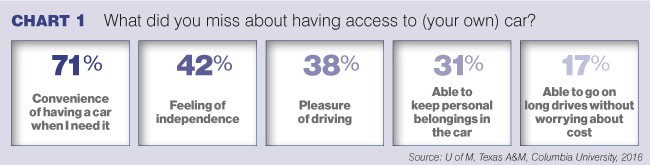
Convenience is the key. People these days live busy and unpredictable lives. It’s all very well to say someone should plan their day or time, but try to tell that to a mother or father with kids. Note how many use their car as extra storage space!
Finally, a study by Ally Bank in the U.S., no strangers to auto financing, shows that, regardless of what ownership model emerges, millennials won’t walk away from some traditional aspects of the customer experience. Don’t assume that millennials just want to consult their phone and aren’t really interested in basic human interaction. When asked what they liked when buying a car now, here’s how millennials, Gen X and Boomers responded (see Chart 2 below).
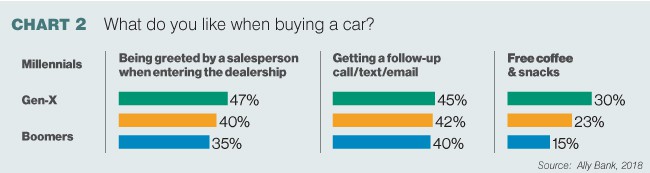
You could argue that this assumes a status quo in the ownership model and the retail environment. I believe that if the ownership model changes, the retail environment will change too. I also believe that the change will be faster and more profound than the changes that took place as the internet found its way into the auto retail industry.
Dealerships may play a very different role, but they will still be the front line where consumers choose, access and upgrade their mobility devices to suit their needs. The values these consumers bring will still revolve around the need for transparency, honesty and trustworthiness along with a quality environment.