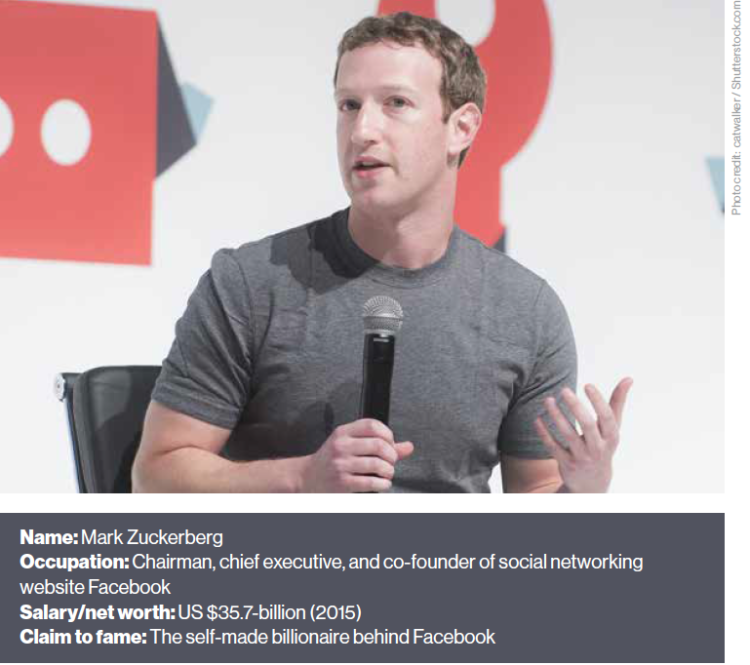
MARK ZUCKERBERG HAS TRANSFORMED THE WAY WE CONNECT WITH EACH OTHER
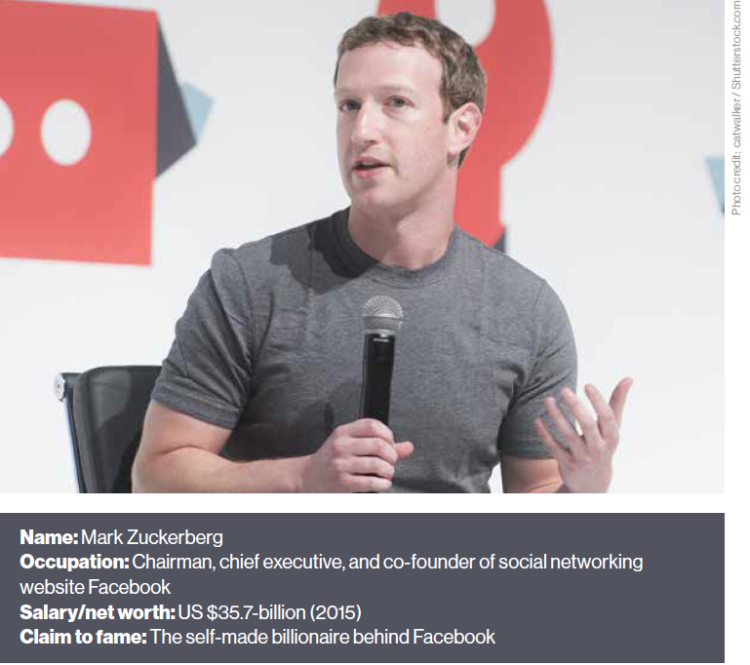
Mark Zuckerberg is a philanthropist and entrepreneur — the self-made billionaire behind Facebook.
In 2015, he was ranked no.1 in “America’s Richest Entrepreneurs under 40” by Forbes magazine. At 31, his net worth is more than US $42-billion.
As the co-founder and CEO of Facebook, he has transformed the way we connect with people through his social networking website, which he started from his Harvard dorm room back in 2004 at the age of 19.
After dropping out, Facebook took the world by storm and became the world’s largest social network platform.
Zuckerberg went public with Facebook in February of 2012, raising US $16- billion, the largest internet IPO ever.
Naysayers complained it was overvalued and would never make money.
Despite a rocky start, he proved them wrong by continuously innovating and finding new ways to expand his services, advertising revenues, and business model.
To date, more than 1.5 billion people use Facebook. The company is profitable and successful — operating four of the world’s largest social platforms including Instagram, WhatsApp, and Messenger.
Zuckerberg also scooped up Oculus, a virtual reality company, for US $2-billion in 2014 — another bold move that will shape the way people interact with each other in the future.
Facebook’s influence is undeniable — perhaps as great as AOL’s impact after introducing the Internet to people. It has forever altered how we communicate with one another.
The social network lets people connect over long distances and reconnect with lost loved ones and friends, making our communities larger, but closer knit.
To date, more than 1.5 billion people use Facebook. The company is profitable and successful — operating four of the world’s largest social platforms including Instagram, WhatsApp, and Messenger
By transcending borders — geographic, political, economic, and social — it has become an instrumental tool for political and social change, even prompting protests worldwide in Egypt, Iran, and Colombia.
Its effects are far reaching, touching every aspect of our lives.
How did we survive before Facebook? We met in person and sent messages via a telegram, telephone, or email. With Facebook there’s no sending — just posting updates of our status.
The software takes care of the rest, controlling who views it and creating a fully automated system of mass communication which we’ve never seen before.
It’s also reshaped how businesses market to consumers, having become an integral part of any digital marketer’s toolkit.
Can Facebook survive in the future?
Let’s face it, we’re not just connected to the network, we’re bound to it. We have no privacy; our every move is tracked 24/7.
Critics claim Facebook won’t be around in 10 years because it’s no longer cool or relevant, especially to younger generations.
Yet Facebook has proved itself and stood the test of time for more than a decade, thanks to Zuckerberg’s ability to change and adapt with the times.
Moving forward, Zuckerberg is banking on technology such as artificial intelligence (AI) and virtual reality as the key to his company’s success. AI could help tailor items directly to specific people — making it attractive to advertisers seeking to target a specific market as we move into an era where everything from our watches to our vehicles will be connected.
Virtual reality, he believes, will be the next big tool of communication — offering innovative ways to share our experiences with others by simply wearing glasses that allow others to be immersed with our own experiences.
It seems unimaginable today, but it could be reality if Zuckerberg has his way.