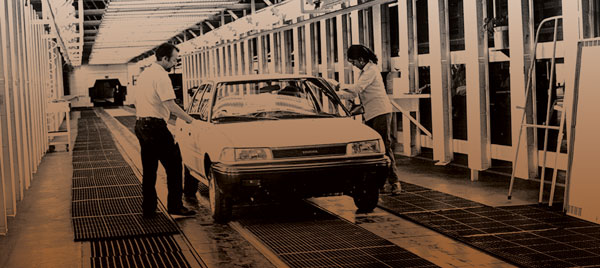
THE 1980S WERE MARKED BY MANY CHANGES TO THE GLOBAL AUTOMOTIVE INDUSTRY

Change was usually gradual in the auto industry, but a massive shift in the 1970s basically came down to a single day.
When the U.S. government backed Israel in the Yom Kippur War, the oil-producing nations in the Middle East cut off the American oil supply. Sales of small cars skyrocketed, and the import manufacturers finally had the foothold they’d sought for so long.
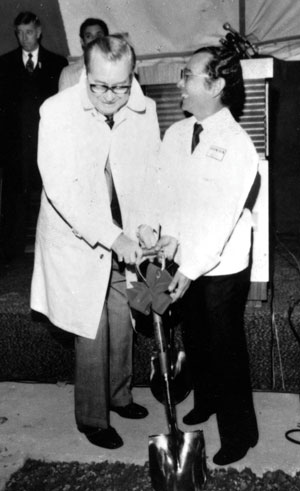
Honda breaks ground for its auto plant in Marysville, Ohio on December 2, 1980
Still, no matter how fuel-efficient it was, a tiny and simple car could only go so far with North American buyers. By the end of the 1970s, Japanese automakers had opened design studios in California to create cars specifically for the market.
Honda’s motorcycle factory in Ohio had opened in 1979 and was the first American production facility for a Japanese company. Shovels went into the ground beside it in December 1980, and two years later, the first Accord rolled off the line in the new car plant. In 1983, Nissan built the first truck in its new factory in Tennessee.
Toyota took a different route. It initially approached Ford for joint production, but Ford worried about competition for a new compact it was developing.
Toyota then met with GM, and in 1984 the two companies created New United Motor Manufacturing Inc., or NUMMI, in a shuttered GM plant in California. And in 1985, both Honda and Toyota announced they would build plants in Ontario.
But this was about far more than just satisfying North American auto preferences. Concerned about losing market share, the Detroit automakers had lobbied the U.S. government, which worked out a voluntary arrangement in 1981 with the Japanese automakers to limit their imports to 1.68 million vehicles per year.
Vehicles made in America weren’t subject to the cap. Even so, the overall reduction pushed up the prices of Japanese cars, and ultimately, sent many buyers back to the domestic brands.
Canada imported more than a quarter of all the vehicles it sold, and got 22 per cent of those from Japan. The federal government decided to keep quotas off the table if the Japanese agreed to build facilities here.
While Honda had entered the U.S. at the entry level, it now decided to go the other way. In 1986 it launched its premium Acura nameplate, sold through a new network of upscale dealers instead of in Honda showrooms. Three years later, Toyota and Nissan would follow by introducing their Lexus and Infiniti brands.
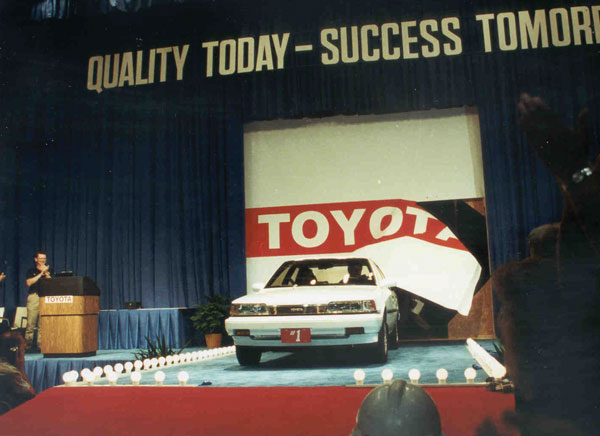
The first U.S.-built Toyota Camry in 1988
In 1979, Chrysler’s downward spiral had ended in a $1.5-billion loan guarantee from the U.S. government. Most critics thought it was money wasted, but salvation was on its way with the new “K-Car,” debuted for 1981 as the Dodge Aries and Plymouth Reliant.
The car’s front-wheel-drive configuration certainly wasn’t new, but it was roomy and well-priced, and it sold more than 400,000 copies in its first year.
Two years later, company chairman Lee Iacocca pulled the wraps at a press event to introduce the minivan. With these successes, Chrysler paid off its loans ahead of schedule in 1983, and many other manufacturers would soon add similar front-wheel sedans and minivans to their portfolios.
Chrysler also ended a chapter in automotive history with its 1987 purchase of AMC, primarily for its Jeep brand, finishing off the last major U.S. independent automaker.
But back in 1984, Canadians were feeling the pinch. That year, mortgage rates soared past 21 per cent, and gasoline prices hit a high point that wouldn’t repeat for another two decades.
The timing couldn’t have been better for Hyundai, which initially bypassed the U.S. entirely when it set up shop here in 1983. Its Pony was crude, but at $5,900 it was less than half the national average retail price for a new vehicle, and it quickly became the hottest-selling car in Canada for 1984.
As the economy improved and the industry picked up, an entirely new segment would quickly become the hottest one of all.
The German automakers were on a steady climb, including Audi, which had introduced its Quattro all-wheel-drive system in 1980. Then it all fell apart.
An all-new Audi 5000 sedan was introduced for 1984, and a year later, more than 48,000 of them went out the door in the U.S. But after crashes in which drivers blamed unintended acceleration, 60 Minutes aired a television segment in 1986 showing the 5000 moving ahead on its own.
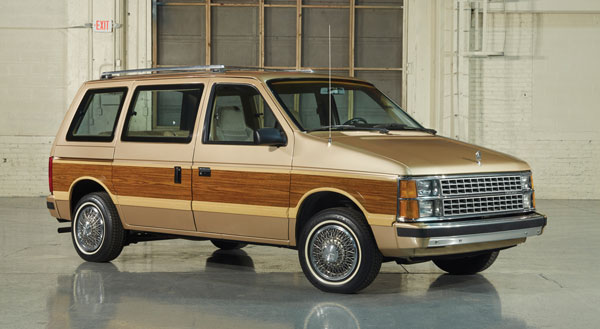
The Dodge Caravan and Plymouth Voyager opened a new segment
It was later found that the transmission had been rigged with an air compressor to make it accelerate, and National Highway Traffic Safety Administration (NHTSA) eventually determined that drivers were mistaking the close-set throttle for the brake, but the damage was done. Sales plummeted, and for a while, Audi seriously considered packing up and going home.
It wasn’t until 1999 that the company came close to the sales numbers it had achieved before the 60 Minutes show aired.
Still, the auto industry was changing and progressing over the decade. Mercedes-Benz put anti-lock brakes on all its cars in 1984, while the 1987 Porsche 944 Turbo was the first car sold in the U.S. with standard driver and passenger front airbags. GM announced its new Saturn brand, and would develop it for a 1991 model-year introduction.
Cadillac introduced a variable-displacement V8 engine, which was problem-prone and lasted only one season, but it would pave the way for effective modern systems. Fuel injection was becoming more common, while leaded gas was being phased out.
On the production front, unionized workers at Canadian auto plants broke away from their American parent organization to form the CAW, while in 1987, Canada and the U.S. signed a free trade agreement.
And there was more ahead in the coming decade. Mexico would join the trade agreement and start a manufacturing shift, while Korea would send over a second brand. Electric cars would make headlines.
A new Canadian arbitration plan would give consumers a fresh way to deal with manufacturers. And as the economy improved and the industry picked up, an entirely new segment would quickly become the hottest one of all.