
Artificial intelligence is becoming embedded in automotive retail, shaping how dealers respond to leads, price inventory and market vehicles. But while adoption is accelerating, understanding remains uneven, with many dealers still experimenting without fully grasping how the technology could reshape operations.
“Where I think a lot of people get AI wrong is they think it operates more in isolation when it’s very much collaborative and complementary, as well as an opportunity to scale human potential and business potential,” said Barry Hillier, CEO and Co-founder of Auto Agentic AI, in an interview with Canadian auto dealer.
More than a tool
For many dealerships, AI has been introduced to solve specific problems — responding faster to customers, automating repetitive tasks and improving marketing efficiency. But Hillier said that approach risks missing a broader shift.
“They’re applying a digital-era mentality into an AI era,” he said.
Rather than rethinking operations, many dealers are layering AI onto existing processes, resulting in incremental gains instead of meaningful change. That reflects how early most dealerships remain in adoption.
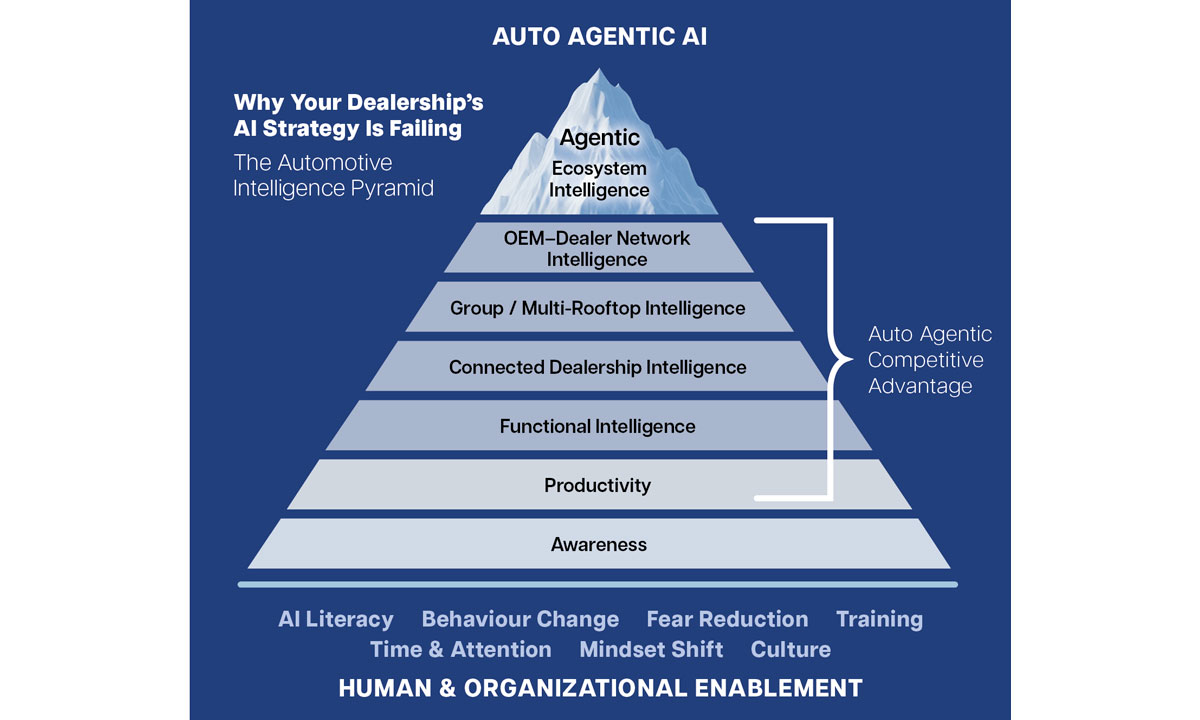
“Most people’s introduction to AI is chat. It’s an awareness. It’s basic chatbot interactions,” said Hillier. “That then shifts to level two: AI helps me work faster. It’s a productivity exercise. It’s task acceleration, content generation (and) personal productivity tools.”
At the next stage AI begins to understand specific dealership functions, such as sales or BDC operations — what Hillier describes as “very much a function level automation.” Most of the industry, he said, remains somewhere below this level.
These early applications can deliver quick gains but are often limited in scope and siloed within departments. The larger opportunity emerges when AI connects systems and data across the dealership.
“AI understands the dealership as the system really starts to come into fruition, because now you can take the system that is recording conversations with systems that are able to connect the emails and leads coming in, that can then connect with the DMS that says, ‘Oh, this is an existing customer. Now let’s look at what their past history is.’”
At that stage, AI moves beyond task automation to identifying patterns in customer behaviour, highlighting performance gaps and supporting decision-making across the business.
Looking ahead, Hillier said, the impact will extend beyond individual rooftops as AI begins to operate across dealer groups and OEM networks, introducing a competitive risk for those that fall behind.
“If they haven’t started to adopt AI from a systems architecture standpoint, they are going to be out-competed. Because the level of insight from the data, the level of optimization that their competition’s going to be able to do — they’re going to be far more productive, far more efficient and far more profitable.”
What’s holding dealers back
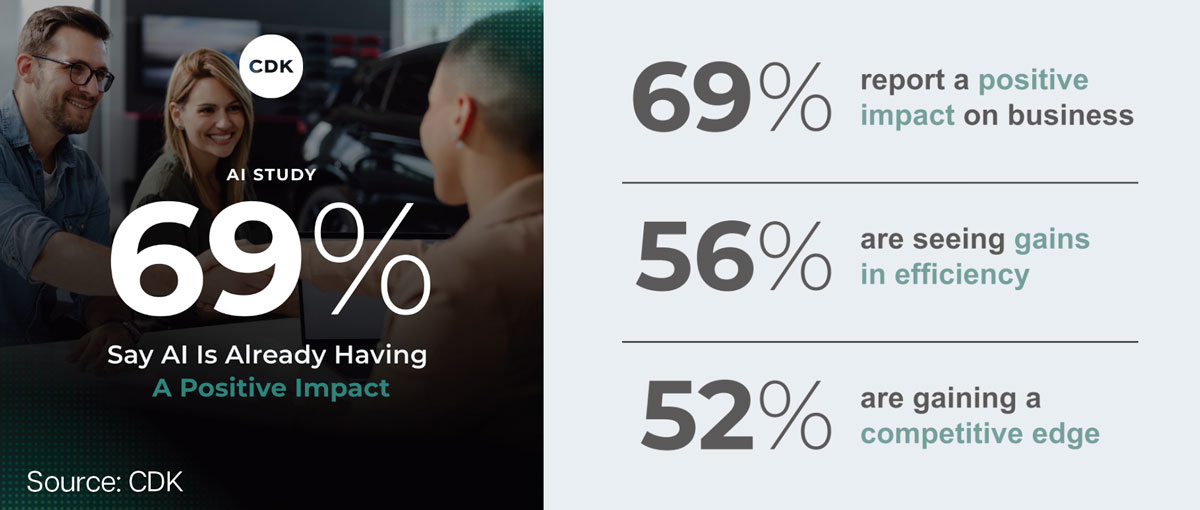
AI adoption is already widespread among dealers, according to a survey conducted by CDK Global, but the focus is shifting from awareness to execution.
“This is the first time we’ve surveyed dealers and all of them had said they’re familiar or using AI,” said Leigh Ann Conver, Senior Director of Product Marketing, Data and Intelligence at CDK Global. “We’ve got about 77 per cent of the dealers already integrating AI tools into their dealership.”
That figure aligns with findings from CDK Global’s January 2026 “AI at the Dealership” report, which found nearly 40 per cent of dealers are actively using AI, while 22 per cent are planning investments.
Conver said the 77 per cent figure reflects a broad definition of AI, including machine learning, natural language processing and agentic tools across dealership operations.
Source: From the Transactional Age to the Intelligence Age: The automotive playbook for rebuilding organizations around AI, Barry Hillier
She said dealers are becoming “a little more critical” about what they adopt and how those tools are configured. The CDK report supports that shift: 63 per cent of dealers said they want AI solutions backed by comprehensive industry data, while 47 per cent are looking for predictive models trained specifically for automotive use.
Chatbots and virtual assistants remain among the most common applications, particularly for handling customer inquiries outside of business hours.
“So (when) leads come on, (such as) someone searching at 2:00 AM in the morning for a car, obviously there is no internet sales lead manager there to deal with it. But you have an AI tool that can interact with that customer,” said Conver.
As AI takes on more customer-facing roles, expectations are rising, with dealers seeking tools that match the accuracy and knowledge of their staff, placing greater emphasis on data quality and training.
“Accuracy, adoption and results are probably the three main things. For example, we see that dealers have a 25 per cent increase in sales appointments when they implement Ava,” she said, referring to CDK Global’s artificial intelligence virtual assistant.
Ease of use also remains critical, she added, particularly in an environment where staff turnover is high.
What dealers are doing today
While dealers continue to refine how they use AI, consumer expectations are already pushing the industry forward.
“I think that adoption of AI technology just generally among Canadians has increased,” said Jody Gill, Chief Sales Officer at AutoTrader.ca. “What we’ve seen is (this increased) significantly over the past few years and it’s driven largely by the rise of AI tools like ChatGPT. And what we’re seeing globally is roughly about eight per cent usage in 2023, and that’s up to 38 per cent in 2025.”
This year-over-year increase signals a shift into the mainstream among consumers. “We think, including car shoppers, people want to have the same experience no matter what platform they’re on,” he said, pointing to Netflix as an example.
That expectation is driving changes in how inventory is presented and matched with buyers.
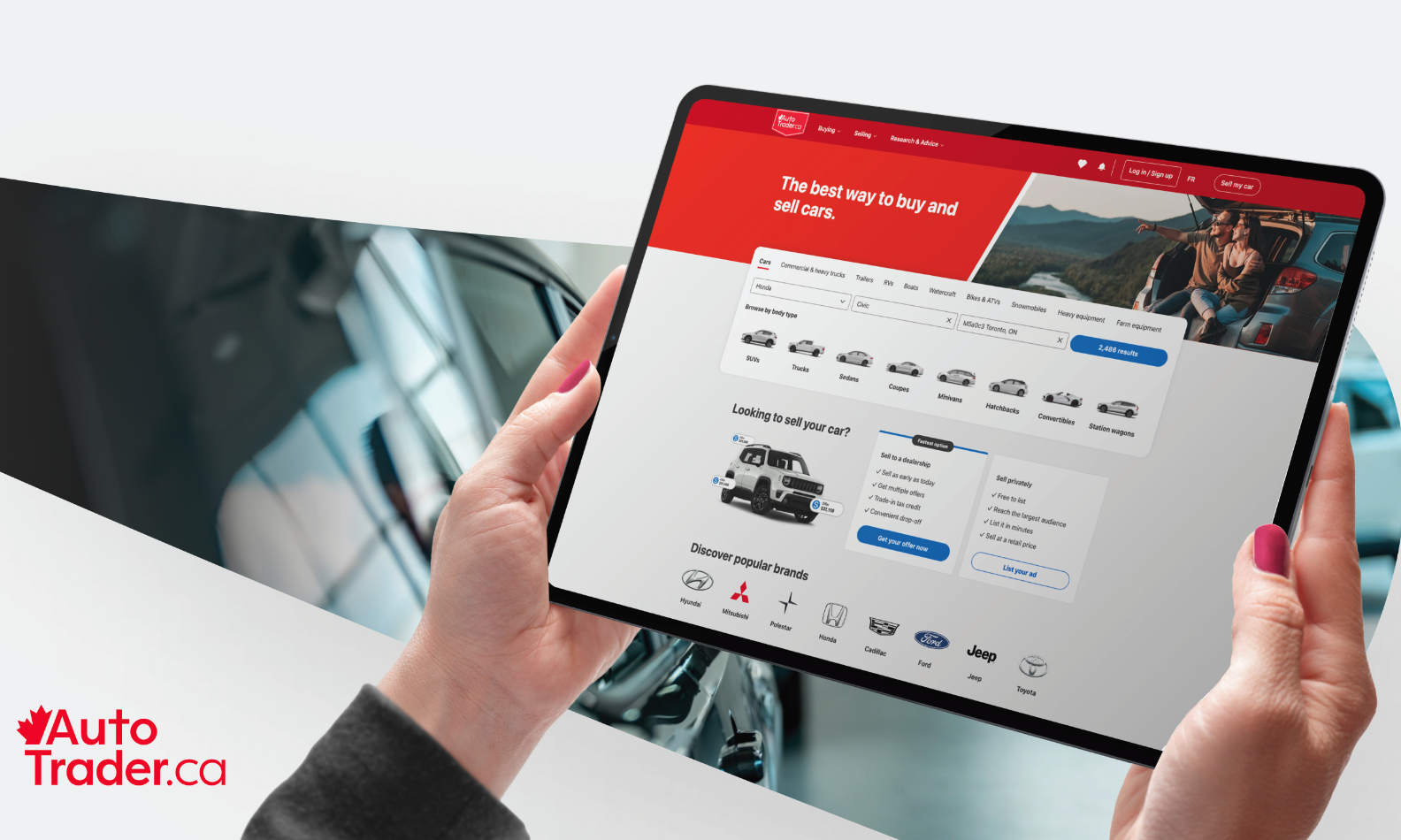
AutoTrader introduced a redesigned AI-powered marketplace after more than a year of testing with dealers and Canadian car shoppers. Built over 12 months with more than 48,000 hours of collaboration and more than 300 engineers, early results showed stronger alignment between shopper intent and dealer inventory, leading to higher-quality inquiries and improved engagement.
At the centre of that platform is DemandAI, an intelligence layer that evaluates more than 50 vehicle attributes alongside more than 30 shopper intent signals.
“We’re taking about 50 different attributes or data sets to serve up an ad,” said Gill. “And we’re also taking 30 different intent behaviours from the consumer at the same time to make sure that we’re serving up the most relevant piece of inventory.”
That translates into clearer insight into inventory performance and more targeted exposure. AutoTrader said its marketplace influences about 60 per cent of used-vehicle sales in Canada, with nearly six in 10 shoppers using the platform exclusively.
“AI will help them identify which vehicles are not merchandised optimally and then be able to change that in real time,” added Gill. “And also look at different price points of vehicles to make sure that they’re competitive in their own market.”
But as AI systems become more integrated and autonomous, the gap between those experimenting and those restructuring around it may soon become impossible to ignore.
AI adoption in Canadian dealerships
What the CARTS study shows
Findings from the Canadian Automobile Dealers Association’s Canadian Automotive Retail Technology Study (CARTS) point to an industry that is actively experimenting with AI, but still early in translating that activity into consistent operational impact.
Adoption is widespread—but results are mixed:
- Nearly 60 per cent of decision-makers are using AI, mainly in marketing and sales
- About 30 per cent report improved customer experience, while a similar share see no measurable impact
This suggests many dealers are still working to define clear use cases and ROI.
At the dealership level, usage is uneven:
- Nearly six in 10 staff have not used AI in their day-to-day roles
- Among users, more than 90 per cent report efficiency gains
The gap between leadership adoption and frontline use points to challenges in rollout, training and governance.
The study, part of CADA’s Road Ahead research series, was prepared by Clarify Group and sponsored by RBC Automotive Finance, drawing on input from dealership decision-makers and frontline staff across Canada.
Taken together, the findings reinforce a common theme: while AI adoption is accelerating, most dealerships are still applying it tactically rather than embedding it across the business.