THE 1960S WERE A TRANSITIONAL TIME FOR THE AUTO INDUSTRY. WE TAKE A LOOK AT THE CHANGES THAT HAPPENED ON THE RETAIL FRONT

The Chevrolet Corvair would figure prominently in Ralph Nader’s book, but he actually attacked the entire auto industry
The 1950s had been a battlefield in the auto industry, as recession-weary carmakers dumped vehicles onto their dealers, who in turn did whatever it took to get them into driveways.
The decade culminated in Oklahoma senator Mike Munroney creating a mandatory factory price sticker, so that dealers could no longer charge as much as they could get from a customer.
Halfway through the “Swinging ’60s,” consumers would find a similar ally and Detroit a fresh adversary, in a young lawyer named Ralph Nader.
American automakers still commanded the bulk of sales, but only two major independent companies, AMC and Studebaker, were still around. The latter closed its doors in Indiana in 1964, although its Canadian subsidiary would build cars at its plant in Hamilton, Ont. for another two years.
One of Studebaker’s last-ditch methods of raising cash was an agreement with Volkswagen Canada, where it bought cars from the German factory and imported them duty-free through its status as a Canadian manufacturer, charging Volkswagen Canada a fee that was less than the tariff.

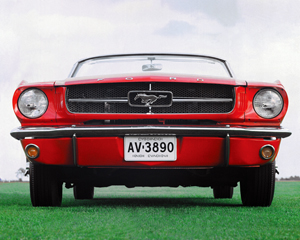
The new Mustang was a primary draw at the 1964 World’s Fair
The company would sell only its Land Cruiser all-terrain vehicle until the 1965 introduction of the Corona, designed specifically for the U.S. market, and the Corolla three years later.
Meanwhile, in 1963, Volvo opened its first foreign assembly plant in Nova Scotia. The cars were shipped from Sweden as knock-down units, and then reassembled for dealers in North America.
 The big news for Canada came with the introduction of the Auto Pact. In 1936, the Canadian government set a 17.5 per cent tariff on imported cars to protect its manufacturing base. This resulted in vehicles built specifically to satisfy the Canadian requirements, such as Ford’s Monarch, Pontiac’s Beaumont, and Chrysler’s Fargo.
But after a study showed advantages to considering all of North America as a single manufacturing entity, Canada and the U.S. signed an agreement in 1965, allowing new cars and parts to cross the border either way without duty.
Some of the “Canadian-only” cars lived on, primarily to satisfy the unique brand divisions of Canada’s dealer networks, but almost all would be gone by the 1980s.
The automotive scene was changing in other ways as well. Buyers seemed to be tiring of the huge land yachts of the 1950s, and AMC and Studebaker were doing well with their smaller models.
It was time for the “Big Three” to test the waters, with the introduction of Chevrolet’s Corvair, Ford’s Falcon, and Chrysler’s Valiant, all of them considered compacts in their day. Still, what the public and critics said they wanted wasn’t necessarily where they spent their cash.

Toyota’s Corona was designed specifically for North America
What did much better in the market were sporty compacts like the Ford Mustang and Chevrolet Camaro, and the famous “muscle cars” where all that mattered was the power under the hood, such as the Dodge Charger and AMC’s SC/Rambler.
While dealerships themselves didn’t change dramatically during the decade, there were some changes made at the retail level.
Fleet sales, which generated numbers but not a lot of profit, were gradually switched over to dealers, as automakers closed their in-house fleet sales departments. Manufacturers lengthened their factory warranties, bringing customers back to dealers for a longer period.
In 1962, Eustace Wolfington, a Chevrolet dealer in Philadelphia, faced buyers who wanted a new car every two years, but could only afford to finance for four.

Mazda made its first car in 1960
Television was also starting to play a major role in the industry. Auto shows were still just as important, but as more and more households bought TVs, carmakers paid attention.
General Motors, which had held “Motorama” events in major U.S. cities to showcase its new models, discontinued them in favour of advertising to the entire nation as a television show sponsor.
But the rosy outlook would soon change. In response to pollution, the U.S. government passed the Clean Air Act in 1963, adding an amendment two years later that dealt specifically with auto exhaust. This would have considerable ramifications on emissions controls in the coming decades.
In 1965, Ralph Nader published a book called Unsafe At Any Speed. In addition to attacking the rear-engine Corvair, which seemed prone to rollovers, Nader accused the American automakers of poor build quality and lack of safety features, and attacked government agencies for not enforcing safety regulations.
In response, the U.S. government passed the National Traffic and Motor Vehicle Safety Act of 1966, and formed the National Highway Safety Bureau, the forerunner of NHTSA. In 1971, Canada would follow suit with its Motor Vehicle Safety Act to require and regulate safety features on new cars and trucks.
The 1960s were a decade of radical social change, from civil rights and women’s liberation, to the Cold War and Woodstock. It was also a transitional time for the auto industry, although the shifts in consumer tastes were happening at a much slower pace.
Those shifts would also remain gradual during the first couple of years into the 1970s. But a U.S. president would take sides in a Middle East war, sparking a chain of events that would finally open North America’s doors to the smallest cars, and to the Japanese and European manufacturers that made them.